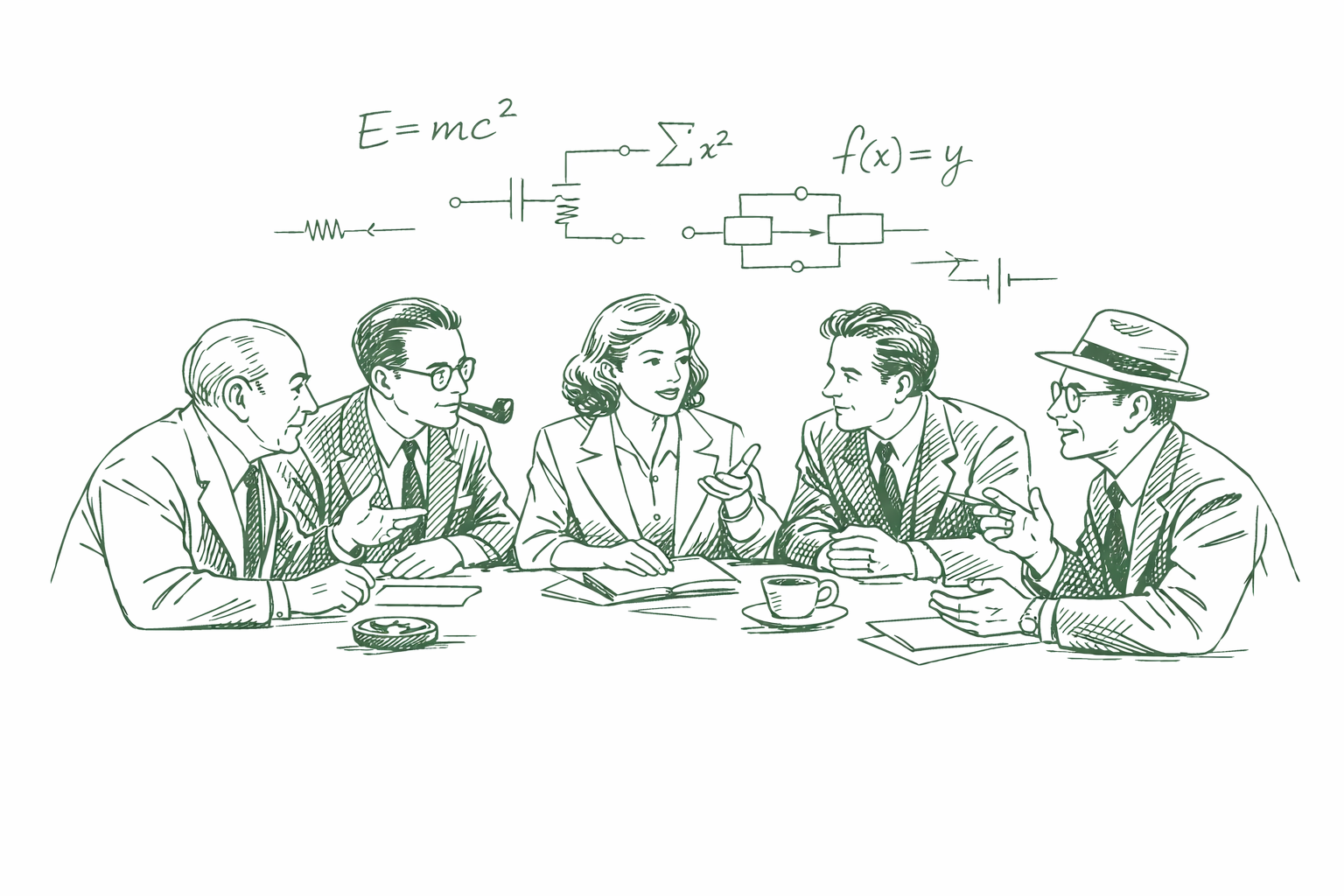
The Macy Conferences on Cybernetics — officially titled "Circular Causal and Feedback Mechanisms in Biological and Social Systems" — ran from 1946 to 1953. Ten meetings. Two days each. Funded by the Josiah Macy Jr. Foundation and chaired by the neurophysiologist Warren McCulloch. They produced no products, no companies, no revenue. What they produced was a vocabulary. The words "information," "feedback," "analog," and "digital" entered mainstream scientific use because of what happened in those rooms. The fields of cybernetics, information theory, systems theory, cognitive science, and the foundational ideas behind artificial intelligence trace their origins to those ten gatherings.
All from a group that met roughly once a year and argued until nobody could agree on what they were even talking about.
The 1942 conversation that started everything
The story begins four years before the first official conference. In 1942, the Macy Foundation hosted a meeting in New York on a narrow topic: cerebral inhibition. It was a medical meeting. Nobody expected fireworks. But Arturo Rosenblueth, a Mexican physiologist working with MIT mathematician Norbert Wiener, gave a presentation that stopped the room. He described a theory he had been developing with Wiener and the engineer Julian Bigelow about feedback and purposive behavior — the idea that living organisms and machines both operate through circular causal loops, constantly adjusting their behavior based on the results of their previous actions.
The audience that day included Warren McCulloch, a neurophysiologist obsessed with the logic of the brain, and two anthropologists — Gregory Bateson and Margaret Mead — who had spent the 1930s studying how cultures regulate themselves. McCulloch recognized that Rosenblueth was describing something much larger than cerebral inhibition. He was describing a universal principle: that feedback mechanisms governed everything from thermostats to nervous systems to social groups. And that the same mathematics might explain all of them.
McCulloch, Bateson, Mead, and the Macy Foundation's medical director, Frank Fremont-Smith, decided that day that they needed a sustained series of interdisciplinary meetings to explore these ideas. The war intervened. It took four years to get everyone back in a room.
The room
The first Macy Conference convened on March 8-9, 1946, in New York City. McCulloch chaired. Fremont-Smith organized the logistics. The twenty-one people in the room represented a breadth of expertise that would be difficult to assemble today and was essentially unprecedented then.
Norbert Wiener was there — a mathematician whose wartime work on anti-aircraft fire control had led him to formalize the mathematics of feedback systems. John von Neumann attended — a physicist and mathematician who was simultaneously designing the architecture of the modern computer at Princeton. Claude Shannon, who would publish his landmark paper "A Mathematical Theory of Communication" two years later, was a guest at several conferences. Gregory Bateson and Margaret Mead brought anthropology. Kurt Lewin brought social psychology. Ralph Gerard brought neurophysiology. Walter Pitts, a self-taught mathematical prodigy who had co-authored the first paper on artificial neural networks with McCulloch in 1943, was a core member at age twenty-three.
Heinz von Foerster, an Austrian-born physicist who arrived at the sixth conference in 1949, became the editor of the proceedings for the final five meetings and later founded the field of second-order cybernetics. G. Evelyn Hutchinson, an ecologist, applied the group's ideas about feedback to ecosystems. Lawrence Kubie, a psychoanalyst, tried — with mixed success — to connect cybernetic models to Freudian theory.
The point was not that these people were brilliant, though most of them were. The point was that they were brilliant in completely different ways. A neurophysiologist sat next to a mathematician who sat next to an anthropologist who sat next to an engineer. No one could retreat into the comfort of their own discipline's assumptions. Every claim had to be defended across boundaries. Every analogy had to survive translation.
The format that made it work
The conferences were deliberately designed to be uncomfortable. McCulloch, as chair, had one mandate from the Macy Foundation: ensure that disciplinary boundaries were crossed. The format was simple. A participant would present a paper or a set of ideas. Then the room would discuss it — not for fifteen polite minutes at the end, but for hours. The discussions, by all accounts, were more important than the presentations. They were messy, confrontational, frequently derailed, and occasionally brilliant.
Steve Joshua Heims, who wrote the most comprehensive historical account of the conferences in his 1991 book The Cybernetics Group, described the dynamic as productive chaos. Wiener would interrupt with mathematical objections. Bateson would reframe the entire discussion in terms of cultural pattern. Mead would push the group to articulate the social implications of their models. Von Neumann would make connections to computing theory that no one else in the room could follow — and then McCulloch would translate von Neumann's point into language the biologists could understand.
The first five conferences were never formally documented. No proceedings, no transcripts, no published papers. Heims called them "the most lively and energizing" of the series, but what actually happened in those rooms is reconstructed primarily from participants' letters and later recollections. It was not until the sixth conference in 1949 — when the meetings officially adopted the title "Cybernetics" after Wiener's 1948 book — that Heinz von Foerster began editing formal proceedings.
This absence of documentation for the most generative years is not unusual. It is, in fact, a pattern that repeats across three centuries of productive small groups. The Lunar Society's most important conversations happened at informal dinners, not in published proceedings. The Inklings met in a pub. Samuel Johnson's Literary Club met over supper in a tavern. The formal record almost always underrepresents the real work — which happens in the gaps between presentations, in the arguments nobody writes down, in the half-formed analogies that only survive because someone else in the room picks them up and finishes the thought.
What the conversations produced
The output of the Macy Conferences is almost absurd in its scope. It is not an exaggeration to say that several foundational fields of modern science emerged directly from those ten meetings.
Cybernetics. Wiener's 1948 book Cybernetics: or Control and Communication in the Animal and the Machine gave the conferences their name and the world a new discipline. The core idea — that feedback mechanisms are the common language of biological, mechanical, and social systems — was developed, tested, and refined in the conference discussions. Wiener defined cybernetics as "the science of control and communication in the animal and the machine." It was deliberately, provocatively broad. He was not describing a specialty. He was describing a way of seeing.
Information theory. Claude Shannon's 1948 paper "A Mathematical Theory of Communication," published in the Bell System Technical Journal, is one of the most influential scientific papers ever written. It formalized the concept of information as a measurable quantity — measured in bits — and laid the foundation for digital communications, data compression, error correction, and ultimately the internet. Shannon attended several Macy Conferences, and the discussions there helped shape how the broader scientific community understood and applied his work. The concept of "information" as the conferences used it — divorced from meaning, treated as a mathematical object — became one of the most powerful and most contested ideas in twentieth-century science.
Artificial neural networks. McCulloch and Pitts had published their landmark 1943 paper "A Logical Calculus of the Ideas Immanent in Nervous Activity" before the conferences began. But the Macy meetings provided the intellectual context in which that paper's ideas were debated, extended, and connected to von Neumann's work on computing architecture. The McCulloch-Pitts neuron model is a direct ancestor of modern neural networks and deep learning.
Cognitive science. The conferences, as Wikipedia summarizes, were "one of the first organized studies of interdisciplinarity, spawning breakthroughs in systems theory, cybernetics, and what later became known as cognitive science." The idea that the mind could be studied as an information-processing system — the foundational assumption of cognitive science — was forged in the Macy discussions. Before cybernetics, psychologists studied behavior. After cybernetics, they could study computation.
Systems thinking. The idea that complex phenomena — from ecosystems to economies to organizations — could be understood as systems of interconnected feedback loops owes its modern formulation to the Macy Conferences. Hutchinson applied these ideas to ecology. Bateson applied them to anthropology and later to psychology. Mead applied them to social systems. The University of Chicago Press describes the conferences as developing "a cohesive and broadly applicable theory of systems that would become equally applicable to living beings and machines, economic and cognitive processes, and many scholarly disciplines."
Second-order cybernetics. Heinz von Foerster, who arrived at the sixth conference as an outsider and became the editor of the proceedings, went on to found the Biological Computer Laboratory at the University of Illinois and develop what he called second-order cybernetics — the cybernetics of observing systems, or "the cybernetics of cybernetics." His insight was that the observer is always part of the system being observed. This idea, developed through his experience at the conferences, influenced constructivism, autopoiesis theory, and the philosophy of science.
When the group broke
Not everything worked. The Macy Conferences also illustrate what happens when a small group's dynamics shift — and the consequences of losing key members.
By the eighth conference in March 1951, both Wiener and von Neumann had stopped attending. Bateson was absent. The two figures most commonly associated with the conferences in later decades — Wiener and von Neumann — participated actively in only the first seven meetings. The ASC Cybernetics summary notes that "it is fair to say that their roles and criticality has been overstated in later decades, particularly in the case of von Neumann."
Wiener's departure was partly personal, partly intellectual. He grew frustrated with what he saw as the psychoanalytic faction's attempts to reduce cybernetic ideas to Freudian frameworks. Kubie, the psychoanalyst, was a polarizing figure — brilliant but domineering, pushing interpretations that the mathematicians and engineers found reductive. The tension between the "hard" scientists (Wiener, von Neumann, Shannon) and the "soft" scientists (Bateson, Mead, Kubie) was productive in the early years but became increasingly contentious.
This is the failure pattern that every small group faces. The same diversity that generates breakthroughs also generates friction. When the friction is managed — when a chair like McCulloch translates between factions and keeps the conversation moving — the group produces work that no individual could. When the friction overwhelms the format, people leave. And once the wrong people leave, the group's character changes irreversibly.
The later conferences, from the eighth through the tenth in April 1953, were still productive. Shannon attended the eighth. Von Foerster continued editing. New guests brought new perspectives. But the explosive interdisciplinary energy of the first seven conferences — the years when Wiener, von Neumann, Bateson, Mead, McCulloch, and Pitts were all in the same room — was never replicated. The group had lost its original collective intelligence, the specific combination of minds that made it more than the sum of its parts.
The thought collective
The University of Illinois Archives, which houses the papers of several Macy participants, describes the group using a term borrowed from the philosopher of science Ludwik Fleck: a Denkkollektiv, or "thought collective." Fleck coined the term in 1935 to describe how scientific knowledge is produced not by individuals but by communities of thinkers who share assumptions, vocabulary, and methods. The Macy Conferences were, perhaps more than any other group in the twentieth century, a thought collective in Fleck's sense.
What made them work was not that the participants agreed. They frequently did not. What made them work was that they shared a question. The question was deceptively simple: are the feedback mechanisms that regulate machines fundamentally the same as those that regulate living organisms and social systems? That question turned out to be enormously productive — not because the answer was yes (it was more complicated than that) but because pursuing it forced mathematicians to think about brains, anthropologists to think about machines, and psychologists to think about information. The question created a shared space that no single discipline could have opened on its own.
This is exactly how the best peer groups work. Not by assembling people who do the same thing and comparing notes. By assembling people who are solving different versions of the same underlying problem — and letting the cross-pollination do what it does. A founder struggling with team dynamics and a founder struggling with product-market fit and a founder struggling with pricing are all, at some level, solving problems about feedback. About what signals to pay attention to, how to adjust based on results, and how to tell the difference between noise and information. The language of one discipline illuminates the blind spots of another.
What Fremont-Smith understood
Frank Fremont-Smith, the Macy Foundation medical director who organized the conference logistics, said something at the first meeting in 1946 that deserves more attention than it gets. He opened the conference by telling the participants: "Each group, when it comes together, is an experiment. If it excites you all enough to want to meet again, we will plan for further meetings."
That framing was not modesty. It was methodology. Fremont-Smith understood that you cannot know in advance whether a group of people will produce something valuable. You can select carefully, design the format thoughtfully, and create the conditions for productive collision. But you cannot guarantee the outcome. The only way to know if a group works is to try it and see what happens when the conversation starts.
This is the opposite of how most professional gatherings operate today. Industry conferences are designed around outcomes. Panels are curated for talking points. Networking events are structured to produce connections that have been pre-qualified. The Macy Conferences had none of this. They had a room, a question, a diverse group of people, and a willingness to let the experiment run for seven years before deciding what it meant.
The result was not one breakthrough but an entire vocabulary. Not one product but multiple fields. Not one career made but a generation of scientists who traced their most important ideas to a set of two-day meetings they attended in New York between the end of the war and the beginning of the Cold War.
Why a small room in midtown mattered more than every lecture hall in the world
The Macy Conferences were not large. Twenty to twenty-five people at most. They were not frequent — roughly annual. They were not prestigious in the traditional sense — there was no selection committee, no application process, no award or publication guarantee. Wiener and von Neumann were famous, but many of the core members were mid-career scientists whose reputations were still forming. Pitts was twenty-three at the first conference. Von Foerster was a relatively obscure Austrian physicist when he arrived at the sixth.
What the conferences had was structure without rigidity. A small enough group that everyone could speak. A chair — McCulloch — who understood that his job was to ensure collision between disciplines, not to smooth it over. A recurring schedule that built enough familiarity that participants could be genuinely confused, genuinely wrong, and genuinely combative without fear of professional consequences. And a shared question that was big enough to sustain seven years of conversation without ever being fully resolved.
The legacy is everywhere. Every time someone uses the word "feedback" outside of audio engineering, they are using a term the Macy Conferences popularized. Every time a data scientist measures information in bits, they are using Shannon's framework, which was debated and refined in those rooms. Every time an organization talks about "systems thinking," they are applying a conceptual vocabulary that was hammered out by McCulloch, Bateson, Mead, and Wiener across ten two-day meetings in midtown Manhattan.
Twenty-odd people. Ten meetings. Seven years. Multiple new scientific fields. The return on investment is incalculable — and the only resource the Macy Foundation invested was the cost of a room and the faith that if you put the right people together with the right question, something would happen.
Fremont-Smith was right. Each group, when it comes together, is an experiment. The Macy Conferences are what happens when the experiment works.