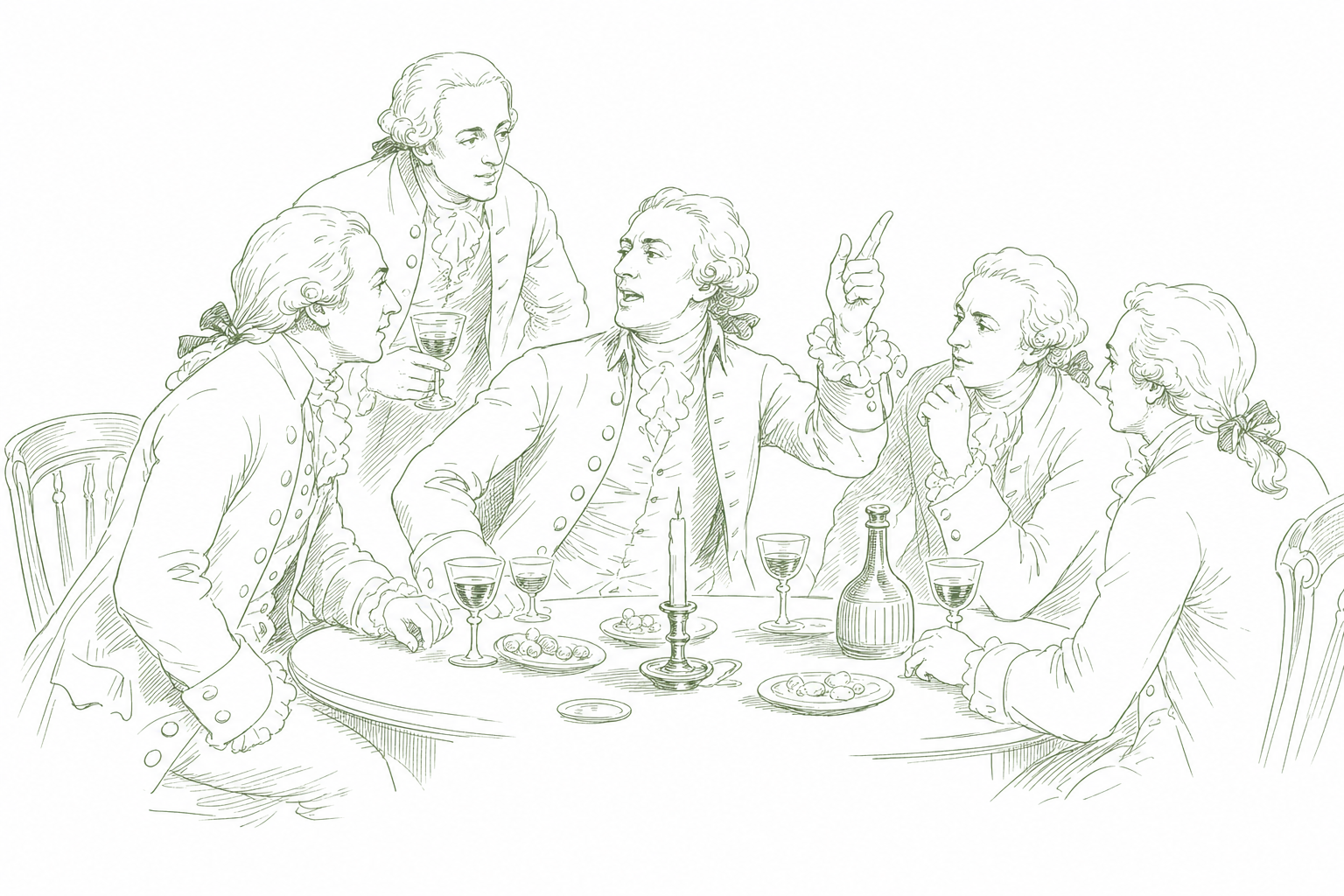
What happened next is one of the most consequential accidents of intellectual history. Those Friday night suppers — fueled by roast mutton, cheap wine, and an unwritten rule that every member had to be, in Johnson's word, "clubbable" — produced a circle whose collective output reshaped literature, economics, political philosophy, historiography, and the visual arts. Within two decades of the club's founding, its members would author the Dictionary of the English Language, The Wealth of Nations, The History of the Decline and Fall of the Roman Empire, Reflections on the Revolution in France, The Life of Samuel Johnson, She Stoops to Conquer, and the foundational theory of the Royal Academy of Arts.
Not bad for a dinner club that started because one man was worried about his friend.
The nine men at the table
The founding members of what became known as The Club — later The Literary Club — were Samuel Johnson, Joshua Reynolds, Edmund Burke, Oliver Goldsmith, Topham Beauclerk, Bennet Langton, John Hawkins, Anthony Chamier, and Christopher Nugent. The roster reads like a greatest-hits list of Georgian London. But here is the detail that gets overlooked: in 1764, almost none of them were famous yet.
Johnson had published his Dictionary nine years earlier and was living on a royal pension of three hundred pounds a year — comfortable, but not celebrated. Reynolds was a successful portrait painter but had not yet founded the Royal Academy. Burke was an Irish-born writer who had not entered Parliament. Oliver Goldsmith was a struggling hack journalist who had not yet written The Vicar of Wakefield or She Stoops to Conquer. The other five were, at the time of founding, essentially private figures — a lawyer, a stockbroker, a physician, an aristocratic wit, and a tall, awkward scholar named Bennet Langton whom Johnson loved for his gentleness.
The club did not recruit its way to greatness. It grew into it. The selection criteria had nothing to do with fame or accomplishment. Reynolds and Johnson wanted people who could hold a conversation, who had opinions and the nerve to defend them, and who would show up every Friday. Johnson's definition of a club was "an assembly of good fellows, meeting under certain conditions." The conditions were simple: be interesting, be present, and be prepared to argue until the candles burned down.
What happened on Friday nights
James Boswell — who joined in 1773 and became the club's most important chronicler — described the format: they met at seven in the evening, ordered supper, and "generally continued their conversation till a pretty late hour." That is Boswell being polite. In practice, these sessions ran until two or three in the morning. They drank steadily. They argued fiercely. And they operated under a social contract that would be familiar to anyone who has sat in a structured peer meeting: you came to talk, but more importantly, you came to listen and to be challenged.
Johnson was the intellectual center of gravity. He was physically imposing — scarred by childhood tuberculosis, twitching with what modern medicine would likely diagnose as Tourette syndrome, perpetually rumpled — and he talked with a force that could silence a room. Boswell recorded Johnson declaring that "there is nothing which has yet been contrived by man, by which so much happiness is produced as by a good tavern" and that "a tavern chair is the throne of human felicity." Johnson did not say these things casually. He believed that structured conversation among sharp people was the highest form of human activity.
But the club was not a one-man show. Edmund Burke, who Boswell called "the most brilliant talker in the history of Parliament," regularly matched Johnson point for point. Oliver Goldsmith, brilliant but socially clumsy, was the wild card — capable of saying something so absurd that it reset the entire conversation, or so genuinely insightful that it redirected everyone's thinking. Reynolds, the quietest of the core members, was described as the person who held the group together — the diplomat, the connector, the one who noticed when someone had been silent too long and drew them back in.
This was not a salon where one genius held court. It was a genuinely collective intelligence — a group of people who sharpened each other through sustained, recurring contact.
The unclubbable man
The club was not without friction. And the friction reveals something essential about how small groups actually work.
John Hawkins, one of the nine founding members, was a lawyer and music historian who had none of Johnson's social grace. He was difficult, confrontational, and — critically — unable to distinguish between rigorous argument and personal attack. After he verbally abused Edmund Burke at a meeting, the rest of the group effectively ostracized him. Hawkins left. Johnson's verdict was devastating in its economy: Hawkins, he said, was "an unclubbable man."
The word "unclubbable" entered the English language at that moment. Johnson may have coined it on the spot. And the concept it described was precise: it was not about intelligence or accomplishment. Hawkins was both smart and productive. It was about a person's capacity for the specific social contract that a small recurring group requires — the willingness to disagree without destroying, to challenge without attacking, to be wrong in front of people and to let others be wrong in front of you.
Psychological safety is the modern term for what Johnson was describing. The Club functioned because its members could say risky, half-formed, provocative things without fear that doing so would cost them their place at the table. Hawkins violated that contract. Not because he was too smart or too honest — because he could not separate the argument from the person making it.
When the club later admitted new members — Adam Smith in 1775, Edward Gibbon in 1774, David Garrick, Richard Brinsley Sheridan — the admission process was a unanimous vote. Every existing member had to approve. The filter was not "are you accomplished enough?" It was "can you sit at this table without breaking what makes it work?"
What the members built — and when they built it
The timeline is what makes the club's story remarkable. The standard narrative of intellectual history treats great works as the product of solitary genius — a lone mind struggling in isolation until a masterpiece emerges. The Literary Club's record tells a different story.
Adam Smith was elected to the club in 1775. The Wealth of Nations was published in 1776. Johnson personally praised it, telling Boswell that Smith's argument about trade required "no less to be illustrated by philosophy than trade does." Smith, whom Johnson had once dismissed as "as dull a dog as he had ever met with," produced the foundational text of modern economics while dining regularly with the man who wrote the dictionary that defined the language Smith was writing in.
Edward Gibbon joined in 1774 and published the first volume of The Decline and Fall of the Roman Empire in 1776 — the same year as Smith's masterpiece. Gibbon's six-volume history, completed over a decade, is still considered one of the greatest works of historical scholarship ever written. He conceived it, drafted it, revised it, and defended it against critics while spending regular evenings with Burke, Johnson, and Reynolds — men who brought perspectives from politics, literature, and the arts to bear on his historical arguments.
Edmund Burke was not yet in Parliament when the club formed. By the 1790s, his Reflections on the Revolution in France had become the foundational text of modern conservatism. Burke honed his rhetorical style not just in the House of Commons but at the Turk's Head, where Johnson — who disagreed with Burke on nearly every political question — forced him to defend his arguments against the best counter-arguments anyone could offer.
James Boswell's Life of Samuel Johnson, published in 1791, is routinely described as the greatest biography in the English language. It was, in a very literal sense, a product of the club. Boswell spent eighteen years observing, recording, and interpreting Johnson — a project that was only possible because the club gave him regular, structured access to the man and the circle that surrounded him. Edmond Malone, another club member, served as Boswell's de facto editor.
Reynolds founded the Royal Academy of Arts in 1768, four years after the club began, and served as its first president for over two decades. His Discourses on Art — the lectures he delivered to the Academy — drew explicitly on the aesthetic conversations he had with Johnson and Burke at the Friday dinners. Leo Damrosch, whose 2019 book The Club is the most comprehensive modern account, argues that Lawrence Lipking demonstrated how the club members' presence was critical to the development of art criticism (Reynolds), music criticism (Hawkins and later Charles Burney), and literary criticism (Johnson).
None of these men worked alone. None of them produced their greatest work before the club existed. That is not a coincidence. It is a pattern — the same pattern visible in three hundred years of peer groups producing outsized results.
Self-made men at a borrowed table
One of the most striking details about the club's membership, which Leo Damrosch highlights, is how many of its members were self-made. Johnson was the son of a failed bookseller in Lichfield who dropped out of Oxford because he could not pay the fees. Goldsmith was an Irish immigrant who had failed at medicine, failed at teaching, and was perpetually in debt. Burke arrived in London from Dublin with no connections, no money, and no obvious path into politics. Garrick was the son of a French Huguenot army officer. Reynolds was the son of a Devon schoolmaster.
This was not a gathering of aristocrats. It was a gathering of people who had earned their place in the conversation by being smart enough, stubborn enough, and lonely enough to seek out other people who could challenge them. The parallel to modern founders is obvious. The best peer groups are not filled with people who inherited their positions. They are filled with people who built something from nothing and need other people who understand what that costs.
Johnson himself was explicit about this. When Lord Charlemont — an Irish peer — was suggested as the original proposer of the club, Johnson rejected the framing immediately: "No, we'll be called Charlemont's Club." He did not want the group defined by the highest-ranking person in the room. He wanted it defined by the conversation itself.
Why the format mattered
The club met weekly for its first decade. Then, as membership grew from nine to thirty-five, they shifted to fortnightly dinners during parliamentary sessions. Johnson noticed the difference immediately — and hated it. He told Boswell that the expanded club had become "a mere miscellaneous collection of conspicuous men, without any determinate character."
This is the same tension every growing group faces. The Dunbar number problem in miniature. When the club was nine people meeting weekly, it had what Johnson called "character" — a shared identity, a trust level that allowed real vulnerability, a conversational rhythm that only develops through sustained repetition. When it grew to thirty-five people meeting biweekly, it became something closer to a networking event. Still valuable. But fundamentally different.
The research on optimal group size confirms what Johnson intuited: the sweet spot for genuine intellectual and emotional exchange is somewhere between five and twelve people. Larger than that, and social dynamics shift. People perform rather than converse. They speak to the room rather than to each other. The candor that produces real breakthroughs gives way to the caution that produces polished performances.
The club's early years — when it was small, frequent, and informal — were the years that produced its greatest output. That is not because the later members were less talented. It is because the structure of regular, small-group contact created conditions for the kind of work that large, infrequent gatherings cannot replicate.
What a tavern teaches about peer groups
The Literary Club still exists. It has met continuously since 1764 — over 260 years of Friday dinners, now held at Brooks's club in St James's. Winston Churchill was rejected for membership (deemed "too controversial"), so he founded his own dining club, The Other Club, in 1911. The format has been replicated endlessly because the underlying principle is durable.
But the club's first twenty years are what matter for understanding how peer groups actually produce results. Here is what the evidence shows:
The group started around a problem, not a credential. Reynolds did not invite the nine most accomplished men in London. He invited people who were interesting, who were struggling, and who needed the specific thing a weekly supper could provide: structured companionship with intellectual rigor. Most of the members' greatest achievements came after they joined.
The membership criteria were about fit, not status. The requirement was "clubbability" — the capacity for honest, sustained, reciprocal conversation. Hawkins, who lacked it, was removed. Smith, whom many members found boring in casual settings, was admitted because his work was extraordinary. The group optimized for what would happen at the table, not what would look good on a list.
Frequency created trust. Meeting weekly — at the same time, in the same room, with the same people — built the kind of relational depth that reciprocal vulnerability requires. Johnson could say half-formed, contradictory, provocative things because he knew the room would challenge him without punishing him. Burke could float political arguments he had not yet refined because he knew the response would sharpen them. That trust does not develop at annual conferences or quarterly check-ins. It develops through repetition.
Diversity of perspective was structural. The club deliberately mixed writers, painters, politicians, actors, scientists, physicians, and philosophers. Johnson told Boswell that the club "numbered among its membership men who were professors in all the main branches of study." That was not an accident — it was a design choice. When Gibbon talked about Roman decline, Burke could connect it to modern governance. When Reynolds discussed aesthetic theory, Johnson could connect it to literary criticism. The cross-pollination was the point.
The social contract was more important than the agenda. The club had no formal program, no presentations, no structured agenda. It had one rule: show up, and be worth talking to. Everything else was emergent. The protege effect operated naturally — members who explained their ideas to each other understood those ideas more deeply themselves. The Solomon's paradox effect was continuous — each member could see the flaws in others' reasoning that they could not see in their own.
A tavern chair, revisited
Samuel Johnson was one of the most accomplished people who ever lived. He compiled the dictionary that standardized the English language. He wrote poetry, fiction, literary criticism, and political commentary at a level that defined the standards of his century. He did all of this while fighting depression so severe that he kept padlocks and chains in his bedroom, afraid of what his mind might do to him if left unchecked.
And the thing that pulled him out — the intervention his closest friend could think of — was a weekly dinner with eight other people.
Not therapy. Not medication. Not a sabbatical. A table. A room above a tavern. Nine chairs. A standing invitation to show up and be challenged by people who were as smart and as struggling as he was.
Reynolds understood something that the research would not formalize for another two centuries: that isolation is not just an emotional problem. It is a performance problem. Johnson was not producing his best work alone. He was not even producing at all. The club gave him a reason to think rigorously, to defend his positions, to stay engaged with the world of ideas when his instinct was to withdraw from it.
A tavern chair is the throne of human felicity. Johnson said it as a quip. He lived it as a practice. And the nine men who sat in those chairs with him reshaped the intellectual foundations of the English-speaking world — not despite the fact that they met over supper every Friday, but because of it.