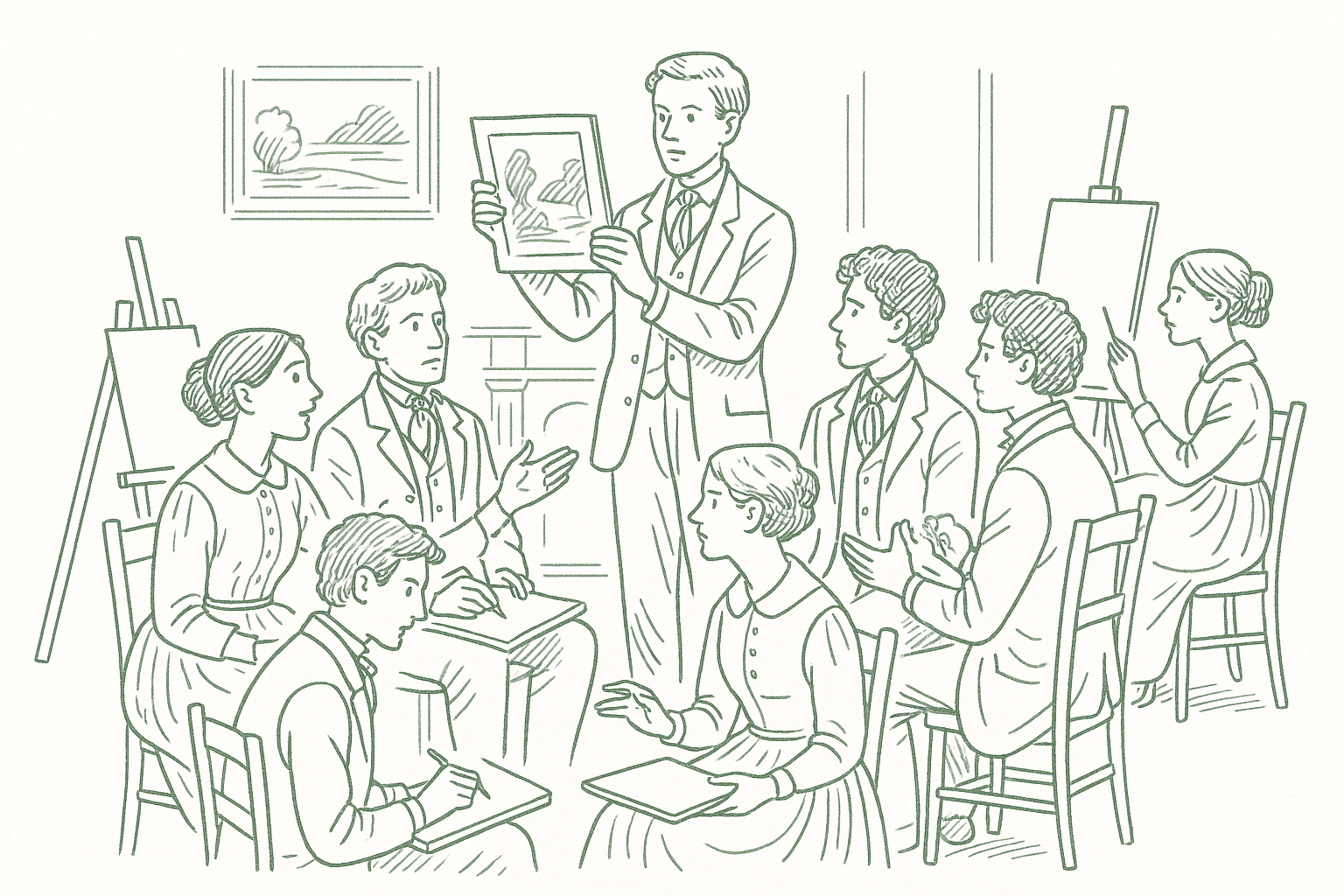
The meeting happened in September 1848 at 83 Gower Street, London — the Millais family home. John Everett Millais, the most technically gifted painter of his generation, was nineteen years old. William Holman Hunt, the group's moral engine, was twenty-one. Dante Gabriel Rossetti, the charismatic son of an exiled Italian poet, was twenty. They had been students together at the Royal Academy Schools. They were frustrated, ambitious, and convinced that the most prestigious art institution in England was teaching them to paint badly.
That evening, they decided to do something about it. Not by writing letters to the press. Not by filing formal complaints. By forming a secret society. They called it the Pre-Raphaelite Brotherhood — the PRB — and they recruited four more members: Rossetti's younger brother William Michael (a critic, not a painter), James Collinson (a painter prone to falling asleep in meetings), Frederic George Stephens (who would become a critic after concluding he was a mediocre painter), and Thomas Woolner (the group's sole sculptor). Seven members. Average age: twenty-two.
They had no funding, no gallery, no patron, and no public profile. What they had was a shared diagnosis of a specific problem and the audacity to believe they could fix it. That combination — a clear problem, a small group, and the mutual reinforcement to act on conviction rather than wait for permission — produced one of the most consequential art movements in Western history.
The problem they diagnosed
The Royal Academy of Arts was, in 1848, the gatekeeper of British artistic life. Founded in 1768 by Sir Joshua Reynolds, it controlled which paintings were exhibited, which artists received commissions, and what counted as good art. Its aesthetic standard was clear: paint like Raphael. Idealized poses. Classical compositions. Smooth surfaces. Noble subjects rendered with academic precision. Anything that deviated from this formula was dismissed as crude, primitive, or incompetent.
The Pre-Raphaelites thought the formula was the problem. In their view, three centuries of slavish devotion to Raphael and his successors had produced painting that was technically accomplished and spiritually dead. William Michael Rossetti, the group's chronicler, recorded their central complaint: the Academy promoted "sloshy" painting — "anything lax or scamped in the process of painting, and hence anything or person of a commonplace or conventional kind." The word became the Brotherhood's shorthand for everything wrong with English art.
Their alternative was in the name. Go back to before Raphael. Study the Italian painters of the fourteenth and fifteenth centuries — Giotto, Fra Angelico, Botticelli — artists who painted with intensity, detail, and what the Brotherhood perceived as moral seriousness. Paint from nature directly, not from classical models. Use vivid color. Reject the brown varnish and dark tonalities that the Academy treated as markers of sophistication. Make art that looked like someone had actually seen the things they were painting.
They codified their principles into four rules, recorded by William Michael Rossetti: "1. To have genuine ideas to express. 2. To study nature attentively, so as to know how to express them. 3. To sympathise with what is direct and serious and heartfelt in previous art, to the exclusion of what is conventional and self-parading and learned by rote. 4. Most indispensable of all, to produce thoroughly good pictures and statues."
Rule four is the one that matters most for what happened next. They were not content to theorize. They intended to produce work — and to exhibit it publicly, in direct competition with the Academy painters they were challenging. The pattern is always the same: a small group forms around a shared conviction, and the conviction demands output, not just discussion.
The secret letters on the canvas
In 1849, the Brotherhood submitted paintings to the Royal Academy's annual exhibition. Hunt showed Rienzi. Millais showed Isabella. Rossetti, bypassing the Academy entirely, exhibited The Girlhood of Mary Virgin at the Free Exhibition. Each painting was signed with the artist's name and three small letters: P.R.B.
Nobody knew what the letters meant. The critics noticed them. The public noticed them. The letters carried no explanation. This was deliberate — part of the Brotherhood's secret society identity. They had their own journal (the Pre-Raphaelite Journal, which recorded their debates) and their own manifesto. They were, as the Metropolitan Museum of Art later described them, "seven rebellious young artists in London who formed a secret society with the aim of creating a new British art."
The first year went well enough. The paintings attracted attention. The Girlhood of Mary Virgin received favorable reviews. The mystery of the initials generated curiosity. But the Brotherhood made a critical mistake: they told people what PRB stood for. The name leaked, probably through Rossetti, who was constitutionally incapable of keeping secrets.
Once the art establishment understood that a group of students was calling itself a Brotherhood, using secret initials, and claiming that three centuries of art history had been a mistake, the response was swift and brutal.
The year everything almost ended
In 1850, Millais exhibited Christ in the House of His Parents at the Royal Academy. The painting depicted the Holy Family as ordinary working people in a real carpenter's workshop — dirt under their fingernails, wood shavings on the floor, muscular arms and roughened hands. By Pre-Raphaelite standards, it was a triumph of the principle of painting from nature without idealization. By Academy standards, it was an act of desecration.
Charles Dickens, the most famous writer in England, published an attack in his journal Household Words that was savage even by Victorian standards. He described the figure of Mary as "so horrible in her ugliness that she would stand out from the rest of the company as a Monster, in the vilest cabaret in France, or the lowest gin shop in England." He called the Brotherhood's work "mean, odious, revolting, and repulsive." The criticism was so prominent that Queen Victoria had the painting brought to Buckingham Palace so she could see for herself what the controversy was about.
The critical assault nearly destroyed the group. Commissions dried up. Patrons hesitated. Collinson, never the most committed member, resigned from the Brotherhood (he would later become a Jesuit). Woolner emigrated to Australia to try gold prospecting. The Brotherhood, barely two years old, was fracturing under the pressure of exactly the kind of institutional resistance that small insurgent groups always face when they challenge established power.
This is the moment that separates groups that produce lasting change from groups that produce interesting conversation. A founder facing this kind of pressure alone has two options: capitulate or burn out. A founder inside a group has a third option: hold the line together.
The intervention that saved them
In May 1851, John Ruskin — the most powerful art critic in England and arguably the most influential voice on aesthetics in the English-speaking world — wrote two letters to The Times defending the Pre-Raphaelites. Ruskin had not been a member of the group. He had not been consulted during their formation. He simply recognized that their principles aligned with what he had been arguing in his own work: that art should pursue truth to nature rather than inherited convention.
Ruskin's intervention was decisive. He did not merely offer polite encouragement. He deployed his enormous critical authority in direct opposition to the Academy establishment, writing that the Pre-Raphaelites "may, as they gain experience, lay in England the foundations of a school of art nobler than the world has seen for three hundred years." Coming from the author of Modern Painters, the multivolume work that had already reshaped how England thought about landscape painting, this was not a minor endorsement. It was a full-scale realignment of critical opinion.
Ruskin became a mentor, a patron, and a public shield. He bought Pre-Raphaelite paintings, introduced the artists to wealthy collectors, and continued defending them in print. The relationship was not without complications — Ruskin's wife, Effie Gray, fell in love with Millais during a painting trip to Scotland, had her marriage to Ruskin annulled, and married Millais in 1855. That particular entanglement did not, remarkably, end Ruskin's support for Pre-Raphaelite painting.
But Ruskin's rescue makes the deeper point. The Brotherhood had attracted a powerful ally not because they had marketed themselves effectively but because they had produced work that embodied their principles with such clarity and conviction that someone with influence could not ignore it. The group's internal structure — its shared aesthetic, its mutual accountability, its culture of genuine artistic challenge — had generated work strong enough to pull in external support organically. Accountability operates the same way in business: when a group holds each member to a high standard of execution, the output attracts opportunities that no amount of networking can manufacture.
What the group actually did for each other
The Pre-Raphaelite Brotherhood was not a social club. It was a working group with a specific function: to hold its members to a shared standard while each pursued individual projects. The Metropolitan Museum described their practice as painting "in the most minutely detailed and brilliantly colored manner" — a technique so demanding that it required genuine commitment to sustain. Millais painted Ophelia by sitting outside for months, rendering every plant along the riverbank with botanical accuracy, in English weather. Hunt traveled to the Holy Land to paint landscapes for his biblical scenes from direct observation. This was not casual commitment. It was the kind of sustained effort that is almost impossible to maintain alone.
The Brotherhood provided three things that made this level of work possible.
First, shared conviction. When Dickens published his attack, each member of the group could look at the others and see people who believed the same thing. Conviction is hard to sustain in isolation. It is much easier to sustain when you are sitting across from someone who is also being attacked and who has not flinched.
Second, genuine critique. The Brotherhood's debates were recorded in the Pre-Raphaelite Journal, and the evidence suggests they were not polite. Rossetti was charismatic but undisciplined — his drawing technique lagged behind his ambition. Hunt was rigorous but rigid. Millais was technically brilliant but young enough to be swayed by commercial pressure. Each member served as a check on the others' weaknesses. Seven people — enough diversity of perspective to prevent groupthink, small enough that criticism was personal and therefore actionable.
Third, a publishing platform. The Brotherhood launched The Germ in January 1850, a journal subtitled "Thoughts towards Nature in Poetry, Literature and Art." It ran for only four issues. William Michael Rossetti edited it. The journal published poetry by Christina Rossetti (Dante's sister, who would become one of the most important Victorian poets), essays on art theory, and etchings by Brotherhood members. It lost money immediately and folded within months. But it served its real purpose: it forced the group to articulate their principles in writing, which crystallized their thinking and created a document that could recruit sympathizers outside the immediate circle.
Every functioning group needs an output mechanism — something that converts internal discussion into external artifacts. For the Pre-Raphaelites, it was paintings and a journal. For the PayPal Mafia, it was companies. The specific medium does not matter. What matters is that the group produces something. Groups that only talk eventually stop meeting.
The long consequence of a short brotherhood
By 1854, the original Brotherhood had dissolved. The members stopped using the PRB initials. They pursued separate careers. The formal group lasted roughly five years. Its influence lasted a century.
Millais became the most commercially successful painter in England, eventually becoming President of the Royal Academy — the very institution the Brotherhood had been founded to challenge. It is one of the more satisfying ironies in art history. The rebel became the establishment, and the establishment had been permanently altered by the rebellion.
Rossetti moved into a second phase of Pre-Raphaelitism, shifting from religious realism toward a sensuous, medieval romanticism. He attracted a new circle of younger artists — Edward Burne-Jones and William Morris — who carried the Pre-Raphaelite aesthetic into entirely new domains. Morris, in particular, channeled the Brotherhood's principles into the Arts and Crafts movement, which reshaped architecture, furniture design, textile production, and the entire philosophy of handcraft versus industrial manufacture. The influence traveled from a parlor in Gower Street to every piece of William Morris wallpaper hanging in a museum today.
Hunt remained the most faithful to the original Pre-Raphaelite principles, producing meticulously researched paintings of biblical subjects for the rest of his career. His two-volume memoir, Pre-Raphaelitism and the Pre-Raphaelite Brotherhood, published in 1905, remains the primary historical account of the group.
The Brotherhood's legacy extended beyond its members. Their principle of truth to nature influenced French Impressionism. Their integration of painting and decorative arts anticipated Art Nouveau. Their rejection of academic convention inspired successive waves of artistic rebellion, from the Aesthetic movement of the 1870s to the Arts and Crafts revival in the early twentieth century. When the Tate Gallery describes the Pre-Raphaelites as "the most significant British artistic grouping of the nineteenth century," it is not making a generous assessment. It is stating the consensus.
What seven people in a room can do
The Pre-Raphaelite Brotherhood is a case study in a specific kind of group leverage. Seven people. Five productive years. A movement that redirected the trajectory of Western art.
The ingredients are familiar by now. A shared diagnosis of a real problem. A group small enough to generate honest critique and large enough to contain diverse skills. A commitment to output — not just discussion, but paintings, exhibitions, and publications. A willingness to face institutional resistance together rather than alone. And the specific kind of mutual reinforcement that comes from working alongside people who believe the same thing you do and are doing the work to prove it.
They were not geniuses who happened to be friends. They were talented people who became transformative because the group structure amplified their individual capabilities in ways that would have been impossible in isolation. Millais could have painted Ophelia without the Brotherhood. But would he have had the conviction to sit in English rain for five months painting every leaf and petal from direct observation if he had not been part of a group that had made "truth to nature" a shared principle? Would Hunt have traveled to Palestine to paint biblical landscapes from life? Would Rossetti have pushed past his technical limitations if his peers had not challenged him to match his ambition with discipline?
Apps cannot replicate this. Accountability partners cannot replicate this. What the Pre-Raphaelites had was not accountability in the thin, modern sense of someone checking whether you completed a task. It was conviction reinforced by proximity to people doing the same difficult thing. It was critique delivered by people who understood the work well enough to see its weaknesses. It was the specific social pressure of not wanting to let down the people in the room — the people who had staked their reputations on the same principles you had staked yours on.
Millais was nineteen when the Brotherhood formed. Rossetti was twenty. Hunt was twenty-one. They took on the most powerful art institution in their country, survived a coordinated critical assault that included the most famous novelist alive, attracted the most influential critic of the century as an ally, and changed the direction of Western art for a hundred years.
Seven people. A parlor on Gower Street. And the decision to stop complaining about the problem and start producing the alternative.