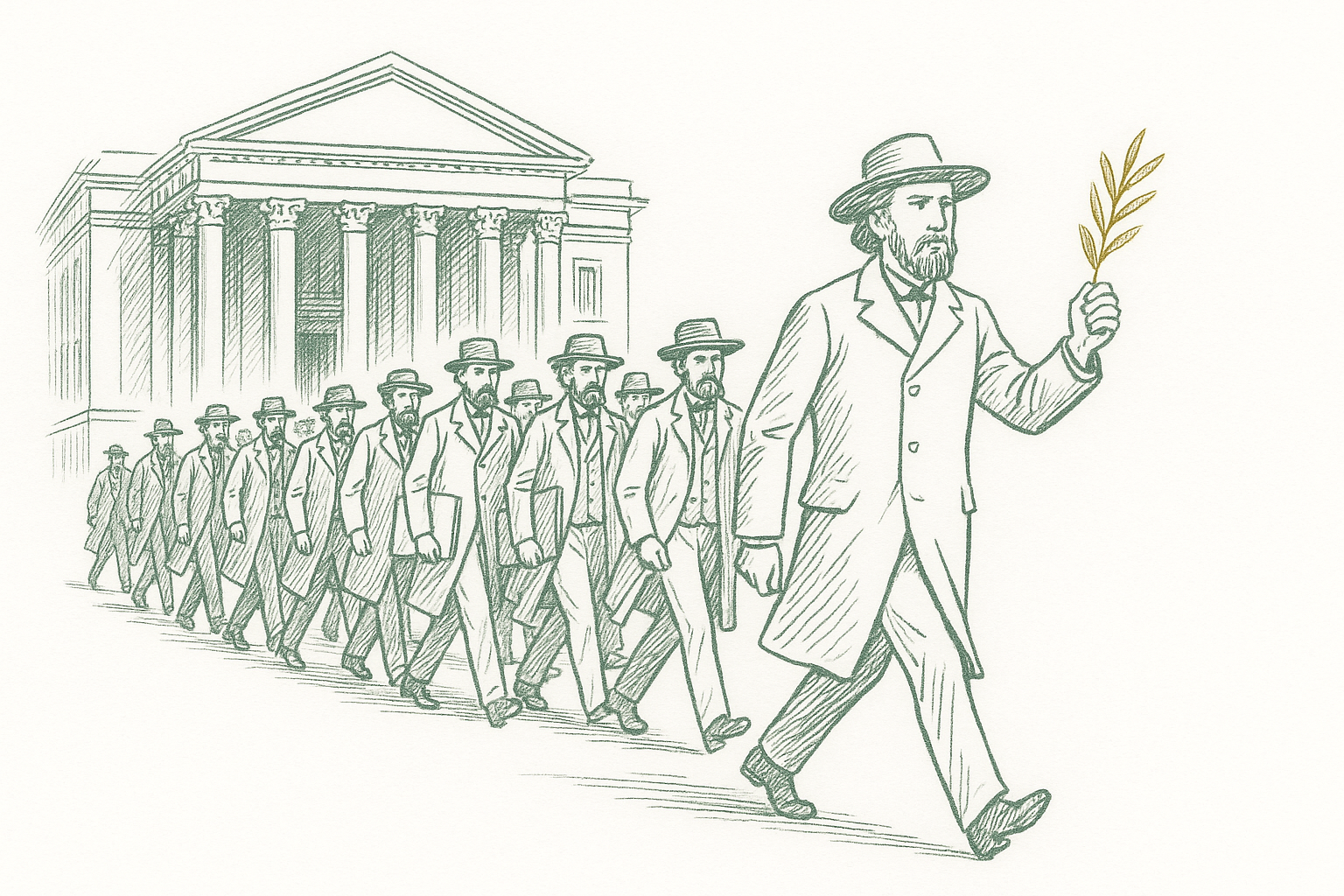
The Vienna Künstlerhaus was the most prestigious arts institution in the Austro-Hungarian Empire. Founded in 1861, it controlled which artists exhibited, which styles were considered legitimate, and which careers advanced. By the 1890s, it had become exactly what powerful institutions tend to become: a gatekeeper protecting the past from the future.
The younger artists in Vienna could feel it. The Impressionists in Paris had already shattered the French Salon's monopoly. The Munich Secession had broken away from the Bavarian establishment in 1892. The Berlin Secession would follow in 1898. Something was in the air across Europe — a recognition that the institutions built to support art had calcified into institutions that suppressed it.
On April 3, 1897, nineteen artists met in a Viennese coffeehouse and voted to form their own organization. They called it the Vereinigung Bildender Künstler Österreichs — the Union of Austrian Visual Artists. History would remember it as the Vienna Secession. Their first president was a 35-year-old painter named Gustav Klimt.
They had not planned to leave the Künstlerhaus. They had tried to reform it from within. But on May 22, the Künstlerhaus board moved to censure the rebels during a general assembly, forcing Klimt and his allies to leave the meeting in silence. Two days later, an official letter of resignation arrived. Twelve artists signed it. More followed over the next two years, until the final signatory — the great architect Otto Wagner — resigned on October 11, 1899.
The Secession's motto, inscribed above the door of the building they would soon construct: Der Zeit ihre Kunst. Der Kunst ihre Freiheit. To every age its art. To every art its freedom.
The people in the room
What made the Vienna Secession remarkable was not that artists rebelled against an establishment. Artists do that every generation. What made it remarkable was who was in the room — and what happened when painters, architects, and designers stopped sorting themselves into separate categories.
Gustav Klimt was the group's gravitational center. Already Vienna's most celebrated decorative painter, Klimt had earned major government commissions and public recognition before the break. He risked the most by leaving. He also cared the least about institutional approval — which is exactly why the younger members followed him.
Koloman Moser was a designer, painter, and graphic artist of extraordinary range. He would design everything from stained glass and furniture to postage stamps and typefaces. His work for the Secession's magazine, Ver Sacrum, helped define what graphic design could be.
Josef Hoffmann, an architect barely thirty years old, brought a geometric severity that would eventually lead him to design some of the most important buildings of the early twentieth century — including the Stoclet Palace in Brussels, a private residence so meticulously conceived that Hoffmann and his collaborators designed every piece of furniture, every light fixture, every fork and knife. It remains one of the purest expressions of the Gesamtkunstwerk — the total work of art — ever realized.
Joseph Maria Olbrich, another young architect and a student of Wagner, would design the Secession Building itself — the golden-domed exhibition hall on the Friedrichstrasse that became the movement's physical symbol and one of Vienna's most recognizable landmarks.
Otto Wagner, the elder statesman, was already transforming Viennese architecture with buildings like the Postal Savings Bank and the Majolikahaus. His treatise Modern Architecture had argued that a building's form must follow its function, not its historical references. "Nothing that is not practical can be beautiful," he wrote — a sentence that would echo through a century of design.
Then there was Carl Moll, a painter and impresario who had the social connections to make things happen. Alfred Roller, who would later revolutionize stage design at the Vienna Court Opera. Josef Engelhart, whose naturalistic paintings had been censored by the Künstlerhaus — one of the provocations that triggered the split.
This was not a group of like-minded stylists. It was a deliberately diverse small group — painters, architects, sculptors, graphic artists, designers — united not by aesthetic agreement but by a shared conviction that the old gatekeepers had to go.
Building the room — literally
Most groups that break from an establishment spend years finding their footing. The Secessionists moved with startling speed. Within a year of their founding, Olbrich had designed and the city had approved their exhibition hall — a white-and-gold cube crowned with a dome of gilded laurel leaves that Viennese wags immediately nicknamed the "Golden Cabbage."
The building itself was a manifesto. While the Künstlerhaus was a Renaissance Revival palace dripping with historical ornament, Olbrich's Secession Building was radically stripped down — clean geometric surfaces, functional spaces designed specifically for displaying art, and that extraordinary dome that declared in gold what the words over the door declared in text: this is new.
The building opened in November 1898 with the Secession's second exhibition. Over 57,000 visitors came in three months. The Secessionists weren't just making art. They were building infrastructure for a different kind of creative exchange.
Ver Sacrum: the magazine that invented modern graphic design
In January 1898, the Secession launched Ver Sacrum — "Sacred Spring" — a monthly art journal that ran until 1903. It became one of the most influential publications in the history of graphic design.
Ver Sacrum was not an art magazine in the conventional sense. It was a total design object. Every page — text, illustration, borders, typography, even the whitespace — was composed as a unified visual field. Moser, Roller, and other Secessionists treated the page as a canvas where words and images were equals. The ornamental borders, the innovative typographic layouts, the integration of illustration with text — all of it influenced everything from Bauhaus typography to mid-century book design to the templates in the graphic design software you use today.
The journal also served a practical purpose that modern organizations would recognize: it created a shared public identity for a group whose members worked in radically different styles and media. The Secession had deliberately avoided adopting a single house style — their pluralism was the point. Ver Sacrum held them together by giving them a shared platform without requiring shared aesthetics.
The Beethoven Exhibition: what collaboration actually looks like
The Secession held twenty-three exhibitions between 1898 and 1905. The most famous — and the one that best illustrates what the group accomplished as a group — was the fourteenth, in 1902.
The exhibition was dedicated to Ludwig van Beethoven. Hoffmann designed the installation architecture. Max Klinger contributed a massive polychrome sculpture of the composer. And Klimt painted the Beethoven Frieze — a 34-meter-long mural that wrapped around the upper walls of the exhibition space. The frieze depicted humanity's longing for happiness, the hostile forces that oppose it, and the redemption offered by art. It was ecstatic, erotic, disturbing, and unlike anything Vienna had seen.
The Beethoven Exhibition was the Gesamtkunstwerk made real. Architecture, sculpture, painting, and music (a conductor performed an arrangement of Beethoven's Ninth Symphony at the opening) were unified into a single immersive experience. Every element was conceived in relation to every other element. Nothing was incidental.
This was the Secession at its peak — a group whose members could maintain the psychological safety to take creative risks together because they had built the structure to support it. Klimt did not paint the Beethoven Frieze to hang on a neutral gallery wall. He painted it for Hoffmann's specific architectural space, alongside Klinger's specific sculpture, as part of a unified vision that none of them could have achieved alone.
The Wiener Werkstätte: from exhibition group to design revolution
In 1903, Hoffmann, Moser, and the industrialist Fritz Waerndorfer founded the Wiener Werkstätte — the Vienna Workshop. It was the Secession's ideas made physical and commercial: a collective of architects, artists, and artisans producing everything from buildings to brooches, furniture to flatware, textiles to teapots.
The Werkstätte's founding principle was radical for its time: there should be no hierarchy between the fine arts and the applied arts. A well-designed chair was as worthy of artistic ambition as a painting. A fork could be a work of art. A wallpaper pattern deserved the same creative intensity as a fresco.
This idea — that design should extend to every object in daily life, that function and beauty are inseparable — is now so embedded in modern culture that it feels obvious. It was not obvious in 1903. The Wiener Werkstätte, along with the British Arts and Crafts movement, established the philosophical foundation for the Bauhaus, for Scandinavian design, for the entire concept of industrial design as a creative discipline. When you sit in a well-designed chair, use a beautifully weighted kitchen knife, or walk through an Apple Store, you are living in the world the Werkstätte imagined.
The split: one vote, two visions
By 1905, the Secession had accomplished something extraordinary. In eight years, nineteen rebels had built a landmark building, launched Europe's most influential art journal, staged twenty-three exhibitions that redefined the Viennese art scene, and spawned a design collective whose influence would last a century.
Then they tore themselves apart.
The fault line had been forming for years. Two camps had emerged within the group. On one side were the "Stylists" — Klimt, Hoffmann, Moser, Wagner, Roller — who believed the Secession should integrate the applied and decorative arts into its mission. On the other were the "Naturalists" — led by Engelhart, Rudolf Bacher, and Friedrich König — who believed the Secession should remain focused on fine art, primarily easel painting.
The breaking point came when Carl Moll, who had become artistic consultant at the Galerie Miethke, proposed that the Secession partner with the gallery to create a commercial outlet for its members' work. Klimt and his allies supported the idea. Engelhart's faction saw it as commercialization — a betrayal of the group's anti-establishment origins.
The proposal was put to a vote. Klimt's side lost by a single vote.
On June 14, 1905, Klimt, Hoffmann, Moser, Wagner, Roller, and several other members formally resigned. The official membership dropped from sixty-four listed in the twenty-third exhibition catalogue to forty-eight in the twenty-fourth. The "Klimtgruppe" — as newspapers immediately branded them — formed a new group, the Kunstschau, the following year.
The Secession continued. It still exists today, still operates from Olbrich's building. But the creative engine that had driven it — the collision between painters, architects, and designers under one roof — was gone. Without Klimt as its artistic force, the institution quickly lost its relevance. Art historians generally speak of "the Vienna Secession" as a movement lasting from 1897 to 1905. Everything after is epilogue.
What survived the room
The Secession's direct legacy is visible everywhere you look — once you know where to look.
Modern architecture. Wagner's functionalism and Hoffmann's geometric purity directly influenced the next generation of architects. Adolf Loos, who orbited the Secession without joining, published "Ornament and Crime" in 1908 — the essay that became a founding text of modernist architecture. The Bauhaus school, founded by Walter Gropius in 1919, inherited the Secession's commitment to dissolving the boundary between fine art and applied design. The Bauhaus itself was a small group of misfits — and it owed an explicit debt to what had happened in Vienna two decades earlier.
Graphic design. Ver Sacrum's integration of typography, illustration, and page composition as a unified visual language anticipated every major development in twentieth-century graphic design. The Swiss Style, Jan Tschichold's New Typography, Bauhaus graphic design — all trace a line back to what Moser and the Secessionists were doing in their journal from 1898 to 1903.
Industrial design. The Wiener Werkstätte's insistence that everyday objects deserve artistic intention — that a spoon can embody a design philosophy — is the DNA of modern industrial design. It runs through the Bauhaus workshops, through Braun's postwar design ethos under Dieter Rams, through Apple's design language under Jony Ive, and through every company that has ever declared that form and function are inseparable.
Expressionism. Before he resigned, Klimt mentored a young artist named Egon Schiele, whose raw, psychologically intense work extended the Secession's legacy into Austrian Expressionism. Oskar Kokoschka, another protégé, followed a similar arc. The line from the Secession's aesthetics to Viennese Expressionism to the broader twentieth-century avant-garde is direct.
Exhibition design. The Secession Building was one of the earliest purpose-built spaces for exhibiting contemporary art. Today, every white-cube gallery, every biennale pavilion, every museum of modern art inherits something from what Olbrich designed on the Friedrichstrasse in 1898 — the idea that the exhibition space should serve the art, not the architecture's vanity.
What the Secession teaches about small groups
The Vienna Secession confirms patterns that appear again and again in the long history of small groups changing the world. The specifics are Viennese. The underlying dynamics are universal.
Shared rejection is a powerful bond — but it's not enough. The Secessionists were united by what they were against: the Künstlerhaus, its conservatism, its gatekeeping. That negative energy was enough to get nineteen people into a coffeehouse in April 1897. But the group only became productive when it built something positive — a building, a journal, exhibitions, a design collective. Groups bonded by opposition alone tend to dissolve once the enemy weakens. Groups that build shared infrastructure endure.
Diversity of discipline matters more than unity of style. The Secession deliberately brought together painters, architects, sculptors, and designers. Their pluralism was the point — they refused to adopt a single house style. This cross-disciplinary collision produced the Gesamtkunstwerk idea, the Wiener Werkstätte, and an approach to design that continues to shape how we build and inhabit the physical world. A group of painters would have produced better paintings. A group that mixed painters with architects produced a revolution.
Infrastructure is identity. The Secessionists didn't just talk about art. They built a building, published a journal, organized exhibitions. These were not side projects. They were the accountability structures that turned a rebellion into a movement. Olbrich's building gave them a public face. Ver Sacrum gave them a shared voice. The exhibitions gave them deadlines, forcing regular creative output rather than perpetual discussion.
Every group has a fault line. The successful ones know where it is. The Stylists-versus-Naturalists divide existed from the beginning. For eight years, the Secession managed this tension productively — the Stylists pushed the group toward ambitious cross-disciplinary projects while the Naturalists kept it grounded in traditional craft. When the tension became irreconcilable, the group split — and both halves continued to produce important work. The split was not a failure. Pretending the fault line didn't exist would have been a failure.
The group's best work is work no individual could have done. Klimt could have painted the Beethoven Frieze without the Secession. But he would have painted it on a standalone wall, in a standard gallery, as an isolated masterpiece. Instead, he painted it as part of a collaborative Gesamtkunstwerk — conceived with Hoffmann's architecture, Klinger's sculpture, and a unified vision that made the frieze something more than a painting. The room didn't diminish individual genius. It amplified it by giving it context, constraints, and collaborators.
That's the story of the Vienna Secession in one sentence: nineteen people who proved that the most dangerous thing to an establishment is a small group of talented individuals who build their own room — and then show up, consistently, to do the work.