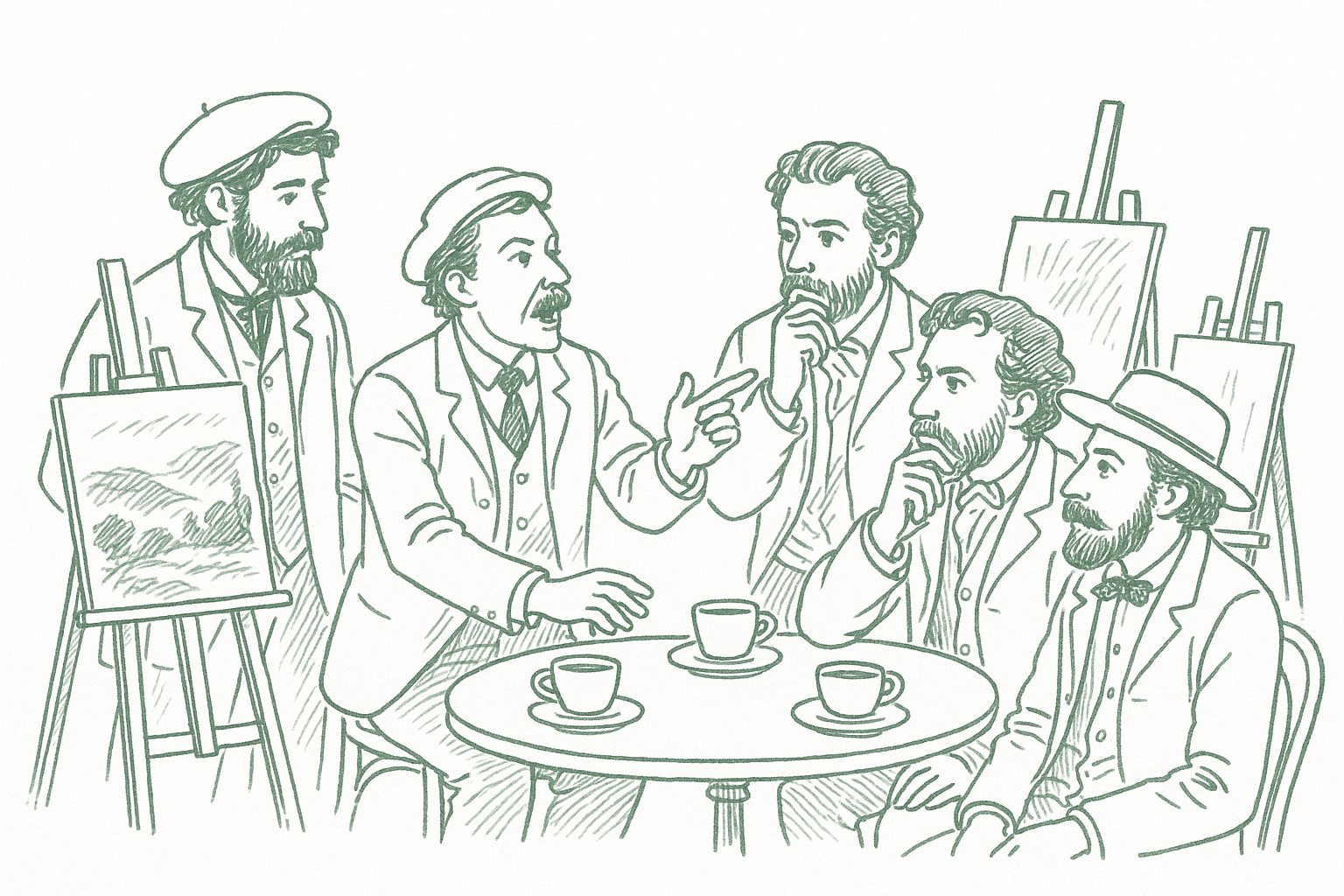
In 1863, the Paris Salon — the only exhibition that mattered for a French painter's career — rejected two-thirds of the works submitted to it. The refusal rate was so extreme that Emperor Napoleon III, embarrassed by the public outcry, authorized a special exhibition of the rejected works: the Salon des Refusés. Over a thousand people a day came to see what the establishment had thrown away.
Among the rejected works was Édouard Manet's Le Déjeuner sur l'herbe, a painting of a nude woman picnicking casually with clothed men. It scandalized Paris. The critics called it indecent, unfinished, a deliberate insult to taste. The public lined up to gawk at it. And a generation of young painters — watching from the margins — saw something else entirely. They saw the future.
Within three years, those young painters had started gathering around Manet at a cafe in the Batignolles neighborhood of Paris. Within a decade, they had formed a cooperative, staged their own exhibition, and been given a name by a hostile critic that was meant as an insult. The name was Impressionism. It stuck. And the group that earned it — a handful of painters meeting over drinks in a Paris cafe — produced the most influential art movement in modern history.
The cafe on Rue des Batignolles
The Café Guerbois sat at 11 Grande Rue des Batignolles (now Avenue de Clichy) in a working-class district north of central Paris. By 1866, it had become the unofficial headquarters of a loose circle of painters, writers, and critics who gathered around Manet every Thursday evening. They called themselves the Batignolles group, or sometimes — to the amusement of the established art world — simply "Manet's gang."
The core members had found each other through the Paris art school system. Claude Monet, Pierre-Auguste Renoir, Alfred Sisley, and Frédéric Bazille had all studied together at the Atelier Gleyre in the early 1860s. Camille Pissarro, older than the rest by nearly a decade, had been studying and exhibiting since the 1850s. Edgar Degas, aristocratic and sharp-tongued, moved in overlapping social circles. Paul Cézanne, awkward and intense, came from Aix-en-Provence with his childhood friend the novelist Émile Zola. Berthe Morisot, one of the few women operating at the highest levels of French painting, entered through her connection to Manet — she would eventually marry his brother.
What pulled them together was not style — their painting styles varied enormously — but a shared frustration. The Salon jury, controlled by the Académie des Beaux-Arts, enforced a rigid hierarchy of acceptable subjects and techniques. History paintings and mythological scenes dominated. Brushwork was expected to be invisible, surfaces smooth, compositions formal. The young painters at the Guerbois wanted something different. They wanted to paint modern life as it actually looked — the flicker of sunlight on water, the blur of a crowd at a train station, a woman reading in a garden. And they wanted to paint it fast, outside, with visible brushstrokes that captured the sensation of seeing rather than the construction of an academic tableau.
The Salon kept rejecting them. Monet was rejected in 1867 and again in 1869. Cézanne was rejected so consistently that he became a running joke among the jurors. Renoir had marginal success but felt constrained. Pissarro — perhaps the most generous and least self-promoting of the group — kept encouraging everyone to stay the course.
The cafe conversations weren't just commiseration. They were the opposite of making decisions alone. The painters critiqued each other's work, debated technique, argued about what painting could be. Monet and Renoir painted side by side at La Grenouillère in the summer of 1869, producing nearly identical views of the same bathing spot on the Seine — each pushing the other toward a looser, more spontaneous style. Pissarro mentored Cézanne through years of rejection, helping him develop the structured brushwork that would eventually make Cézanne the bridge between Impressionism and modern art. Degas, who distrusted plein air painting and preferred the precision of studio work, sharpened his ideas against the outdoor painters and emerged with a style that was entirely his own.
The group dynamic was not harmonious. Degas and Monet clashed constantly. Cézanne was prickly and isolated. Manet, who never exhibited with the group at their independent shows, maintained an ambivalent relationship — inspiring them while refusing to fully join them. But the friction was productive. These were a small number of people with different temperaments and different techniques, united by a shared conviction that painting needed to change and that the established system would not change it for them.
The war, the loss, and the decision
In 1870, the Franco-Prussian War tore the group apart. Bazille — the youngest, the wealthiest, the one who had shared his studio with Monet and Renoir when they couldn't afford rent — enlisted in a Zouave regiment. He was killed at the Battle of Beaune-la-Rolande on November 28, 1870. He was twenty-eight years old.
Bazille's death was a genuine blow. He had been the group's financial backstop and emotional anchor — the one who bought Monet's paintings when no one else would, who paid Renoir's model fees, who hosted work sessions in his studio. The war scattered the rest of them: Monet fled to London, where he met the art dealer Paul Durand-Ruel, who would become their champion. Pissarro also went to London, where Prussian soldiers ransacked his home and destroyed most of his life's work — roughly 1,500 paintings. Cézanne retreated to L'Estaque in the south of France.
When the group reconvened in Paris after the war, the cafe conversations shifted. The Salon had rejected them before the war. It continued to reject them after it. Talk turned from frustration to action. If the establishment would not show their work, they would show it themselves.
On December 27, 1873, they formally incorporated the Société Anonyme Coopérative des Artistes Peintres, Sculpteurs, Graveurs — the Anonymous Cooperative Association of Painters, Sculptors, and Engravers. The cooperative structure was deliberate. Each member contributed dues. Decisions were made collectively. No single artist's name appeared above the group's. It was, in its legal and operational structure, a peer group with real structure, not just a social circle.
Thirty artists, one photographer's studio, and a hostile critic
On April 15, 1874, the cooperative opened its first exhibition in the former studio of the photographer Nadar at 35 Boulevard des Capucines. Thirty artists showed roughly 165 works across seven or eight rooms. The show ran for a month.
The official Salon, running concurrently, drew roughly half a million visitors. The Impressionist exhibition drew somewhere between 3,500 and 4,000. The disparity was staggering. But the people who came mattered.
The critic Louis Leroy visited the show and published a review in the satirical newspaper Le Charivari on April 25, 1874. Titled "Exhibition of the Impressionists," the review was written as a dialogue in which a fictional academician is driven progressively insane by the paintings he encounters. Leroy took his title from Monet's painting Impression, Sunrise — a misty harbor scene rendered in loose, rapid brushstrokes — and used the word "impression" as a weapon. These painters didn't finish their work, he argued. They offered mere impressions, sketches, half-thoughts masquerading as art.
The name was meant to destroy them. Instead it defined them. The painters — with varying degrees of enthusiasm — adopted it. By the second exhibition in 1876, they were calling themselves Impressionists. By the third in 1877, the term had become the name of a movement. The hostile critic had given them something invaluable: an identity.
The pattern is remarkably similar to what happened with the PayPal Mafia, whose name was also coined by outsiders trying to describe a group that defied conventional categories. Labels created in mockery have a way of becoming badges of belonging.
Eight exhibitions and the slow victory
Between 1874 and 1886, the Impressionists staged eight independent exhibitions. No two were identical. The membership shifted. The internal politics were brutal. Degas insisted on including artists that Monet considered deadweight. Monet threatened to boycott exhibitions that included too many non-Impressionist painters. Renoir, who had finally achieved Salon acceptance, began to pull away from the group. Cézanne, whose work was savaged even by critics sympathetic to the Impressionists, stopped exhibiting with them after 1877.
Pissarro was the only artist who exhibited at all eight shows. He was also the one who held the group together through its worst internal conflicts — mediating between Degas and Monet, encouraging younger painters like Paul Gauguin and Georges Seurat, maintaining the cooperative's ideals when everyone else was ready to abandon them. Accountability in a group sometimes looks less like confrontation and more like one person simply refusing to let everyone quit.
The dealer Paul Durand-Ruel was equally essential. He bought Impressionist paintings when no one else would, sometimes at considerable personal financial risk. He organized shows in London and, critically, in New York in 1886, where the American market — less encumbered by academic tradition — embraced the work. Durand-Ruel is estimated to have purchased nearly 12,000 works by the Impressionists over his career. Without a commercial champion willing to bet against the establishment, the group's artistic revolution would have remained a financial catastrophe.
By the late 1880s, the battle was effectively won. Impressionist paintings were selling. Museums were acquiring them. The younger generation — the Post-Impressionists, Gauguin, Van Gogh, Toulouse-Lautrec, Seurat — had absorbed the lessons of the group and pushed further. The Salon's monopoly on taste was broken. The idea that artists could organize independently, exhibit on their own terms, and build an audience outside institutional approval became the operating model for modern art. Every avant-garde movement that followed — Cubism, Surrealism, Abstract Expressionism, and experiments like Black Mountain College — walked through the door the Impressionists kicked open. The Vienna Secession, founded just a decade later, followed the same playbook — nineteen artists breaking from the Austrian establishment to build their own exhibition hall and redefine modern design.
What they built
The Impressionists collectively produced what art historians estimate at roughly 15,000 paintings. Many of those paintings now hang in the most visited museums on earth. The Musée d'Orsay in Paris — built to house Impressionist and Post-Impressionist art — draws over 3 million visitors annually. Monet's water lily paintings at the Musée de l'Orangerie in Paris are among the most visited artworks in the world.
The financial legacy is equally staggering. Monet's Meules (Haystacks) sold at Sotheby's in 2019 for $110.7 million. His Nymphéas en fleur sold for $84.7 million in 2018. Cézanne's The Card Players was purchased by the Qatari royal family in 2011 for a reported $250 million. Renoir's Bal du moulin de la Galette sold for $78 million in 1990. These are paintings that the official art establishment of their time considered unfinished, incompetent, and worthless. Two decades earlier, the Pre-Raphaelite Brotherhood had faced the same institutional contempt from the Royal Academy in London — and survived it through the same mechanism: a small group holding the line together.
The stylistic influence is total. Before the Impressionists, Western painting had spent four centuries perfecting the illusion of three-dimensional reality on a flat surface. The Impressionists broke that project open. They showed that a painting could be about the act of seeing itself — the way light changes, the way color behaves, the way a moment feels before you have time to analyze it. That insight runs through every subsequent development in modern art, from Cézanne's structural analysis of form through Cubism through Abstract Expressionism through the conceptual art of today.
All of it traces back to a table at the Café Guerbois. A group small enough to actually know each other, meeting consistently enough to develop a shared language, and committed enough to keep working when the entire establishment told them they were wrong.
What the Impressionists teach about peer groups
The Impressionist story confirms every pattern we see in the history of high-performing groups. The mechanism is consistent across centuries, fields, and cultures.
Rejection creates cohesion. The group formed because the Salon rejected them. Shared exclusion — when it's unjust and the participants know it — is one of the strongest bonding forces available. Franklin's Junto was composed of tradesmen excluded from Philadelphia's genteel intellectual circles. The Homebrew Computer Club was built by hobbyists excluded from the corporate computing establishment. The Impressionists were artists excluded from the only platform that mattered. In every case, the group built its own.
Productive disagreement drives innovation. Degas and Monet had fundamentally different ideas about what painting should be. Degas worked in studios and distrusted plein air painting. Monet insisted that capturing natural light required working outside. Cézanne wanted to make Impressionism "solid and lasting, like the art of the museums" — a goal that took him in a completely different direction from Monet's dissolving, light-saturated surfaces. These disagreements were not resolved. They were productive. The collision of approaches within a shared commitment to breaking from tradition produced a richer, more varied body of work than any single painter's vision could have.
Structure beats sentiment. The Impressionists didn't just hang out. They incorporated a legal cooperative with dues, exhibition schedules, and collective decision-making. The Société Anonyme gave them a framework for action — a way to translate cafe conversations into public shows. Groups that operate only on shared enthusiasm tend to dissipate. Groups with formal structure — meeting cadences, financial commitments, defined roles — tend to produce results.
The convener matters more than the star. Manet was the inspiration, the most famous painter in their orbit. But he never exhibited with them. Pissarro — less celebrated, less dramatic, less commercially successful — was the one who held the cooperative together for twelve years. He mediated conflicts, mentored younger artists, and exhibited at every single show. The group's most essential member was not its most talented or most famous. It was the person who maintained the structure.
A commercial champion changes everything. Durand-Ruel didn't paint. He sold paintings. And his willingness to absorb financial risk on behalf of the group — buying when no one else would, opening markets in London and New York — transformed an artistic movement into a viable career for its members. Most peer groups produce ideas. The ones that produce outcomes have someone connecting those ideas to the market.
The Impressionists met regularly for roughly fifteen years, from the mid-1860s through the early 1880s. Their influence has lasted over a century and a half. Decades later, the Bauhaus would run the same experiment — painters, architects, and craftsmen in a single room, producing the vocabulary of modern design in just 14 years. A handful of painters, rejected by every institution that mattered, sat down at a table together and changed how the human race sees the world.
That's not a metaphor. That's what happened. And the infrastructure was a cafe, a cooperative, and the discipline to keep showing up.