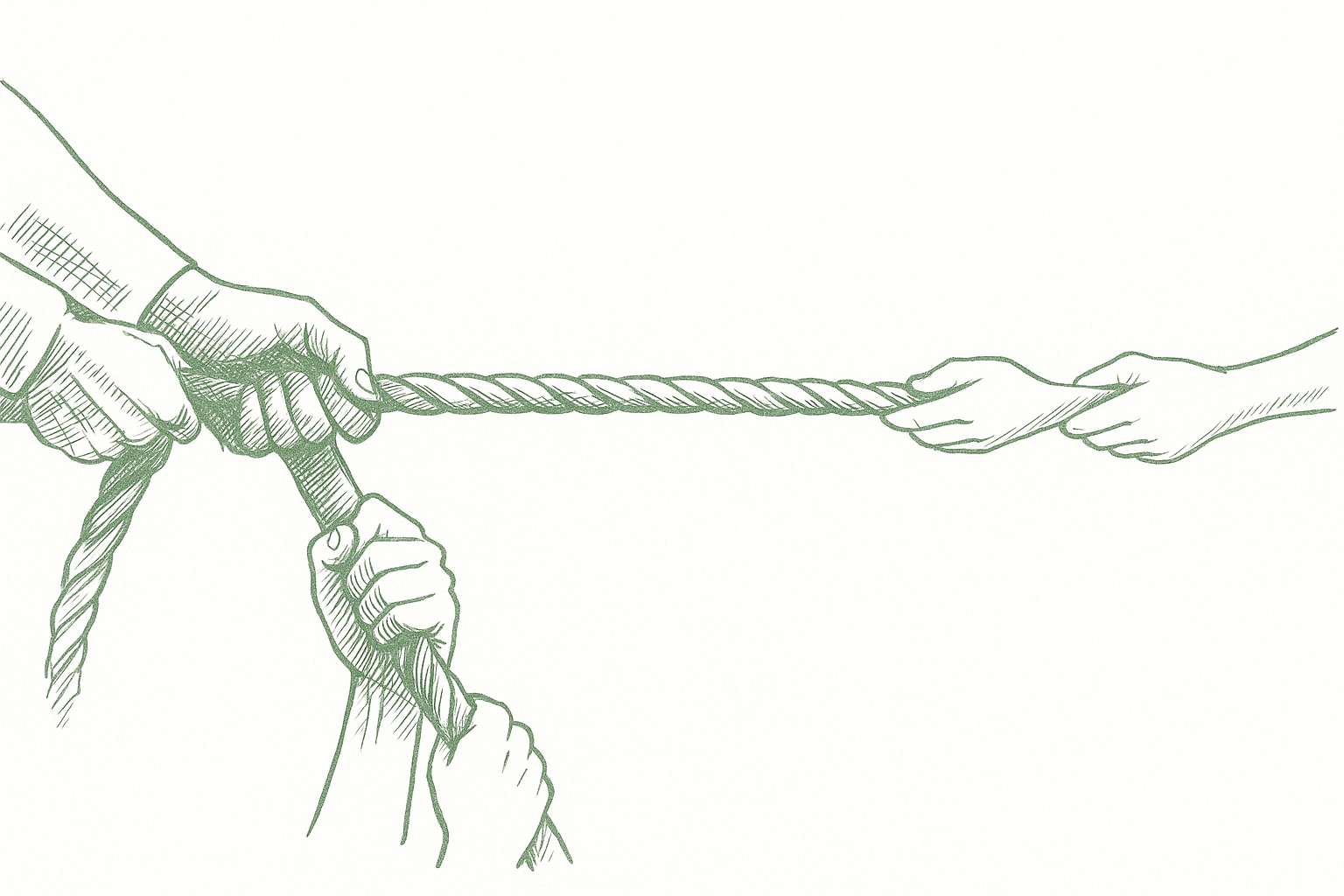
Maximilien Ringelmann was not a psychologist. He was a French agricultural engineer who, sometime in the 1880s, asked a simple question: if one person can pull a rope with X force, do eight people pull with 8X force?
The answer, published in 1913, upended the assumption that effort scales linearly with headcount. When Ringelmann measured rope-pulling force across groups of varying sizes, he found that two people exerted only about 93% of their combined individual capacity. Three dropped to 85%. Eight people pulled at roughly 49% of what their individual efforts should have produced. Half the potential output, evaporated.
Ringelmann was measuring agricultural labor. But what he discovered was a law of human behavior that applies to every boardroom, every Slack channel, every advisory group, and every team standup happening right now.
It is not a coordination problem. It is a motivation problem.
For decades, researchers assumed the performance drop was mechanical. More people on a rope means more tangled effort. People pull at different angles. They cannot synchronize perfectly. The loss is physical, not psychological.
In 1974, Ingham, Levinger, Graves, and Peckham tested that assumption with an elegant experiment. They blindfolded participants and told them they were pulling a rope alongside others. In reality, the other "group members" were confederates who only pretended to pull. There was zero coordination problem because there was no actual group. And yet individual effort still dropped significantly when participants believed they were pulling with others.
The implication was clear: the performance decline was not about logistics. It was about motivation. When people believe others are sharing the load, they unconsciously pull back. Not maliciously. Not even consciously. The brain recalibrates effort based on perceived diffusion of responsibility. Psychologists gave this phenomenon a name: social loafing. (Its opposite — the Köhler effect, where the right group structure makes people work harder — would not be rediscovered for decades.)
The research has been replicated hundreds of times since. In brainstorming sessions, in clapping experiments, in cognitive tasks, in workplace teams. The finding is consistent: as group size increases, individual contribution decreases. Not because people are lazy. Because human psychology is wired to distribute effort across the group, and the larger the group, the more each individual assumes someone else will carry the weight.
The math gets ugly fast
The data does not improve at scale. It degrades.
Bain & Company's research on decision-making effectiveness established what they call the Rule of Seven: once a decision-making group exceeds seven members, every additional person reduces decision effectiveness by approximately 10%. By the time you reach 17 people, the group "rarely makes any effective decisions at all." That is a consultancy with no incentive to romanticize small teams telling you that large groups are structurally broken for the thing they are supposed to do best.
Lawrence Putnam, a pioneer in software project management, analyzed 491 projects and found that teams of three to seven people delivered at roughly four times the productivity of teams of nine to twenty. Not a modest improvement. A 4x difference. Lead times ballooned when teams exceeded eight members, and the relationship was not linear. It was exponential.
J. Richard Hackman, a Harvard psychologist who spent his career studying team dynamics, distilled it to a rule of thumb: "No double digits." His research with Neil Vidmar in 1970 even arrived at a precise optimal number for member satisfaction: 4.6 people. Hackman was not being cute. He was being empirical. His broader conclusion was blunt: "Big teams usually wind up just wasting everybody's time."
Jeff Bezos translated this into corporate policy at Amazon with the two-pizza rule: no team should be larger than what two pizzas can feed. The reasoning was not about pizza. It was about the exponential growth of communication channels as team size increases. A team of six has 15 unique communication pairs. A team of twelve has 66. A team of twenty has 190. Every additional person does not just add one more voice. They add dozens of new relationship dynamics that dilute individual ownership and erode accountability.
Why this matters for peer groups
The Ringelmann effect is not an abstract curiosity. It is the single most important design constraint for any group that claims to produce outcomes — and the primary reason most mastermind groups fail.
Consider the typical networking event. A hundred people in a room. Name tags. Small talk. Everyone is polite. Nobody is accountable. The Ringelmann effect predicts exactly what happens: individual effort collapses toward zero because the group is too large for any single person's contribution to feel consequential. You leave with a stack of business cards and the vague sense that you wasted two hours. This is why masterminds work and networking events do not.
Now consider a Slack community with 500 members. The Ringelmann effect does not care that the technology enables everyone to speak. What it predicts is that almost nobody will. Research on online communities consistently shows that 90% of members in large groups lurk, 9% contribute occasionally, and 1% create most of the content. The 90-9-1 rule is social loafing wearing a digital costume.
Contrast this with a structured peer group of five people. Every person's absence is felt. Every person's silence is noticed. Every person's commitment or lack thereof is visible to everyone else. There is nowhere to hide, which means there is no mechanism for effort to diffuse. The Ringelmann effect cannot take hold because the group is too small and too transparent for the psychological escape hatch to open.
This is not a theory about peer groups. It is the empirical foundation for why they work. The research on optimal group size does not arrive at five or six people by coincidence. It arrives there because that is where individual accountability is maximized, communication overhead is minimized, and the Ringelmann effect is structurally neutralized.
The antidotes that actually work
Social loafing is not inevitable. The same research that identified the problem also identified the conditions under which it disappears.
Individual identifiability. When people know their specific contribution will be measured and attributed, effort rebounds. This is why structured peer groups that use hot seats, action item tracking, and regular check-ins produce different outcomes than open forums. The structure is not bureaucratic overhead. It is an anti-loafing mechanism.
Task significance. When people believe their contribution is essential to the group's success, they invest more. In small groups where every member brings a unique perspective or expertise, the sense of indispensability is built into the architecture. Research on collective intelligence confirms that group performance depends more on equal turn-taking and social sensitivity than on stacking the room with the smartest individuals. Research on group flow confirms this from the opposite direction — small teams do not just avoid the losses of large groups, they unlock a neurologically distinct state of collective engagement that large groups cannot access. In large groups, substitutability kills motivation.
Evaluation potential. The Ingham study showed that merely believing others are watching changes behavior. Peer groups with regular accountability check-ins create a permanent state of gentle evaluation. Not surveillance. Not pressure. Just the knowledge that someone will ask, "Did you do what you said you would do?" That question changes everything.
Group cohesion. Research shows that social loafing decreases in groups where members care about each other's outcomes. Strangers loaf. Peers who know each other's stakes invest. This is why matching matters. A random collection of business owners in a room produces networking-event dynamics. A carefully matched group of founders facing similar problems produces a mastermind.
The founder application
Founders who make decisions alone are not experiencing a milder version of this problem. They are experiencing its inverse. Where the Ringelmann effect describes effort disappearing in crowds, founder isolation describes effort concentrating in a single person with no external calibration. Both are failures of group design. One has too many people. The other has too few.
The solution is the same in both cases: a group sized for accountability. Small enough that every member's effort is visible. Large enough that the diversity of perspective prevents echo chambers. Structured enough that social loafing cannot take root. Dunbar's research on relationship capacity points to the same conclusion from a different direction: humans can only maintain a small number of meaningful relationships, and the quality of those relationships determines the quality of the outcomes they produce.
Ringelmann pulled a rope in a field in France 140 years ago and discovered something that every founder, executive, and team leader still gets wrong: more people is not better. The right number of people, in the right structure, with the right accountability, is better.
The most consequential groups in history understood this intuitively. Ben Franklin's Junto had twelve members. The PayPal Mafia was a tight circle of roughly a dozen. The Inklings met weekly in groups of four to seven. They did not grow their groups to gain more input. They kept their groups small to maintain the conditions under which great work happens.
The Ringelmann effect is not a warning about teamwork. It is a design specification. And the specification is clear: keep it small, keep it visible, and keep every person in the room accountable for pulling their weight.