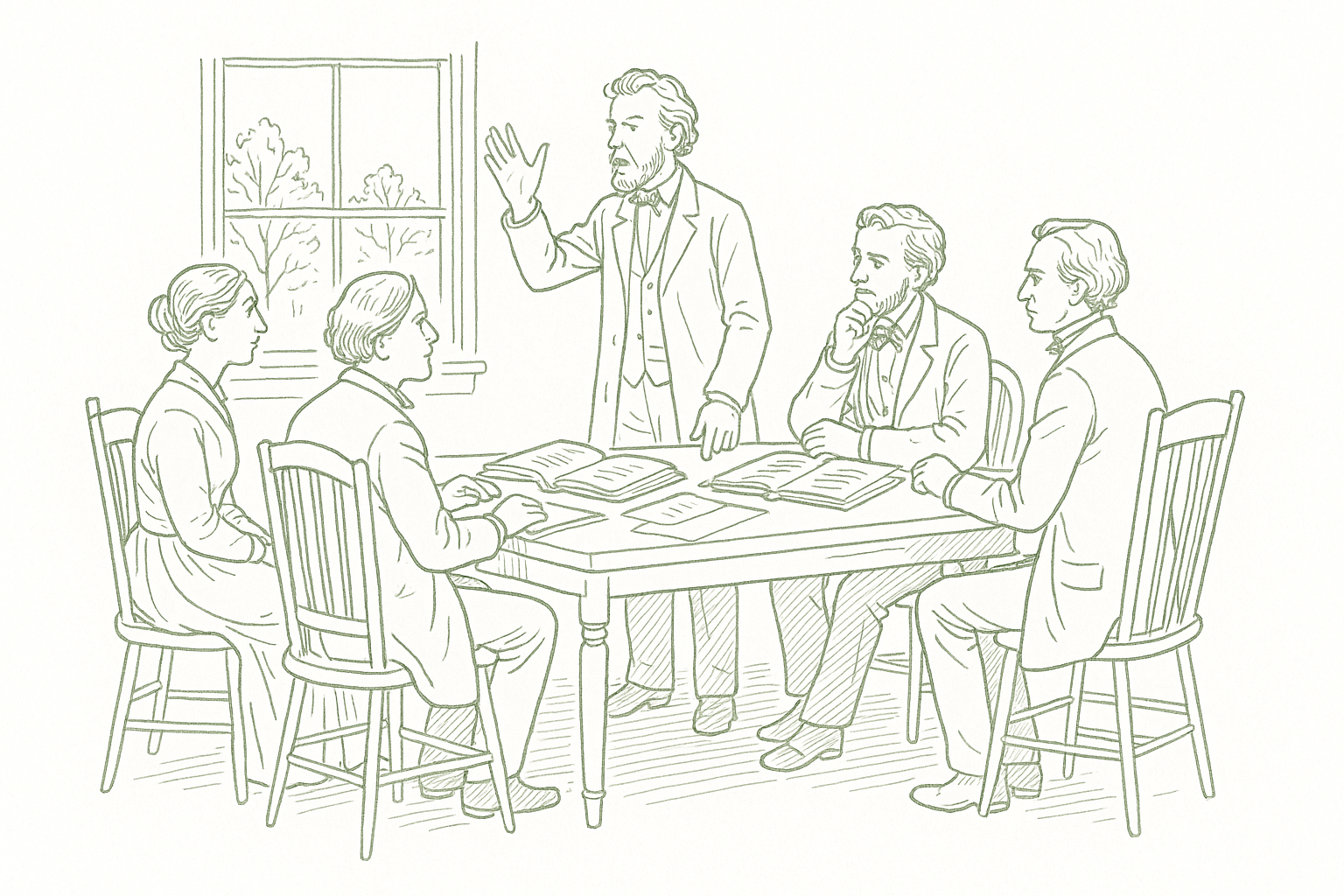
On September 8, 1836, Frederic Henry Hedge, Ralph Waldo Emerson, George Ripley, and George Putnam sat down in Ripley's parlor in Boston. They were Unitarian ministers, all of them, and they were frustrated. The church had become intellectually stale. Theology had calcified into routine. The questions they cared about — about the nature of the individual, the purpose of intuition, the limits of inherited doctrine — had no venue.
So they made one. They agreed to meet again, and to bring others. Within weeks the group expanded to include Bronson Alcott, Margaret Fuller, Elizabeth Peabody, and eventually Henry David Thoreau. They called it nothing official. Outsiders called it "Hedge's Club" because meetings were scheduled around Hedge's visits from Bangor, Maine. Later, critics gave it the name that stuck: the Transcendental Club.
The next day — September 9, 1836 — an anonymous book called Nature appeared in Boston bookshops. Its author was Emerson. The timing was not coincidental. The club and the manifesto were born from the same impulse: the conviction that inherited ideas were insufficient, and that a small group of committed thinkers could build better ones.
They were right. Over the next two decades, this loose circle of intellectuals would produce self-reliance as a philosophical framework, civil disobedience as a political strategy, Walden as a literary landmark, the first American feminist treatise, a utopian commune, a literary journal that defined an era, and a set of ideas so foundational to American identity that most people have forgotten they were invented at all.
None of it came from a single genius working alone. All of it came from the room.
The club that met when Hedge was in town
The Transcendental Club had no bylaws, no dues, no formal membership. It met approximately thirty times between 1836 and 1840, usually when Hedge traveled from Maine to Boston. The meetings rotated between members' homes — Ripley's parlor, Emerson's study in Concord, Alcott's rooms in Boston. The format was simple: someone proposed a question, and the group discussed it for hours.
Topics from the club's recorded meetings included "American Genius — the causes which hinder its growth," "the Education of Humanity," "Is Mysticism an element of Christianity?" and "the question of labor and reform." These were not polite academic seminars. The Stanford Encyclopedia of Philosophy describes the participants as "disaffected young Unitarian clergy" — people who had outgrown their institutions and needed a space where the real questions could be asked.
The roster reads like a syllabus of nineteenth-century American thought. Emerson — the philosopher who would redefine individualism. Thoreau — the writer who would make civil disobedience a global strategy. Margaret Fuller — the editor, critic, and author of Woman in the Nineteenth Century, America's first major feminist text. Bronson Alcott — the educator whose radical ideas about childhood learning anticipated progressive education by a century. Elizabeth Peabody — who opened the first English-language kindergarten in America. George Ripley — who would leave the ministry to found Brook Farm, the most famous utopian experiment of the nineteenth century.
Every one of these people produced their most important work during or after their years in the club. The coincidence is not a coincidence.
How the room made Thoreau
Henry David Thoreau was twenty years old in 1837 when Emerson took an interest in him. The older man — fourteen years his senior, already famous for Nature — recognized something in the Harvard graduate who had refused a teaching position because the school required corporal punishment. Emerson did not just mentor Thoreau. He brought him into the circle.
Thoreau moved into the Emerson household in 1841, living with the family while working as a handyman and tutor. In practice, he was an intellectual apprentice embedded in the most stimulating environment in American letters. He attended club meetings. He debated Alcott. He absorbed Fuller's arguments about individual freedom. He wrote for The Dial, the journal that the club produced.
And then, in 1845, Thoreau walked to a piece of land Emerson owned near Walden Pond, built a cabin, and spent two years testing the club's ideas in practice. Walden is not a book about escaping society. It is a book about applying a philosophy that was developed in a group to the problem of how a single life should be lived. Every major idea in Walden — self-reliance, simplicity, the primacy of direct experience over inherited knowledge — was first articulated, debated, and refined in the conversations of the Transcendental Club.
Thoreau did not discover his philosophy alone at the pond. He developed it in the room and tested it in solitude.
The Dial: when a peer group becomes a publishing house
By 1839, the club members had a problem familiar to any group producing original ideas: they had no outlet. The existing literary magazines were controlled by the establishment they were critiquing. So in September 1839, at a club meeting, Alcott proposed creating "a journal designed as the organ of views more in accordance with the Soul."
The Dial launched in July 1840 with Margaret Fuller as its editor. The prospectus was written by Ripley. Emerson contributed heavily, eventually taking over editorial duties when Fuller's health declined. The journal ran for four years and published some of the most consequential essays and poems of the era — including Thoreau's first published writing, Emerson's major essays, and Fuller's criticism that established her as America's first professional female literary critic.
The journal lost money. It never had more than about 300 subscribers. But its influence was wildly disproportionate to its circulation, because the people reading it were the people who shaped American culture for the next century. The Dial was not a commercial venture. It was a peer group that formalized its conversations into text.
This pattern — a small group generating ideas that become publications, institutions, or movements — recurs throughout intellectual history. The Transcendentalists did it before the word "platform" existed. The mechanism was not reach. It was density. A small group of deeply committed thinkers producing work that mattered to the right 300 people.
From club to commune to institution
The club's formal meetings ended after September 1840, but its influence was just beginning. The conversations did not stop — they metastasized into projects.
George Ripley left the ministry in 1841 and used what he had learned in the club to design Brook Farm, a cooperative community in West Roxbury that attempted to merge intellectual life with manual labor. Hawthorne lived there briefly. Fuller visited regularly. The experiment lasted six years before a fire destroyed the main building, but its influence on American utopianism and cooperative living persisted for decades.
Emerson, meanwhile, evolved the club into something more durable. In 1855, he co-founded the Saturday Club, a monthly dinner gathering at the Parker House hotel in Boston. The members now included not just the Transcendentalists but the broader intellectual elite of mid-century America: Longfellow, Hawthorne, Oliver Wendell Holmes, Louis Agassiz, James Russell Lowell. It was at a Saturday Club dinner that the Atlantic Monthly was conceived — Holmes named it — creating the magazine that would dominate American letters for the next century and a half.
Longfellow worked on an early draft of "Paul Revere's Ride" at a Saturday Club meeting. Charles Dickens read from A Christmas Carol to club members during a visit. The club contributed so much to Boston's intellectual reputation that the city earned the title "Athens of America." The Saturday Club still meets today, more than 170 years after its founding.
And in 1879, the aging Bronson Alcott co-founded the Concord School of Philosophy — a summer lecture series explicitly designed to continue the Transcendental Club's work. Emerson attended before his death in 1882. The school ran for nine summers, welcoming women as both lecturers and students, including Julia Ward Howe. It was, in Alcott's words, an institution dedicated to "the interchange of thought among its originators" — the same goal the four clergymen had set in Ripley's parlor forty-three years earlier.
The philosophy that ran on a peer group
The ideas that came out of the Transcendentalist circle are so embedded in American culture that they feel like natural law rather than intellectual inventions. Self-reliance. Civil disobedience. The primacy of individual conscience over institutional authority. The value of direct experience. The moral weight of simplicity. These are ideas so foundational that it is easy to forget they were arguments — contested, refined, and sharpened by people sitting in rooms together.
Emerson's "Self-Reliance" was not a solo revelation. It was the distillation of years of argument with Alcott, who believed in communal education, and Ripley, who believed in communal living. Emerson's individualism was forged against the collectivism of his peers. He needed people who disagreed with him to figure out what he actually believed. That is not a paradox. That is how intellectual accountability works.
Thoreau's "Civil Disobedience" — written after his night in jail for refusing to pay a poll tax during the Mexican-American War — drew directly on the club's discussions about individual conscience versus institutional obedience. The essay would go on to influence Gandhi's independence movement, and through Gandhi, movements for political change across the globe. A conversation in a Boston parlor became a strategy that reshaped nations.
Fuller's Woman in the Nineteenth Century, published in 1845, grew out of her "Conversations" — a series of paid discussion sessions for educated women in Boston that ran from 1839 to 1844. Fuller had learned the format in the Transcendental Club and applied it to a different audience. She took the peer group model and made it a feminist tool.
The pattern is always the same. A small number of people, meeting regularly, with enough trust to say what they actually think, producing work that none of them could have produced alone. The Transcendentalists did not invent this pattern. But they executed it with a thoroughness that makes their example almost unfairly clear.
Thirty meetings that built a century
The Transcendental Club met roughly thirty times over four years. Thirty dinner conversations. That is all. From those conversations came Nature, Self-Reliance, Walden, "Civil Disobedience," Woman in the Nineteenth Century, The Dial, Brook Farm, the Saturday Club, the Atlantic Monthly, the Concord School of Philosophy, and a philosophical framework that defined American identity for two hundred years.
The members were not superhuman. Emerson struggled with depression and financial pressure after leaving the ministry. Thoreau died at forty-five, largely unrecognized. Fuller drowned in a shipwreck at forty, her last manuscript lost. Alcott went bankrupt multiple times. Ripley's commune failed. These were people with ordinary problems and extraordinary clarity about one thing: they needed a room where the real conversations could happen.
The Transcendentalists are remembered as individual geniuses. Emerson the philosopher. Thoreau the naturalist. Fuller the feminist. But the historical record tells a different story. They were a peer group. They met regularly. They challenged each other. They published together. They built institutions from their conversations. And the work they produced together was categorically different from anything they could have produced alone.
The peer effect is not a modern discovery. Emerson understood it in 1836. He just called it something else. He called it friendship. Then he built a structure around it and changed the world.