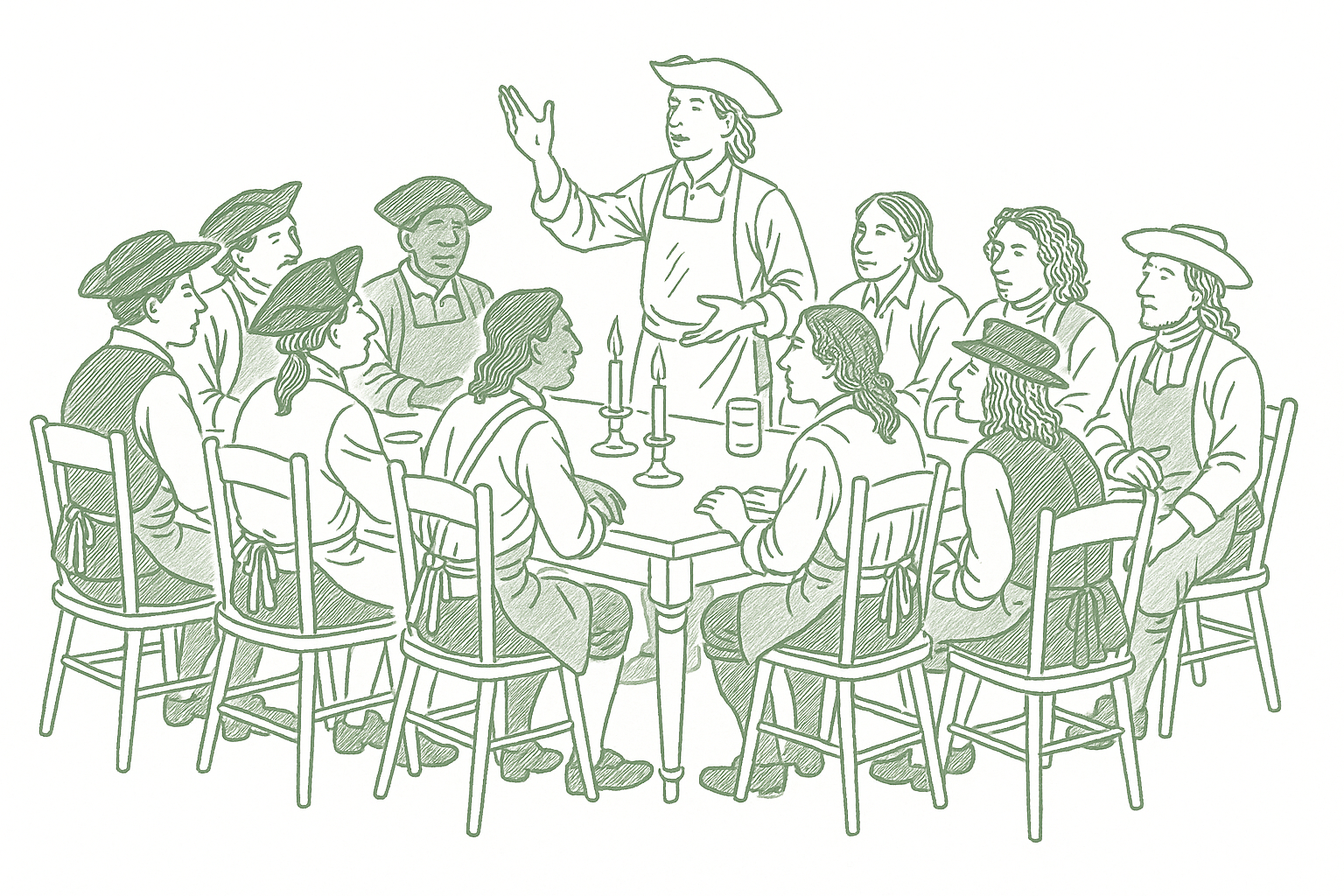
Benjamin Franklin was 21 years old, newly returned to Philadelphia, and running a struggling print shop when he had an idea that had nothing to do with printing. In the autumn of 1727, he invited eleven men to meet him at a tavern every Friday evening. The group would discuss morals, politics, and natural philosophy. They would share what they had read that week. They would help each other's businesses.
He called it the Junto, from the Spanish junta, meaning a deliberative assembly. Others called it the Leather Apron Club, because most of its members were tradesmen who wore the leather aprons of their trade. The name stuck because it captured something Franklin understood instinctively: the people most likely to improve a city were not its aristocrats but its working class. The ones who made things. The ones who needed each other.
The Junto met every Friday for 38 years, from 1727 to approximately 1765. In that time, the discussions in that tavern room directly produced the Library Company of Philadelphia (America's first lending library), the Union Fire Company (the colonies' first volunteer fire department), the American Philosophical Society (the nation's oldest learned society), the precursor to the University of Pennsylvania, America's first property insurance company, and a municipal night watch that became a model for policing. Franklin himself would go on to help draft the Declaration of Independence, negotiate the treaty that ended the Revolutionary War, and become perhaps the most consequential American of his century.
He credited the Junto for most of it.
Twelve tradesmen in a tavern
The original Junto had twelve members. Franklin chose them deliberately. They were not wealthy. They were not powerful. They were young working men from Philadelphia's artisan class, and Franklin selected them for diversity of trade and quality of mind.
The roster: Franklin himself, a printer. Hugh Meredith, his business partner. Thomas Godfrey, a glazier and self-taught mathematician who would later invent an improved mariner's quadrant. Joseph Breintnall, a copier of deeds who wrote poetry on the side. Nicholas Scull, a surveyor who would eventually become surveyor general of Pennsylvania. William Parsons, a shoemaker and amateur mathematician who also later became surveyor general. William Maugridge, a cabinetmaker. Robert Grace, a gentleman with inherited means and a generous disposition. William Coleman, a merchant's clerk known for exacting moral standards. Stephen Potts, a bookseller's apprentice. George Webb, a runaway Oxford student working as a printer's apprentice. And John Jones Jr., a Quaker shoemaker.
Not a single one of them held public office when the group began. Most were in their twenties. Several were functionally self-educated. What they had in common was curiosity, ambition, and the capacity for honest conversation. Franklin later wrote in his autobiography that he had chosen members "who had the best characters for integrity and good understanding."
The membership cap of twelve was not arbitrary. Research on group dynamics consistently shows that small groups outperform large ones for sustained, high-quality discussion. Franklin seemed to understand this intuitively three centuries before the research existed. The Junto stayed at twelve. When demand grew, Franklin didn't expand the group. He told members to start their own.
The structure that made it work
The Junto was not a casual social gathering. Franklin designed it with rules, rituals, and expectations that modern organizational psychologists would recognize immediately.
Every Friday evening, the group met first at a tavern, and later in a rented room. Each meeting was led by a president — a rotating role — and followed a set format. Each member, in turn, was required to produce a topic for discussion. Every three months, each member had to write and present an original essay on any subject. The discussions covered morals, politics, and what they called "natural philosophy," meaning science.
But the most important structural element was what Franklin forbade. "Expressions of positiveness in opinions, or direct contradiction" were banned. Members who violated this rule were fined. Franklin explained in his autobiography: "I even forbid myself the use of every word or expression in the language that imported a fix'd opinion, such as certainly, undoubtedly, etc., and I adopted, instead of them, I conceive, I apprehend, or I imagine a thing to be so or so."
This was not a rule against disagreement. It was a rule against the performance of disagreement. Franklin wanted the room to be safe for inquiry, not debate theater. The goal was "sincerely inquiring after truth" rather than scoring rhetorical points. What researchers now call psychological safety — the shared belief that a group is safe for interpersonal risk-taking — was built into the Junto's operating rules from day one.
Everything said in the room stayed in the room. Confidentiality was absolute. New members had to answer a series of qualifying questions, including whether they held "any particular disrespect" for any present member. If they did, they couldn't join.
And then there were Franklin's 24 standing questions — a protocol for structured inquiry that members worked through regularly. These questions were remarkably specific and remarkably practical. Not "What do you think about morality?" but rather:
"Hath any citizen in your knowledge failed in his business lately, and what have you heard of the cause?"
"Do you know of any fellow citizen, who has lately done a worthy action, deserving praise and imitation? Or who has committed an error proper for us to be warned against and avoid?"
"Do you think of anything at present, in which the Junto may be serviceable to mankind? To their country, to their friends, or to themselves?"
These questions did three things at once. They forced members to pay attention to the world around them — to arrive with observations, not just opinions. They created a built-in accountability rhythm, because you couldn't show up empty-handed. And they oriented the group toward action, not abstraction. The Junto didn't discuss problems in the general case. It discussed problems in Philadelphia, this week, involving people they knew.
What one room produced
The Junto's first major civic achievement grew directly from its format. Members were required to read — but books were expensive, and none of them could afford large personal libraries. In the early years, members pooled their own books in the meeting room so they could consult them during discussions. When that arrangement proved inadequate, Franklin proposed something more ambitious.
In 1731, four years after the Junto's founding, Franklin and his fellow members established the Library Company of Philadelphia. Fifty subscribers each paid 40 shillings to join and 10 shillings per year in dues. The first shipment of books arrived from London. It was the first subscription lending library in the American colonies — the idea that books could be shared, not just owned, at a time when access to knowledge was determined almost entirely by wealth.
The Library Company still exists. It is the oldest cultural institution in America.
That same year, 1736, Franklin would deploy another insight from the Junto's culture of mutual contribution — asking a political rival for a personal favor to build trust, a technique psychologists would later name in his honor. But the Junto's civic output was already accelerating. Five years after its founding, the Junto's discussions about fire safety led to the Union Fire Company — 26 volunteers who agreed to respond to any fire alarm in the city with their own equipment: six leather buckets and two stout linen bags per member, the bags for salvaging property from burning buildings. Unlike earlier mutual fire societies in Boston, which only protected their members, Franklin's company protected the entire community. It was the colonies' first true volunteer fire department and the direct ancestor of the modern Philadelphia Fire Department.
In 1743, the Junto's interest in science and experiment led Franklin to propose a broader organization dedicated to sharing discoveries across the colonies. The result was the American Philosophical Society, founded on May 25, 1743. Its mission: "promoting useful knowledge." It became the nation's preeminent scientific body. Its members would eventually include Washington, Jefferson, Adams, Hamilton, Lafayette, Darwin, Edison, and Einstein.
In 1751, the Junto's advocacy for education contributed to the founding of the Academy and College of Philadelphia — the institution that would become the University of Pennsylvania. In 1752, the group's fire safety discussions led to the Philadelphia Contributionship for the Insurance of Houses from Loss by Fire, the nation's oldest surviving property insurance company.
All of this from twelve tradesmen meeting on Friday nights.
The network effect
By the late 1730s, the Junto was full. Demand exceeded supply. Franklin's solution was elegant and, in retrospect, extraordinarily sophisticated for a 30-year-old printer: he told each member to start a subsidiary club.
These daughter clubs — called the Vine, the Union, the Band, and others — followed the Junto's format and rules. Their members didn't know about the Junto proper, but the Junto members who seeded them could channel ideas, proposals, and support between the groups. Franklin had, in effect, built a peer group network — a system for scaling trust and structured discussion without diluting the quality of any individual group.
Research on network structure and Dunbar's number suggests that the strength of relationships degrades dramatically beyond certain group sizes. Franklin solved this problem by keeping each group small and creating connections between groups through shared members — the same architecture that would later make organizations like the Young Presidents' Organization effective across thousands of members.
When Franklin needed political support for a civic proposal — the library, the fire company, the college — he could mobilize opinion across multiple groups simultaneously. The Encyclopedia of Greater Philadelphia describes the Junto members' "intellectual and financial collaboration" as ensuring "the success of each project beyond the life of the club itself." The group wasn't just a discussion forum. It was infrastructure.
Why it lasted
Thirty-eight years. Most organizations don't survive a decade. Most informal groups don't survive a year. The Junto lasted nearly four decades because Franklin got several things right that are easy to name and very hard to execute.
First, the group was useful. Members directly helped each other's businesses. They shared commercial intelligence ("who has lately failed?"), recommended each other to customers, and provided what amounted to a mutual aid network. The isolation that most business owners experience — making decisions without informed feedback — was structurally eliminated for Junto members. You didn't just get friendship. You got market intelligence, referrals, and accountability.
Second, the group had rituals. The weekly cadence, the essay requirement, the standing questions, the rotating presidency — these created reliability without bureaucracy. Members knew what to expect. They prepared. The structure made attendance feel like an obligation worth keeping rather than a social event worth skipping.
Third, the group selected for character, not status. Franklin didn't recruit the most powerful men in Philadelphia. He recruited the most curious. The qualification questions for new members screened for integrity and goodwill, not wealth or connections. This meant the room was full of people who genuinely wanted to learn from each other — not people positioning for advantage.
Fourth, the rules prevented the group from deteriorating into argument for argument's sake. The ban on dogmatic assertion, the culture of provisional language, the small fines for violations — these were mechanisms for maintaining what researchers now call a "learning orientation" rather than a "performance orientation." The Junto rewarded curiosity and punished certainty.
The group eventually dissolved around 1765, coinciding with Franklin's extended absence in London and growing political divisions in Pennsylvania. But by then, the institutions it had spawned — the library, the fire company, the philosophical society, the university, the insurance company — had taken on lives of their own. The Junto's legacy was not its longevity but its output.
The lesson that keeps repeating
Franklin was not the smartest person in colonial Philadelphia. He was not the most educated. He was not the wealthiest. But he understood something about the mechanics of progress that most people still miss: individual talent is necessary but insufficient. The returns come from structure — from creating a room where prepared people with diverse expertise show up consistently, exchange what they know honestly, and hold each other to a standard of contribution.
The pattern appears everywhere once you start looking. Three hundred years of history show the same dynamic: the Lunar Society powering the Industrial Revolution from a monthly dinner table, Edinburgh's dinner clubs producing modern economics and philosophy from a city of 50,000, the Fairchild Eight creating Silicon Valley, the PayPal Mafia building a $500 billion empire, the Inklings producing modern fantasy literature, the Vienna Circle rewriting the rules of science from a Thursday seminar room, the Transcendentalists rewiring American philosophy from a Boston parlor. In every case, the mechanism is the same. A small group. A consistent structure. An expectation of honesty.
Franklin described the Junto as "the best school of philosophy, morality, and politics that then existed in the province." He was not exaggerating. The University of Pennsylvania, which the Junto helped create, would not surpass the educational output of that Friday night tavern group for decades.
The most remarkable thing about the Junto is not what it produced. It's how little it required. Twelve people. A room. A set of questions. The discipline to show up every week. That was it. That was the entire infrastructure behind the most productive civic organization in colonial America.
Franklin never called it a mastermind group. That language would come later, from Napoleon Hill, who may or may not have borrowed the concept from Andrew Carnegie. But the Junto was the thing before the word existed. A group of people who made each other smarter, braver, and more accountable — and who changed a city because of it.