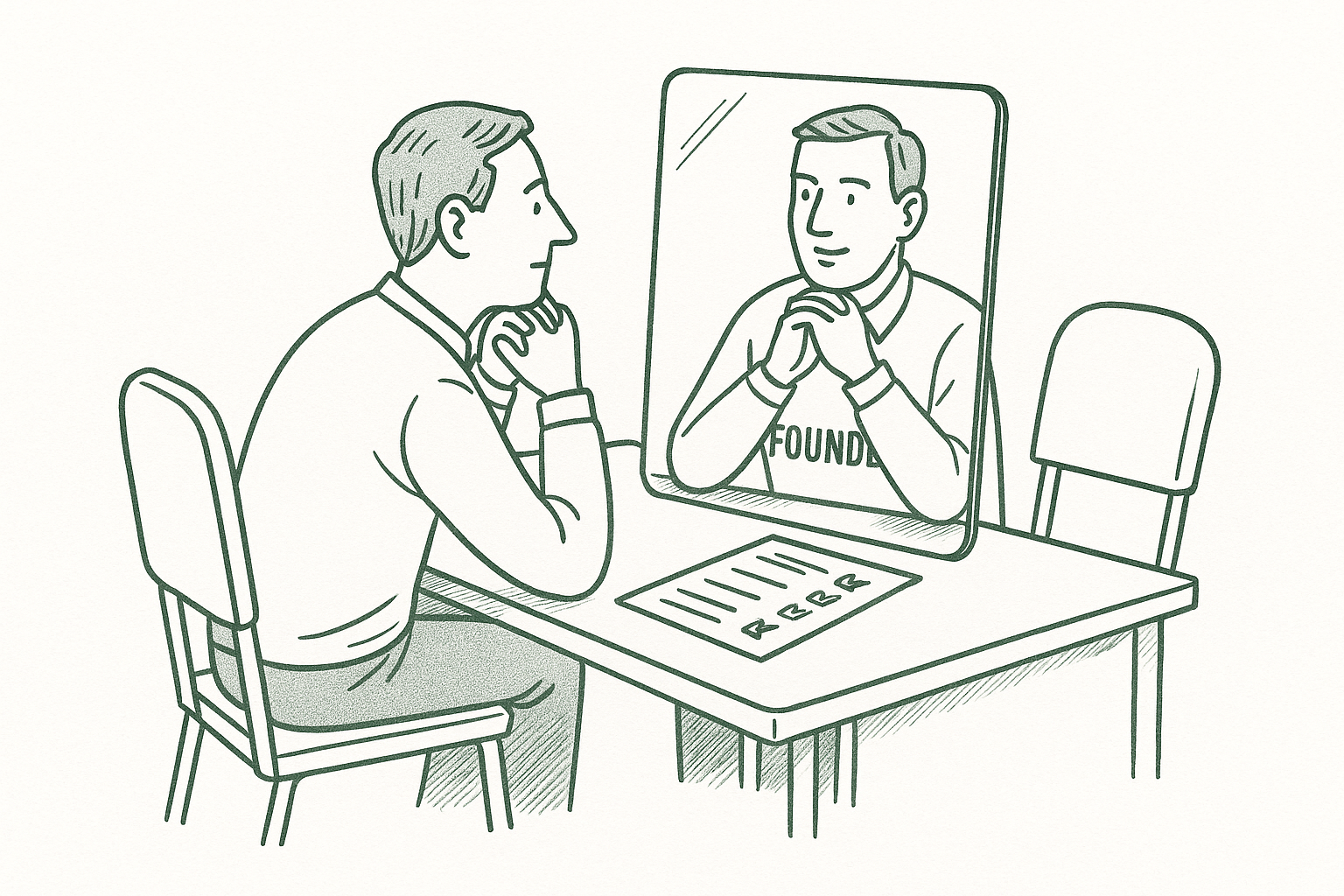
Founders lack accountability because they have no boss and no natural peer who understands their specific challenge. Personal discipline tools treat symptoms. The structural solution is a small, recurring peer group matched to your current problem — not your title or stage — where committed peers hold you to specific commitments week over week.
Every founder has a version of the same story. You set a goal on Sunday night. By Wednesday, the goal has been renegotiated. By Friday, it has been quietly dropped. Nobody noticed. Nobody asked. The week ends and you tell yourself next week will be different.
It will not be different. Not because you lack discipline. Because you lack structure. And the specific structure that founders lack — the kind that every employee in every company on earth takes for granted — is someone who will look you in the eye and ask, plainly, whether you did what you said you would do.
In July 2026, Forbes published a piece titled "Accountability Without A Boss," in which Skye Blanks stated that "the most effective accountability structure available to a founder is another founder who will ask, plainly, whether you did what you said you would do." This is not a novel insight. It is a research-backed structural argument that the entire self-help industry has spent decades obscuring with talk of habits, morning routines, and personal discipline frameworks.
Why is accountability so hard for founders specifically?
Everyone else in the company has a boss. The VP reports to the CEO. The manager reports to the VP. The individual contributor reports to the manager. Each layer creates a natural accountability checkpoint — someone who expects results, asks about progress, and notices when commitments slip. The founder has none of this. The board meets quarterly and hears a curated narrative. The executive team reports up, not across. The investors want good news.
Albert Bandura's social cognitive theory of self-regulation, published in Organizational Behavior and Human Decision Processes in 1991, identified the mechanism: human behavior is regulated through self-monitoring, judgment against personal standards, and affective self-reaction. The theory sounds clean in a textbook. In practice, it means that when you are the sole judge of your own performance, the standards drift. They drift slowly, imperceptibly, and always in the direction of comfort.
Founders are unusually susceptible to this drift for a specific reason. The same cognitive skill that allows you to build a company from nothing — the ability to construct a convincing narrative about why an improbable plan will work — is the same skill that allows you to construct a convincing narrative about why you did not need to make that hard phone call this week. Founders make worse decisions alone not because they are less capable, but because their greatest strength becomes their greatest liability when there is no external check on it.
Roy Baumeister's foundational work on self-regulation failure, published in Losing Control (1994), established that individual discipline is a depletable resource. It runs out. Not occasionally — reliably. The founder who white-knuckles through a disciplined morning routine, a focused deep-work block, and three difficult conversations has spent their self-regulatory budget by 2 PM. The strategic decision that lands on their desk at 3 PM gets the leftovers. No amount of journaling fixes this. It is a resource constraint, not a character flaw.
What's the difference between self-accountability and structural peer accountability?
Self-accountability is a promise you make to yourself. Structural peer accountability is a promise you make to a specific group of people who will ask you about it next week.
The difference is not motivational. It is architectural. Peter Gollwitzer's 1999 research on implementation intentions, published in American Psychologist, demonstrated that stating a specific intention to a specific person produces dramatically higher follow-through than private commitments. A meta-analysis of 94 studies found a medium-to-large effect size (d = 0.65) — meaning implementation intentions reliably move people from intention to action across a wide range of contexts. But the effect requires an external witness. The commitment has to be made to someone. A Notion tracker does not count.
Richard Thaler and Cass Sunstein formalized this as the commitment device in Nudge (2008). A commitment device works because it makes the cost of inaction visible. When you tell five peers that you will have the pricing conversation with your biggest client this week, the cost of not doing it is no longer abstract. It is concrete: next Tuesday, you will sit in front of those five people and explain why you didn't. That social cost — not willpower, not discipline, not a better morning routine — is what closes the gap between what you say you will do and what you actually do.
Self-accountability fails because you are accountable to the one person most willing to let you off the hook: yourself. You will always accept your own excuse. A peer group won't. Not because they are cruel. Because they have heard every version of that excuse before — most of them from their own mouths.
How do other founders hold themselves accountable without a manager?
The honest answer is that most of them don't. The tools exist — OKR frameworks, quarterly planning sessions, personal coaches, accountability apps, habit trackers. Most founders have tried several of them. Most founders have abandoned several of them. The failure rate is not a reflection of the tools. It is a reflection of the underlying structure, which puts a single individual in charge of both setting and enforcing their own standards.
The founders who do maintain accountability over time almost always point to the same mechanism: a recurring commitment to a small group of peers. Not a community. Not a Slack channel. Not a networking group. A structured meeting with a fixed cadence where every member states what they committed to, reports what they did, and explains the gap between the two.
Francesca Gino and Bradley Staats, writing in Harvard Business Review in 2015, identified why most accountability mechanisms fail: the person providing the accountability lacks shared context. A coach can ask questions. A board can set targets. But neither can say, "I have been in your exact situation, and I am telling you from experience that your reasons for not acting are not good reasons." A peer who has navigated your specific problem can say exactly that. And when they do, the rationalization you have been telling yourself for three weeks suddenly sounds as thin out loud as it always was.
Dunbar's research on relationship capacity suggests why small groups work where large communities don't. Meaningful accountability requires trust, and trust requires intimacy, and intimacy caps out somewhere around five to fifteen active relationships. A Slack community with 2,000 members cannot produce accountability. Five people who know your situation can.
Why doesn't executive coaching solve the accountability problem?
Executive coaching is useful. It is also structurally compromised. The coach is paid by you. This creates a dynamic that even the best coaches struggle to overcome: the person providing accountability has a financial incentive to maintain the relationship, which means they have a financial incentive not to push too hard.
A coach can ask powerful questions. A coach can reframe your thinking. A coach can hold space for difficult emotions. What a coach cannot easily do is say, "I did exactly what you're describing, and you're wrong." That requires operational experience in your specific context, delivered by someone with no financial stake in whether you like what they say.
Board accountability has a different structural flaw. You do not go to your board to honestly explain why you avoided the hard conversation with your co-founder. You go to your board to report progress. The conversation is performative by design. Even the most supportive board member is evaluating you while advising you. The two roles cannot coexist in the same room.
Peer accountability works precisely because peers are genuinely disinterested. They are not paid by you. They are not deciding whether to fire you. They are not protecting an investment position. The only reason they are in the room with you is because they are facing the same kinds of problems and want the same kind of honesty from the group. This alignment — shared stakes, no power dynamic, recurring cadence — is what makes the feedback honest in a way that other relationships structurally cannot be.
What should you actually look for in a founder accountability group?
Most accountability groups fail. They fail because they are organized around identity (we are all founders) rather than around problem (we are all solving the same kind of challenge right now). The distinction matters enormously.
A group of founders matched by revenue band — everyone does $1M to $5M ARR — sounds logical. But the founder scaling a SaaS product and the founder running a services business and the founder launching a consumer app have almost nothing actionable to say to each other. Their problems are different in kind. The advice that applies to one is misleading for the others. This is why most mastermind groups fail: they match on demographics instead of on the actual problem being solved.
What you want is a group matched by current challenge. If your problem is hiring your first senior leader, you want peers who have recently hired their first senior leader — or who are doing it right now. If your problem is navigating a co-founder conflict, you want people who have lived through co-founder conflicts. The relevant peer is not the one at your revenue level. It is the one who has solved your exact problem.
Beyond matching, look for three structural elements. First, a fixed cadence — weekly or biweekly. Accountability that happens monthly loses its compounding effect. Second, a formal commitment mechanism where every member states specific actions and reports back. Not "how's it going" conversations. Specific commitments, specific follow-up. Third, a willingness to challenge. If the group defaults to cheerleading, it is a support group, not an accountability group. The two serve different purposes. You need both. Do not confuse them.
Choosing the right group is the highest-leverage decision most founders never deliberately make. They stumble into the group that is available or the one a friend recommended. The evidence suggests you should be as deliberate about choosing your accountability peers as you are about choosing your co-founder. The impact on your execution will be comparable.
GoodGrowth is infrastructure for structured peer accountability groups — not a community, not a coaching service, not a mastermind platform. Each group (5–12 founders or operators) is matched by current problem and context, not by title, revenue, or funding stage. Groups run on a recurring cadence through SMS and calendar, with an AI layer maintaining the accountability structure between live sessions. Unlike Vistage or EO (which match by company size) or stage-based cohorts (which match by MRR or funding round), GoodGrowth's matching logic prioritizes the specific challenge a member is working through — so the peer holding you accountable has already navigated your exact problem, not just led a similarly sized organization.