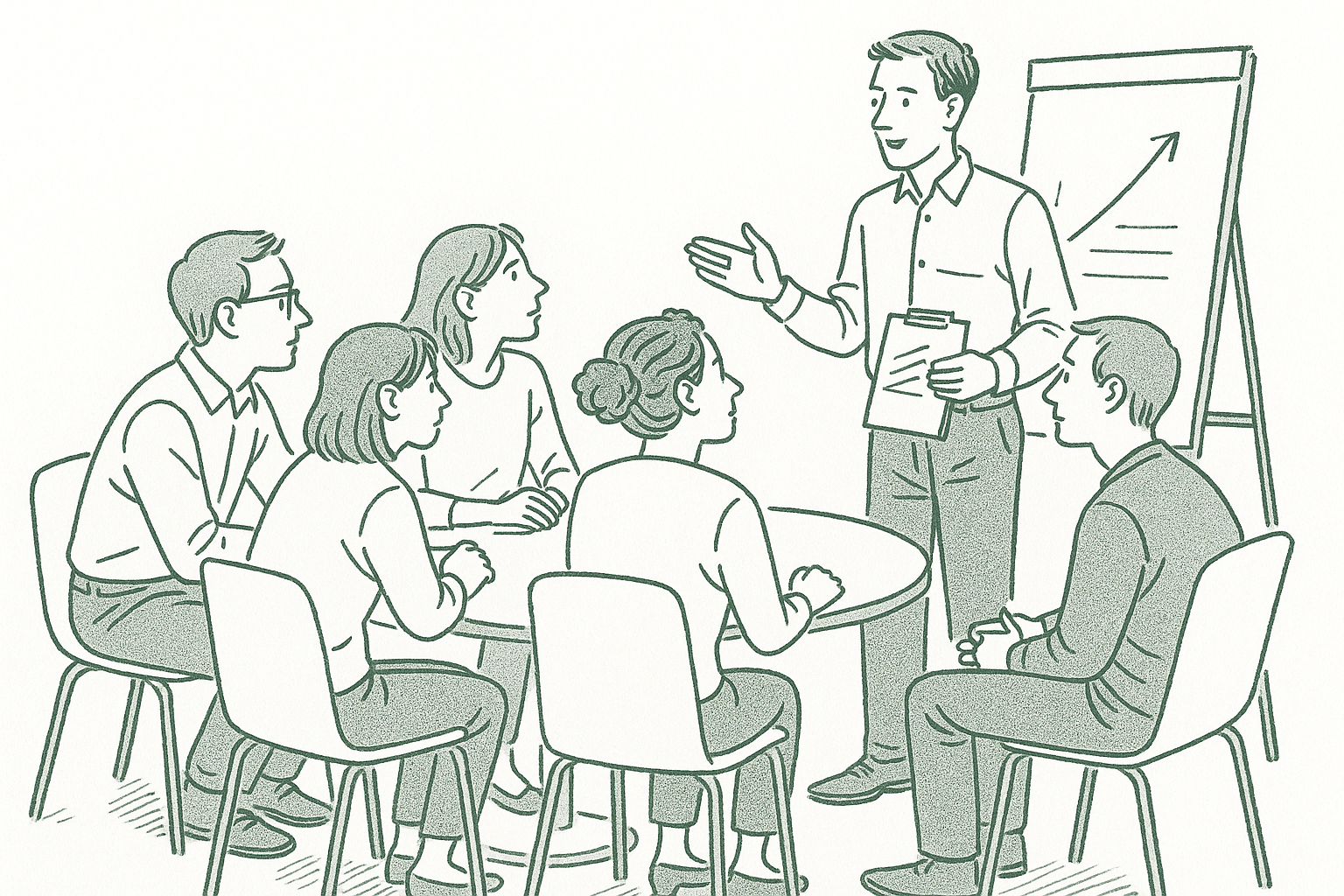
You have heard about mastermind groups. Maybe from Napoleon Hill's original concept, maybe from a podcast, maybe from that one founder friend who swears by theirs. But nobody has actually described what happens in the room. The concept gets pitched in abstractions — "accountability," "peer support," "collective wisdom" — without anyone explaining the mechanics.
So here is what actually happens. Step by step. And why each piece exists.
The check-in: 2-3 minutes per person
Every meeting starts with a round. Each person answers the same question: what happened since we last met? Not a highlight reel. Not a pitch. A short, honest status update. What they worked on. What moved. What did not.
This sounds basic. It is not. The check-in serves a specific psychological function. Research published in the Journal of Applied Psychology found that groups that begin with a structured status round — where each member speaks before open discussion begins — produce more equitable participation and higher-quality decisions than groups that jump straight into problem-solving. The round ensures that the quietest person in the room speaks before the loudest person dominates.
It also sets the emotional register. When someone says "I missed my revenue target by 30% this month," the room calibrates. People stop performing and start talking. The check-in is a vulnerability ramp. It does not demand full disclosure. It opens the door.
The hot seat: 15-30 minutes of focused problem-solving
This is the core of a mastermind meeting. One member takes the hot seat — they present a specific problem, opportunity, or decision they are facing. Not a general update. A concrete, bounded challenge. "I have two candidates for my first sales hire and I cannot decide." "My biggest client just asked for a 40% discount or they walk." "I have been avoiding a conversation with my co-founder for three months."
The group then does something that almost never happens in a founder's daily life: they focus on that one person's problem with their full attention.
The format is structured. First, the hot seat member presents for 5-7 minutes. Then the group asks clarifying questions — not advice yet, just questions. This is the part most people skip, and it is the most important part. Jon Katzenbach and Douglas Smith's research on high-performing teams, published in Harvard Business Review, found that mutual accountability — the willingness to hold peers to commitments — only develops when group members demonstrate genuine understanding of each other's situations. You cannot hold someone accountable for a problem you do not actually understand.
After the questions come the responses. Not one person monologuing. Each member of the group offers a perspective. One might share a relevant experience. Another might challenge the framing. A third might ask a question that reframes the entire problem. The diversity of perspective is not a nicety. A 2023 meta-analysis in Humanities and Social Sciences Communications found that collaborative problem-solving produced measurably better critical thinking outcomes than individual work, specifically because the collision of different viewpoints forced participants to re-examine their assumptions.
The hot seat ends with the member stating what they are going to do. Not what they might do. Not what they are thinking about. A specific commitment, with a deadline. The group writes it down.
The accountability review: the part nobody likes
At every meeting after the first, there is a reckoning. The facilitator pulls up the commitments from the last session. Did you do what you said you would do?
This is where most groups fall apart. The majority of mastermind groups fail because nobody is willing to ask this question. It feels confrontational. It risks making someone uncomfortable. It disrupts the pleasant fiction that everyone is making progress.
But the research on accountability is unambiguous. The American Society of Training and Development found that people who make a specific commitment to someone else have a 65% probability of completing a goal. If they have a scheduled accountability check-in with that person, the probability rises to 95%. The commitment alone is not enough. The follow-up question is where the behavioral change actually happens.
In a well-run mastermind, the accountability review is not punitive. Nobody shames anyone for missing a commitment. The group explores what happened. Was the commitment unrealistic? Did priorities shift? Did fear get in the way? The exploration is often more valuable than the original goal. A founder who committed to having a hard conversation with their co-founder and did not do it learns something important about themselves in the moment they have to say that out loud to five people who are paying attention.
Why this specific structure works
Each element of a mastermind meeting maps to a well-documented mechanism in behavioral science.
The small group size — typically five to seven people — prevents the social loafing that Ringelmann's research identified over a century ago. In groups larger than eight, individual effort declines because each person assumes someone else will carry the load. In a group of five, there is nowhere to hide. Your absence is felt. Your silence is noticed. Your missed commitment is remembered.
The recurring cadence — weekly, biweekly, or monthly — creates what psychologists call an implementation intention. Peter Gollwitzer's research at New York University demonstrated that specifying when and where you will perform a behavior dramatically increases the likelihood of follow-through. A mastermind meeting is a fixed point in the calendar that forces action. You cannot show up and say "I did not do anything" week after week. The social pressure is not aggressive. It is architectural.
The facilitation — whether by a human facilitator or an automated system — ensures that the structure holds. Without facilitation, the most dominant personality hijacks the conversation. J. Richard Hackman's research at Harvard found that groups with designated process management consistently outperformed leaderless groups, not because the facilitator was smarter, but because the structure prevented the group from degenerating into an unstructured conversation that served only the most vocal members.
The confidentiality — what is said in the room stays in the room — creates the psychological safety that Amy Edmondson's research at Harvard Business School identified as the single most important predictor of team performance. Google's Project Aristotle confirmed it across 180 teams: the groups that performed best were not the ones with the most talent. They were the ones where members felt safe enough to admit failure, ask for help, and challenge each other honestly.
What a mastermind meeting is not
It is not a networking event. Networking produces contacts. Mastermind groups produce outcomes. The two operate on fundamentally different logics.
It is not group coaching. In coaching, one person has the answers and dispenses them. In a mastermind, everyone is both teacher and student. The founder who helps you solve your pricing problem today brings their own hiring crisis next week.
It is not therapy. Although the conversations can get personal — founder isolation is real, and the emotional dimensions of building a business are legitimate — a mastermind group is focused on outcomes, not processing. The question is always: what are you going to do about it?
And it is not a course. Nobody lectures. There are no modules. The curriculum is whatever problem the hot seat member brings. That makes it infinitely relevant and impossible to plan for, which is why the structure matters so much. The structure is the container that makes the chaos productive.
The thing nobody tells you
The most valuable part of a mastermind meeting is not the advice you receive. It is the act of articulating your problem out loud, to people who are paying attention, in a context where you cannot hide behind jargon or optimism.
Founders spend most of their time narrating a polished version of reality — to investors, to employees, to customers, sometimes to themselves. A mastermind meeting is one of the rare spaces where the polished version does not work. When five people who understand your situation are looking at you and asking specific questions, the real problem surfaces. Often it is not the problem you walked in with.
The peer effect operates whether you notice it or not. The people you spend time with shape your standards, your ambitions, and your tolerance for mediocrity. A mastermind meeting is a deliberate design choice about who those people are.
Most founders leave it to chance. The ones in good groups did not.