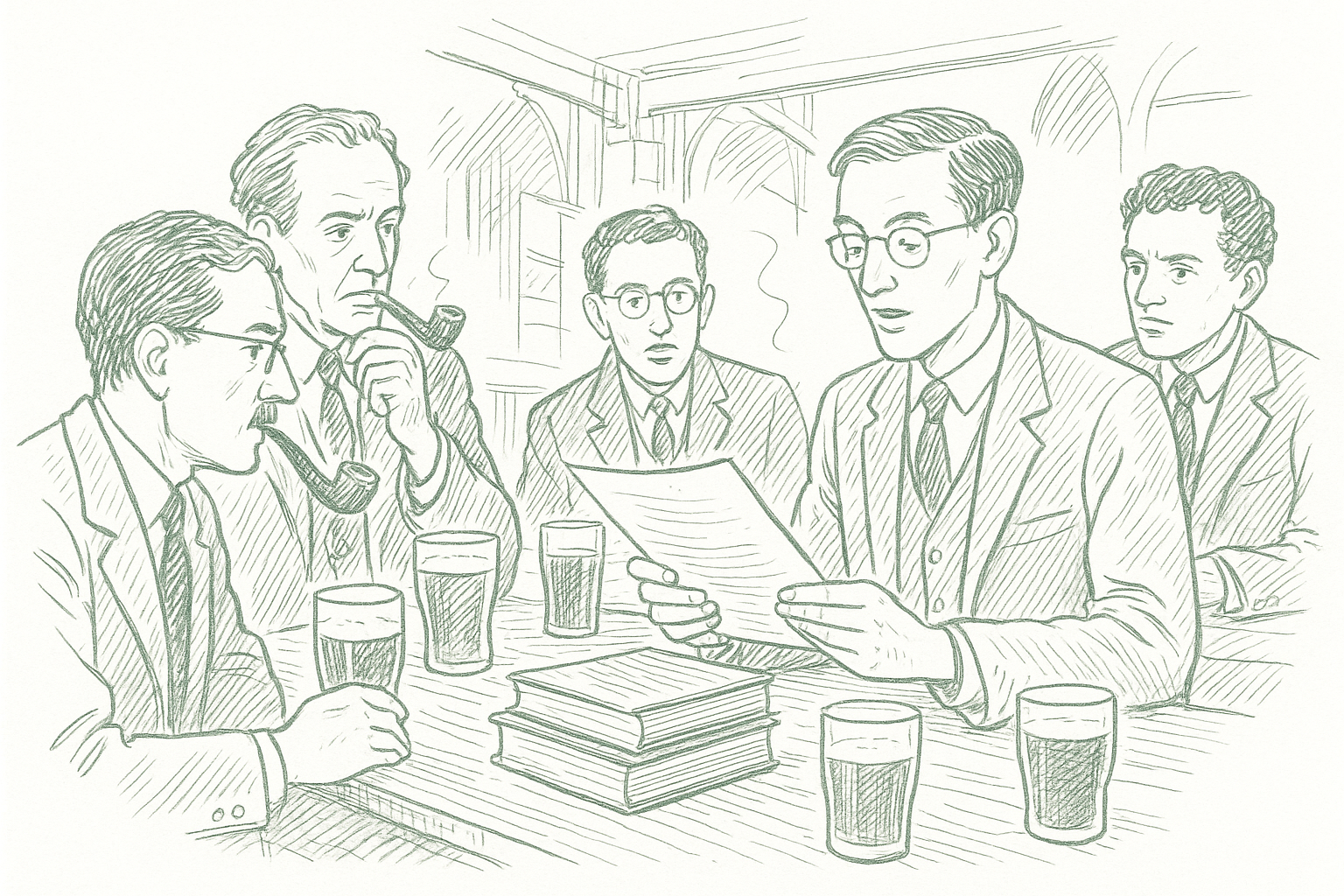
On Thursday evenings in the 1930s and 1940s, a small group of men gathered in C.S. Lewis's rooms at Magdalen College, Oxford. Someone would pull out a manuscript. The room would settle. And for the next several hours, the group would listen, interrupt, argue, encourage, and critique.
On Tuesday mornings, the same people reconvened at The Eagle and Child pub on St Giles' Street — a place they called "The Bird and Baby" — where the publican, Charlie Blagrove, let them use his private parlor. The conversations were looser there, more social. But the habit was the same: show up, talk about the work, come back next week.
They called themselves the Inklings. Over the course of nearly two decades, this informal literary group — never more than about a dozen core members at any given time — produced some of the most enduring works of imagination in the English language. J.R.R. Tolkien read aloud the chapters of The Lord of the Rings as he wrote them. C.S. Lewis tested The Screwtape Letters, The Great Divorce, and the Space Trilogy in those rooms. Charles Williams workshopped All Hallows' Eve. Warren Lewis read drafts of his histories of Louis XIV's court.
The books that came out of that room have sold over 700 million copies. The film adaptations alone have grossed more than $3 billion. The fantasy genre as we know it — the one that gave us everything from Game of Thrones to Dungeons & Dragons — traces its lineage directly to what happened at those Thursday evenings.
None of it was designed. It was a peer group that happened to get the fundamentals right.
How the Room Came Together
The name "Inklings" originally belonged to an undergraduate literary society at University College, founded around 1931 by a student named Edward Tangye Lean. The group's purpose was simple: members read aloud their unfinished compositions and received feedback from their peers. Lean had invited both students and dons, and among the dons were two young Oxford professors — Tolkien and Lewis — who found they had more in common with each other than with most of the undergraduates.
When Lean left Oxford in 1933, the student society dissolved. But Tolkien and Lewis kept the name and the format, rebuilding the Inklings as their own circle around Lewis's rooms at Magdalen College. The group was invitation-only and entirely informal. There were no dues, no agenda, no officers. You came because you were asked, and you kept coming because the conversation was worth the trip.
The core membership shifted over the years but typically included Lewis, Tolkien, Lewis's brother Warren (known as Warnie), Owen Barfield (a philosopher and solicitor who had been Lewis's closest intellectual sparring partner since their undergraduate days), Dr. Robert "Humphrey" Havard (the group's physician, sometimes called "the Useless Quack" with characteristic Oxford affection), and Hugo Dyson, a Shakespeare scholar and English lecturer. Charles Williams, a London-based editor and novelist at Oxford University Press, joined the circle in 1939 when the Press relocated to Oxford during the war, and quickly became a central figure until his sudden death in 1945.
Other members rotated through: Nevill Coghill, Adam Fox, Lord David Cecil, Christopher Tolkien. The group was exclusively male — a limitation of its era and its institutional setting. But within its boundaries, the membership represented a genuinely diverse range of disciplines: philology, philosophy, history, medicine, theology, literature, publishing.
The Format That Made It Work
The Thursday evening sessions followed a pattern. Someone arrived with a manuscript — a chapter, a poem, an essay, sometimes just an idea. They read it aloud. The rest of the group listened, then responded with what Tolkien described as "vigorous criticism." Lewis's rooms had deep chairs and a coal fire. Tea was available. Beer was available. Pipes were lit. The atmosphere was collegial, not clinical.
But the criticism was real.
When Tolkien read chapters from The Lord of the Rings, the response was not uniformly positive. Lewis was consistently enthusiastic — he later described the work as containing "beauties which pierce like swords or burn like cold iron." But Hugo Dyson was famously hostile. Christopher Tolkien recorded Dyson "lying on the couch, and lolling and shouting and saying, 'Oh God, no more Elves.'" Other accounts suggest the language was considerably earthier.
Dyson's complaints were loud enough and frequent enough that Tolkien eventually stopped reading The Lord of the Rings to the full group. Some scholars argue that Dyson's hostility was one of the factors that contributed to the Inklings' eventual decline as a reading group. But it also illustrates something important about what was happening in that room: the feedback was honest. The group maintained a standard of candor that most professional relationships never achieve. You could bring your best work and hear that it was your best work. You could also bring your best work and hear "Oh God, no more Elves."
That honesty ran in both directions. When Lewis read early chapters of what would become The Chronicles of Narnia, Tolkien objected strongly. He found the allegorical approach too blunt, the mythological mixing too careless — a faun and Father Christmas in the same story struck Tolkien as a violation of the internal coherence he prized above all else in fantasy writing. Tolkien told Lewis so directly. Lewis kept writing anyway. The series has sold over 100 million copies.
The research on psychological safety in groups is often misunderstood as meaning that groups should be "nice." What it actually means is that groups should be safe enough for honest disagreement. The Inklings had that. They disagreed loudly, frequently, and without lasting damage to the relationships — because the relationships were strong enough to absorb it.
The Friendship That Built the Room
The anchor relationship of the Inklings was the friendship between Tolkien and Lewis. They met in 1926 at an English faculty meeting and found each other immediately. Both were interested in Norse mythology, medieval literature, and the then-unfashionable art of storytelling. Lewis later said that their friendship "marked the beginning of my real education."
The friendship deepened through a now-famous conversation. On September 19, 1931, Tolkien and Hugo Dyson joined Lewis for an after-dinner walk along Addison's Walk at Magdalen College. Lewis was at the time an atheist who loved mythology but couldn't accept the Christian story as anything more than another myth. Tolkien — a devout Catholic — argued that Christianity was the "true myth," the story that all other myths were pointing toward. The conversation lasted until 4am. Twelve days later, Lewis converted to Christianity. It was, by Lewis's own account, a transformation that changed his life and his work.
That night on Addison's Walk is the kind of thing that only happens inside a relationship with depth. Research on relationship depth suggests that the most consequential exchanges happen within our closest five relationships — not across our broad network. Tolkien didn't convert Lewis through a persuasive essay or a public lecture. He did it through a late-night walk with a friend he'd been talking to for five years. The trust was already there. The argument could land because the relationship could hold it.
The Tolkien-Lewis friendship also produced the most important creative deal in modern literary history. In the mid-1930s, Lewis and Tolkien made a mutual agreement: Lewis would write a space-travel story and Tolkien would write a time-travel story. Lewis produced Out of the Silent Planet. Tolkien started but never finished The Lost Road — but the ambition of the project pushed him deeper into the mythology that would eventually become The Lord of the Rings.
The history of peer groups is full of these pacts — creative wagers between equals that raise the stakes beyond what either person would set alone. The group doesn't just provide feedback. It creates obligation. When your peer is writing their novel, you'd better be writing yours.
Charles Williams and the Problem of Chemistry
The arrival of Charles Williams in 1939 tested the group's dynamics in ways that reveal something important about how small groups actually function.
Williams was a novelist, poet, and editor at Oxford University Press — a different kind of intellectual from the academic dons who made up the rest of the circle. His novels were strange, mystical, charged with supernatural symbolism. Lewis was immediately captivated. He read Williams's The Place of the Lion and became, by multiple accounts, "obsessed" with Williams as a thinker and a friend. Williams was invited to the Inklings, and Lewis considered him one of the most important presences in the group.
Tolkien had a different reaction. He liked Williams personally — they were good friends during Williams's time in Oxford. But Tolkien "reviled his literary style and taste," found Williams's writing "wholly alien," and privately believed that Williams's influence was "spoiling" Lewis's fiction. Tolkien thought That Hideous Strength, the final volume of Lewis's Space Trilogy, suffered directly from Williams's influence — too much mysticism, too little internal coherence.
When Williams died suddenly in 1945, the loss hit the group hard. Lewis said the Inklings "would never be the same." And they weren't — but partly for reasons Lewis didn't acknowledge. After Williams's death, the tension between what Lewis wanted the group to be and what Tolkien wanted the group to be became more apparent. The reading sessions became less frequent. The Tuesday pub meetings continued, but the creative core of the Thursday evenings gradually dissipated through the late 1940s.
The research on optimal group composition is clear that chemistry matters more than credentials. A group of five brilliant people who don't read each other well will underperform a group of five competent people who do. The Inklings had exceptional members but imperfect chemistry — and the friction between Tolkien's and Lewis's aesthetic sensibilities, amplified by Williams's presence, was a factor in the group's eventual decline as a creative workshop.
What the Room Actually Produced
The numbers are staggering.
Tolkien's novels have sold over 600 million copies worldwide. The Lord of the Rings alone accounts for nearly half a billion. Peter Jackson's film adaptations grossed close to $3 billion at the box office. Amazon's The Rings of Power series cost over $1 billion to produce. The broader Tolkien franchise — including video games, merchandise, and cultural licensing — represents one of the most valuable literary properties in history.
Lewis's Chronicles of Narnia has sold over 100 million copies. The film adaptation of The Lion, the Witch and the Wardrobe alone grossed over $745 million worldwide. Lewis's theological works — Mere Christianity, The Screwtape Letters, The Problem of Pain — have remained continuously in print for over 80 years and continue to sell millions of copies annually.
Beyond the direct economic output, the Inklings' influence on the fantasy genre is foundational. George R.R. Martin, Neil Gaiman, Ursula K. Le Guin, Terry Pratchett — the lineage of modern fantasy runs directly through what Tolkien and Lewis established. The global fantasy books market was valued at over $17 billion in 2024 and is projected to reach $26 billion by 2033. A substantial portion of that industry exists because of what was read aloud in C.S. Lewis's rooms on Thursday evenings.
None of this was inevitable. Tolkien was a perfectionist who nearly abandoned The Lord of the Rings multiple times during its seventeen-year gestation. Lewis was the one who kept pushing him to finish — who kept asking "What happened next?" when Tolkien read new chapters. Without that external pressure from a trusted peer, there is a reasonable case that the most influential fantasy novel ever written would never have been completed.
Why It Worked — and Why It Ended
The Inklings worked for the same reasons that every effective peer group in history has worked.
First, the members were genuine peers. Not mentors and mentees, not employers and employees — people at roughly the same professional stage wrestling with roughly the same creative challenges. The absence of hierarchy made the honesty possible. Networking events fail because the relationships are too thin for real candor. The Inklings succeeded because the relationships were deep enough to absorb Hugo Dyson shouting about Elves.
Second, the group was small and consistent. The core never exceeded about a dozen members, and the reading sessions typically involved five to eight. That's squarely within the range that research identifies as optimal for trust and accountability. Large enough for diverse perspectives, small enough for everyone to matter.
Third, the format demanded vulnerability. Reading your unfinished work aloud — in front of people smart enough to find every weakness — requires a particular kind of courage. But vulnerability is how trust compounds. Each time someone brings an imperfect manuscript and survives the criticism, the group's permission structure gets a little stronger. Eventually, the room becomes the safest place to be honest about what you're actually working on.
And then it ended. The Thursday readings declined through the late 1940s. The Tuesday pub meetings continued into the 1960s, but they had become purely social — no manuscripts, no readings, just conversation over beer. Multiple factors contributed: Williams's death in 1945, Tolkien's growing reluctance to read after Dyson's hostility, the cooling of the Lewis-Tolkien friendship (strained by Lewis's relationship with Joy Davidman and, later, by Lewis's move to Cambridge in 1954).
The difference between community and structure is that community can survive on social bonds alone, but structure requires deliberate maintenance. The Inklings had a natural structure — the Thursday readings, the Tuesday pub — but no mechanisms for resolving internal conflict, managing membership changes, or adapting when relationships shifted. When the key relationships strained, the structure had nothing to fall back on.
The Lesson for Everyone Who Works Alone
The Lord of the Rings took seventeen years to write. During that time, Tolkien had a full teaching load at Oxford, family obligations, and long stretches where the work stalled completely. What kept him going was Lewis. Not an editor waiting for a manuscript. Not a publisher's deadline. A friend who kept asking what happened next.
Lewis, in turn, produced his most enduring work during the period when the Inklings were most active. The Screwtape Letters, Mere Christianity, the Space Trilogy — all of them were first tested in that room, against the standards of people Lewis considered his intellectual equals. The quality of the feedback shaped the quality of the work.
The Inklings weren't a writers' workshop in the modern sense. They weren't a mastermind group with a formal agenda. They were something simpler and, in some ways, more powerful: a small group of people who showed up consistently, shared their work honestly, and held each other to a standard higher than any of them would have held alone.
The Fairchild Eight created Silicon Valley with a similar dynamic. The Algonquin Round Table built American literary culture the same way. The PayPal Mafia did it with a $500 billion technology portfolio. Different eras, different domains, same mechanism: a small room, a consistent roster, and the willingness to hear the truth about your work.
Tolkien once described the Inklings meetings as "a feast of reason and flow of soul." That's a generous description of a group that included a man yelling about Elves from a couch. But the underlying point holds. The feast only happens when you show up to the table. And the table only works when the people sitting at it are willing to tell you what they actually think.
GoodGrowth builds structured peer groups for founders, operators, and professionals who want the creative honesty of the Inklings without the seventeen-year revision cycle. Small groups. Consistent structure. Real feedback. Read the full history of peer groups, or see what happens when no one asks "did you do it?"