Most groups that want to change the world choose one of two strategies: seize power or wait for it. The Fabian Society invented a third. They called it permeation. The idea was simple: instead of overthrowing the existing system, infiltrate it. Write better research than anyone else. Train better experts. Put your people on committees. Make your ideas so obviously correct that politicians adopt them without realizing where they came from.
It worked. The Fabian Society never had more than a few thousand members. It never ran a candidate for office under its own name. And yet, by the middle of the twentieth century, Fabian ideas had produced the National Health Service, universal public education, the modern welfare state, and one of the world's most influential universities. Over 220 Fabian members sat in Parliament after Labour's 1945 landslide. Clement Attlee, the prime minister who built postwar Britain, was a Fabian. So was Tony Blair.
The story of the Fabian Society is not really about socialism. It is about what happens when a small group of smart people commit to meeting regularly, producing rigorous work, and holding each other accountable to a shared standard of intellectual honesty. It is one of the clearest examples in history of a peer group punching absurdly above its weight.
Eleven people in a drawing room
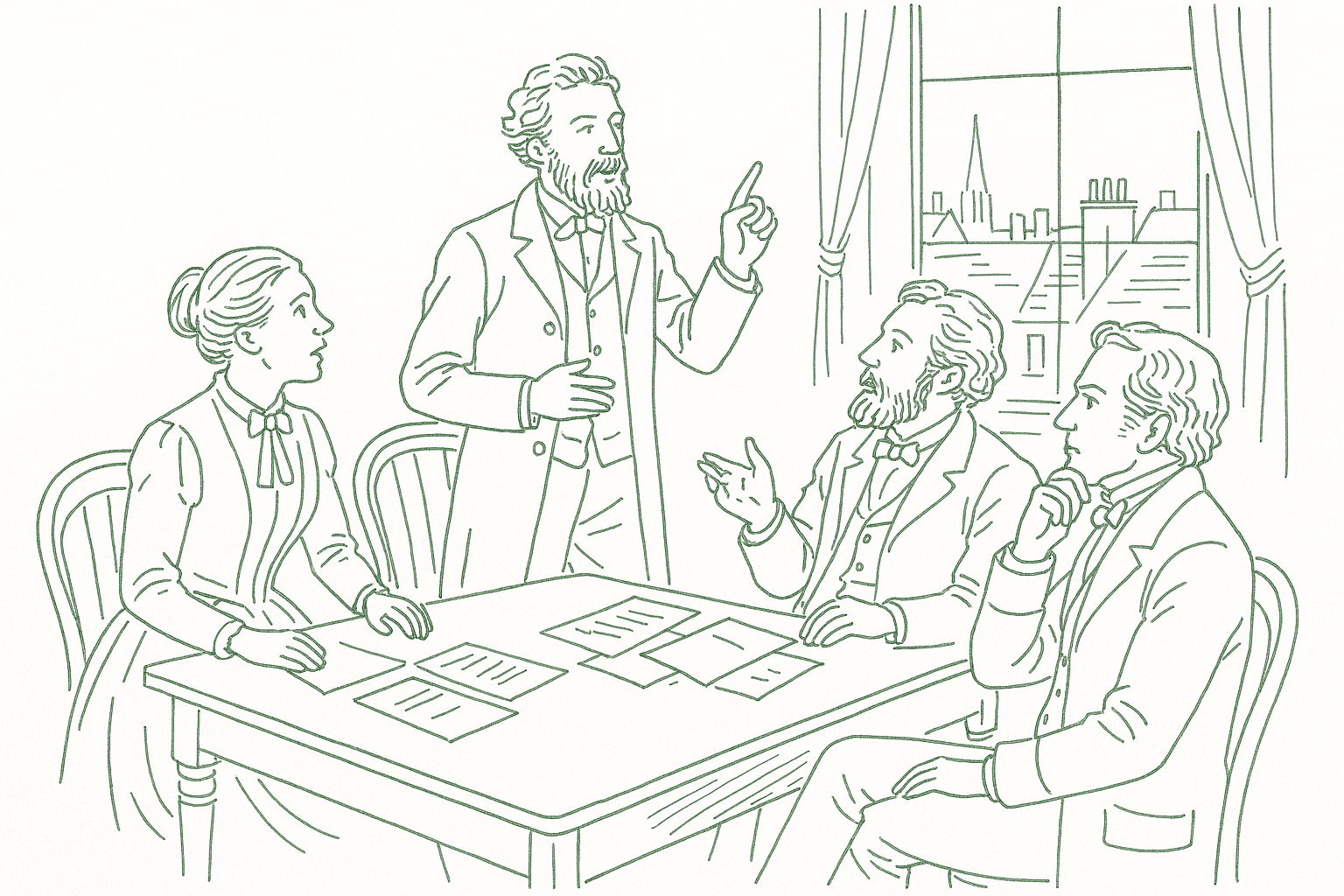
On January 4, 1884, eleven people gathered at 17 Osnaburgh Street in London, the home of Edward Pease, a stockbroker with socialist sympathies. They were members of a group called the Fellowship of the New Life, a loose collective interested in ethical reform. But a faction within the Fellowship was restless. They did not want to contemplate a better world. They wanted to build one.
That evening, the splinter faction voted to form a new society. Frank Podmore, a postal clerk and amateur historian, suggested the name: the Fabian Society, after Quintus Fabius Maximus, the Roman general who defeated Hannibal not by charging into battle but by waiting, preparing, and striking only when the moment was right. The name was a mission statement. Patience was the strategy. Rigor was the weapon.
The first meeting had no celebrity members, no large budget, and no obvious path to influence. The founders were middle-class professionals — civil servants, writers, a stockbroker, a postal worker. They were not aristocrats or factory owners. They were people who believed that intelligence, applied systematically and communicated clearly, could change the structure of a nation.
Within a year, the Society had attracted a member who would define its voice for the next four decades: George Bernard Shaw.
Shaw, the Webbs, and the intellectual engine
Shaw joined the Fabian Society in 1884, the same year it was founded. He was twenty-eight, broke, unpublished, and making his living delivering speeches at socialist meetings across London. What he brought to the Fabians was not money or connections. It was the ability to make complex ideas entertaining. Shaw could take a dry argument about land taxation and turn it into a performance that filled a lecture hall. In 1889, he delivered over 700 lectures on behalf of the Society.
But Shaw knew that charisma without substance was theater. The substance came from Sidney Webb, a civil servant who joined the Society in 1885 at Shaw's urging. Webb was the anti-Shaw: quiet, meticulous, almost pathologically well-informed. He did not give fiery speeches. He compiled facts. He drafted legislation. He memorized government reports and municipal budgets the way other people memorized poetry. Shaw once said that Webb's knowledge of facts was "extraordinary" and that he had "the most prodigious power of work I have ever known."
In 1892, Sidney married Beatrice Potter, a social researcher and diarist who was already one of Britain's most respected investigators of poverty and labor conditions. Together, the Webbs became the Fabian Society's intellectual engine. They co-authored books on trade unionism, local government, and industrial democracy. They conducted the kind of exhaustive, data-driven research that turned opinions into policy proposals and policy proposals into laws. Their partnership was a case study in the power of a small, tight-knit group — they sharpened each other's thinking, divided the labor, and produced work that neither could have created alone.
The core group also included Graham Wallas, a political scientist who would later be considered one of the founders of modern political psychology, and Sydney Olivier, a colonial administrator who became Governor of Jamaica. These five — Shaw, Sidney Webb, Beatrice Webb, Wallas, and Olivier — were the inner circle. They met constantly, debated fiercely, and held each other to a standard of rigor that made their output qualitatively different from the socialist pamphlets being produced by anyone else in Britain.
The strategy that nobody saw coming
The Fabians had a theory of change that was unusual for socialists. They did not believe in revolution. They did not believe in building a separate political party, at least not initially. They believed in what they called "permeation" — the idea that socialist principles could be introduced into British society gradually, by influencing the people already in power.
The mechanism was research. The Fabians produced hundreds of pamphlets — the "Fabian Tracts" — on subjects ranging from minimum wage laws to municipal gas supply to public education funding. Each tract was meticulously researched, clearly written, and designed to be useful to politicians and civil servants who might never call themselves socialists but who needed practical solutions to practical problems.
This was not propaganda in the usual sense. It was something more sophisticated: making your ideas the default option. If a Liberal MP needed data on housing conditions in East London, the Fabian tract was the best source available. If a city councillor wanted to understand the economics of municipalizing the water supply, the Fabians had already published the analysis. The strategy was to make Fabian research so thorough and Fabian experts so credible that the establishment would absorb their ideas by osmosis.
Webb articulated this in his essay "Historic" in Fabian Essays in Socialism, published in 1889. He argued that socialism was not a radical departure from existing trends but their logical conclusion — that public control of services had already been expanding for decades through municipal governance, and that the Fabians were simply accelerating a process already underway. The book, edited by Shaw, sold over 27,000 copies in its first two years. It became, as Britannica notes, one of the "classics of British socialism."
Building institutions, not just arguments
The Fabians understood something that most intellectual movements miss: ideas without institutions are just opinions. So they built institutions.
On August 4, 1894, at a breakfast party, the Webbs, Shaw, and Wallas decided to create a new kind of university. Not a traditional Oxford or Cambridge, with its classical curriculum and aristocratic culture, but a research institution focused on the social sciences — economics, politics, public administration. A place that would train the people who would actually run the modern state.
The funding came from a £20,000 bequest left by Henry Hunt Hutchinson, a Fabian member who had died earlier that year. In 1895, the London School of Economics and Political Science opened its doors. Today, the LSE is one of the top universities in the world. It has educated eighteen Nobel laureates, fifty-five current or former heads of state, and countless economists, political leaders, and journalists. When the Fabians could not find an institution that taught what they believed the world needed to learn, they built one from scratch.
They also founded The New Statesman in 1913, a political magazine that became one of Britain's most influential journals of opinion. And in 1900, the Fabian Society was one of the founding organizations of the Labour Representation Committee, which became the Labour Party. Sidney Webb largely authored Labour's 1918 constitution, including the original Clause IV — the party's commitment to common ownership — and its foundational program, "Labour and the New Social Order."
A dinner club that started with eleven people had, within thirty-six years, created a major political party, a world-class university, and a publishing empire. Not by commanding an army or controlling capital, but by meeting regularly, producing rigorous work, and placing their members in positions where the work mattered.
The dinner table as policy lab
The Fabians were not just writers and researchers. They were conveners. Between 1902 and 1909, the Webbs organized a monthly dining club called the Coefficients Club, which brought together political thinkers from all parties — Liberals, Conservatives, and socialists — to debate policy over dinner. The membership included H.G. Wells, the geographer Halford Mackinder, the journalist J.L. Garvin, and the future foreign secretary Edward Grey. It was a cross-partisan intellectual salon with no formal agenda and no minutes. Just dinner and argument.
The Fabian Society itself met fortnightly, with a speaker and open discussion. Local Fabian chapters spread across Britain, organizing their own lectures and debates. The model was recursive: a small group at the center produced the ideas, and a network of local groups disseminated them. By the early 1900s, the Fabians were delivering hundreds of lectures per year across the country. In 1889 alone, Fabian members gave over 700 public lectures.
H.G. Wells joined in 1903 and promptly tried to take over. He wanted to transform the Society into a mass movement — bigger membership, broader platform, louder voice. The old guard, led by Shaw and the Webbs, pushed back. They believed that influence came from depth, not breadth. A small group of experts producing serious work would always outperform a large group producing noise. Wells resigned in 1908, frustrated. The Society carried on, small and focused, and continued to shape British politics for another century.
The Wells episode is instructive. Every effective group faces the temptation to scale — to add more members, broaden the mission, chase reach over depth. The Fabians resisted that temptation, and the resistance was the reason they lasted. A group of 7,000 members, 140 years after its founding, still shapes the agenda of one of the world's major political parties. That is not the result of scale. It is the result of structure.
Outputs that outlasted everyone in the room
The concrete policy achievements of the Fabian Society read like a list of things people now take for granted. Fabian pamphlets first proposed a minimum wage in 1906. They proposed universal healthcare — what would eventually become the National Health Service — in 1911. They advocated for the abolition of hereditary peers in 1917. They pushed for free compulsory education, unemployment insurance, and old-age pensions.
When Labour won its 1945 landslide and Clement Attlee became prime minister, over 220 of the new MPs were Fabian Society members. The parliamentary Labour Party was described as "an enormous Fabian school." The reforms that followed — the NHS, the expansion of public housing, the nationalization of key industries, the modern welfare state — were not improvised. They had been drafted, debated, and refined in Fabian pamphlets and Fabian meetings for decades. The 1945 government did not invent its agenda. It implemented an agenda that a small group had been preparing since the 1880s.
The Fabians also exported their model. Their influence ran parallel to other small intellectual groups reshaping the twentieth century — the Frankfurt School applied a similar structure of regular meetings, interdisciplinary tension, and rigorous output to build critical theory from scratch. Jawaharlal Nehru, India's first prime minister, was influenced by Fabian principles and applied them to India's industrial and social policy. Lee Kuan Yew, Singapore's founding leader, described Fabian socialism as a major influence on his early political philosophy. The model of gradualist reform through expert-driven policy spread to Australia, Canada, New Zealand, and across the developing world. An intellectual dinner club in London had, inadvertently, produced a global template for how democracies could reform themselves without tearing themselves apart.
What the Fabians got right about groups
The Fabian Society worked for reasons that have nothing to do with politics and everything to do with group dynamics.
First, they had a shared framework but not a shared opinion. The Fabians agreed on a method — gradual reform through research and permeation — but disagreed constantly on specifics. Shaw wanted a separate political party; Webb wanted to influence the Liberals. Wells wanted mass membership; everyone else wanted to stay small. The disagreements were not dysfunctional. They were productive. The group was psychologically safe enough to argue honestly, and the arguments made the output better.
Second, they produced artifacts, not just conversations. Every Fabian meeting generated a pamphlet, a policy proposal, an essay, or a book. The conversations were not ends in themselves. They were raw material for work that would reach people outside the room. Accountability was built into the structure: if you argued for a position at dinner, you were expected to write the tract that proved it.
Third, they played a long game. The Society's namesake, Fabius, was famous for patience. The Fabians proposed the NHS in 1911. It was created in 1948. That is thirty-seven years of incremental persuasion — publishing evidence, training experts, placing members on committees, making the idea so well-documented that by the time politics caught up, the policy was ready to implement. Most groups dissolve when they do not see results in a year. The Fabians measured progress in decades.
Fourth, they were small at the core and networked at the edges. The inner circle was five people. The active membership was a few hundred. The affiliate network, through local societies and the Labour Party, was tens of thousands. The structure was concentric: a tight core produced the ideas, a wider ring refined and debated them, and the broadest ring distributed them. This is not how most organizations think about structure, but it is how most effective groups actually work.
The room that rewrote the rules
On January 4, 1884, eleven people sat in a London drawing room and decided to change the world without raising their voices. No army. No revolution. No charismatic leader on a balcony. Just research, argument, and a willingness to show up every two weeks for the rest of their lives.
One hundred and forty years later, the Fabian Society still exists. It still publishes policy research. It still influences the Labour Party. It still claims roughly 7,000 members. It describes itself, accurately, as the oldest political think tank in Britain.
The lesson of the Fabians is not ideological. You do not have to agree with their politics to recognize what they demonstrated about the mechanics of influence. A small group, meeting regularly, producing rigorous work, holding each other accountable, and playing a long game can reshape the institutions that govern millions of people. Not because the group has power. Because the group has structure. Because the group has standards. Because the people in the room make each other sharper than any of them would be alone.
Shaw, who was never short of a good line, reportedly said that the Fabian Society's purpose was "to make thinking persons socialistic and socialistic persons thoughtful." Replace "socialistic" with whatever problem your group is working on, and you have a mission statement for any peer group that takes itself seriously.
The world was not changed by the eleven people who showed up on January 4, 1884. It was changed by what those eleven people built: a structure for turning conversation into consequence. A room where arguments had to earn their place. A group small enough to be honest and rigorous enough to be dangerous.
That is the Fabian model. And it still works.