In 1762, Voltaire wrote that "today it is from Scotland that we get rules of taste in all the arts, from epic poetry to gardening." Benjamin Franklin, after visiting Edinburgh, called it a place where the university possessed "a set of truly great men, Professors of Several Branches of Knowledge, as have ever appeared in any age or country." These were not casual compliments. They were acknowledgments that one of the smallest, coldest, most politically marginal cities in Europe had, somehow, become the intellectual capital of the Western world.
Edinburgh in the 1750s was a city of roughly 50,000 people. The author James Buchan described it as "inconvenient, dirty, old-fashioned, alcoholic, quarrelsome and poor." Scotland had lost its parliament in the 1707 Act of Union. It had no court, no political power, and no reason, by any structural logic, to produce anything of consequence. And yet, between roughly 1740 and 1790, this walled-off city on the edge of nowhere produced David Hume, Adam Smith, Adam Ferguson, Joseph Black, James Hutton, James Watt, William Robertson, and dozens of others whose ideas still govern how we understand economics, philosophy, chemistry, and geology.
The question is not whether Edinburgh punched above its weight. It obviously did. The question is why. And the answer, more than the university or the culture or the Scottish character, was the clubs.
The Select Society: fifteen men and a debating rule
On November 12, 1754, the portrait painter Allan Ramsay walked into the Advocates' Library in Edinburgh with an idea. He brought it to two friends: David Hume, already the most controversial philosopher in Britain, and Adam Smith, a young moral philosopher who had not yet written a word about economics. Together, they founded the Select Society.
The initial membership was fifteen. It included Hume, Smith, Ramsay, the historian Adam Ferguson, the jurist Lord Kames, and the clergyman William Robertson — who would later become Principal of the University of Edinburgh and one of the most widely read historians in Europe. The purpose, according to Reverend Alexander Carlyle, was "philosophical inquiry and the improvement of the members in the art of publick speaking."
That second objective — public speaking — was not a footnote. Edinburgh's intellectuals were acutely aware that their Scottish accents and dialects made them sound provincial to London ears. The Select Society was partly an exercise in mutual improvement: sharpen each other's arguments, refine each other's delivery, and emerge as more persuasive communicators of ideas that deserved a wider audience.
The format was a structured debate. A question was proposed. Members argued sides. Rules governed the length and style of contributions. An account published in The Scots Magazine in March 1755 explained the intention: "by practice to improve themselves in reasoning and eloquence, and by the freedom of debate, to discover the most effectual methods of promoting the good of the country."
By the end of its first year, the Select Society had eighty-three members. It spawned a subsidiary — the Edinburgh Society for Encouraging Arts, Sciences, Manufactures, and Agriculture in Scotland — dedicated to applying the group's intellectual output to practical improvement. Being admitted to the Select Society gave you instant credibility. Having a title or money was not enough. You had to demonstrate that you could contribute to the conversation.
The society ran for about a decade. Historian Roger L. Emerson described its rules as "cumbersome," and by the late 1750s, attendance had slipped. Hume complained that he preferred "the plain roughness" of the Poker Club, a less formal group that several Select Society members had started on the side. But by then, the Select Society had done its work. The 300-year pattern of small groups producing outsized results played out in textbook fashion: a small group of ambitious, talented people, meeting regularly under a shared structure, sharpened each other into the most influential thinkers of their era.
The Oyster Club: a weekly supper that produced three revolutions
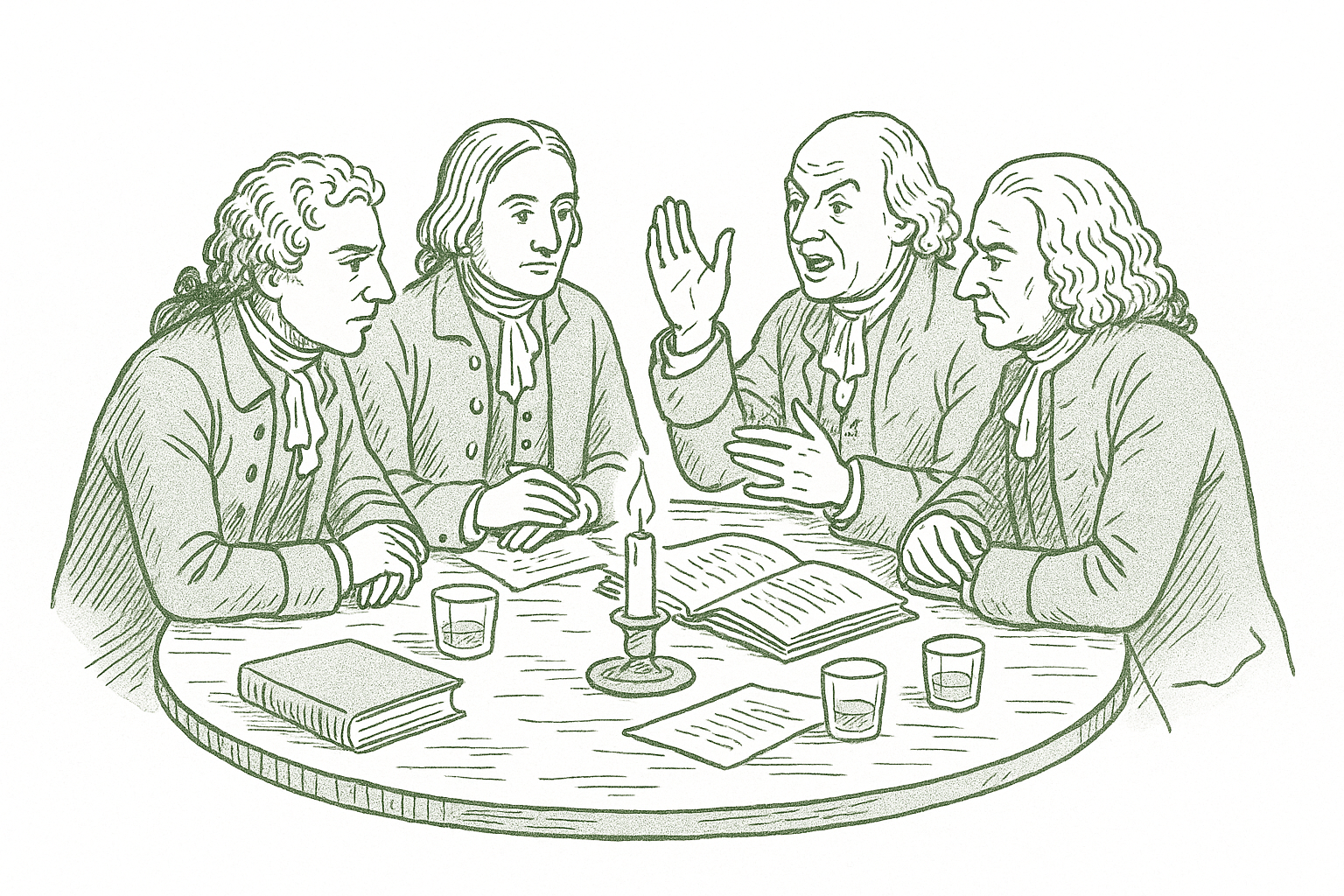
If the Select Society was Edinburgh's formal debating parliament, the Oyster Club was its kitchen table. Founded in the 1770s by Adam Smith, Joseph Black, and James Hutton, this eleven-member weekly supper club met in the Old Town taverns of Edinburgh — cheap oysters, good whisky, and arguments that rewrote how we understand the physical world.
Consider the three founders. Adam Smith had by then published The Wealth of Nations, the book that invented modern economics. Joseph Black had discovered latent heat and carbon dioxide, laying the groundwork for modern chemistry. James Hutton had formulated the theory of deep time — the idea that the Earth was not thousands but millions of years old — which became the foundation of modern geology. Three people. Three revolutions. Meeting for supper every week.
The mathematician John Playfair, a regular attendee, described the club's atmosphere with a single telling detail: the discussions were "informal and amusing, despite their great learning." This was not a lecture series. Nobody read papers aloud. They ate, they drank, and they talked about whatever was on their minds. The informality was the point. Formality creates hierarchy, and hierarchy suppresses the kind of honest exchange that actually changes minds.
Hutton's theory of deep time is a perfect example of how peer influence worked in these clubs. The idea was radical. It contradicted both the Church and the prevailing scientific consensus. Hutton first tested it not in a lecture hall or a published paper but in conversations at the Oyster Club, where Black and Smith — neither of them geologists — could pressure-test his reasoning without the institutional risk of a public claim. By the time Hutton presented his theory formally at the Royal Society of Edinburgh in 1785, it had already survived years of skeptical interrogation from people whose opinions he respected. The peer group did not invent the idea. It stress-tested it until it was bulletproof.
The Poker Club: where debate had consequences
The Poker Club, founded in 1762 by Adam Ferguson, was named not for cards but for the verb "to poke" — to stoke a fire, to agitate, to provoke action. Its stated purpose was to advocate for the establishment of a Scottish militia, but its real function was broader: a convivial club where Edinburgh's intellectuals could debate questions of politics and policy without the constraints of formal procedure.
Where the Select Society had cumbersome rules about speaking order and debate structure, the Poker Club operated on a simpler model: show up, eat, drink, argue. The membership eventually reached around 130, but the active core was much smaller. Hume, Smith, Ferguson, Black, Robertson, and the architect Robert Adam were regulars. The conversations ranged from military policy to trade economics to the nature of human motivation.
What made the Poker Club historically significant was not any single outcome but the density of cross-pollination. An economist sat next to a chemist who argued with a historian who debated a clergyman who challenged a painter. The disciplines bled into each other. Smith's economics was influenced by Hume's philosophy. Hutton's geology was refined by Black's chemistry. Ferguson's sociology drew on Smith's moral philosophy. The breakthrough ideas of the Scottish Enlightenment were not produced in isolation. They were produced in conversation, at tables where the person sitting next to you was brilliant but working in a different field entirely.
Dennis Rasmussen, author of The Infidel and the Professor, a study of the Hume-Smith friendship, noted that "there are few pages of Smith in which one does not sense the shadow, if not the influence, of Hume." That influence was not transmitted through published papers. It was transmitted through decades of dinners, walks, letters, and debates in clubs where both men were active members. The peer effect — the documented tendency of people to adopt the habits, standards, and ambitions of those around them — was operating at full force. These men did not just talk to each other. They made each other better.
Why Edinburgh and not London
London in the 1750s had a population of 675,000. It had the Royal Society, the British Museum, the Houses of Parliament, and every institutional advantage a city could possess. Edinburgh had 50,000 people, no parliament, and a two-week stagecoach ride to the capital. Why did the smaller city produce more?
Three structural factors explain it, and all three have implications for how groups work.
Density and proximity. Edinburgh was physically compact. The Old Town was a walled city where everyone of consequence lived within walking distance of everyone else. Hume and Smith lived on the same streets. The taverns where the clubs met were minutes from the university, which was minutes from the courts, which were minutes from the church. In London, the intellectual community was dispersed across a vast metropolis. In Edinburgh, you could not avoid your peers if you tried. This compression meant that ideas bounced between minds faster and more frequently than was possible in a larger, more diffused city.
Absence of hierarchy. London had a court, a government, and an established aristocratic pecking order that determined who mattered and who did not. Edinburgh, having lost its parliament, had no such hierarchy. The clubs filled the vacuum. Historian Nicholas Phillipson argued that Edinburgh's political marginality was, paradoxically, its greatest intellectual asset: without a power structure to defer to, the city's thinkers created their own, based on the quality of ideas rather than the accidents of birth. When networks are too large, influence gets diluted. Edinburgh's smallness meant that the people who mattered could actually influence each other.
Shared adversity. Scotland in the mid-1700s was a nation with something to prove. The Act of Union had created a deep anxiety about national relevance. The clubs were driven in part by a collective determination to show that Scotland was not a provincial backwater but a center of serious thought. This shared purpose — what researchers now call group cohesion — transformed casual gatherings into engines of productivity. Accountability works best when there is a shared stake in the outcome. Edinburgh's intellectuals were not just improving themselves. They were proving their country.
The output is staggering
A partial list of what Edinburgh's club members produced:
- Adam Smith — The Wealth of Nations (1776), the foundation of modern economics
- David Hume — A Treatise of Human Nature, An Enquiry Concerning Human Understanding — foundational texts of empiricism that influenced Kant, Darwin, and the entire trajectory of Western philosophy — including the Cambridge pragmatists who would build on Hume's empiricism a century later
- James Hutton — the theory of deep geological time, published in 1788, which upended biblical chronology and made modern geology possible
- Joseph Black — the discovery of latent heat and carbon dioxide, enabling the development of the steam engine
- Adam Ferguson — An Essay on the History of Civil Society (1767), considered a founding text of sociology
- William Robertson — The History of Scotland and The History of the Reign of Charles V, which made him the most widely read historian in 18th-century Europe
- James Watt — the separate condenser steam engine, developed with direct input from Joseph Black's research on latent heat — a case of peer-group knowledge transfer that literally powered the Industrial Revolution
- Allan Ramsay — portrait painter to King George III, whose intellectual ambitions drove him to found the Select Society in the first place
James Watt's story deserves special attention. Watt was an instrument maker at the University of Glasgow who was asked to repair a Newcomen steam engine in 1763. His breakthrough — the separate condenser — was directly informed by Joseph Black's discovery that steam contained far more thermal energy than boiling water. Black and Watt knew each other. They moved in the same circles. They discussed the problem. The best way to solve your problem is often to help someone else solve theirs, and in Edinburgh's interconnected club world, the boundaries between "your problem" and "my problem" barely existed.
What the clubs actually did
The Scottish Enlightenment clubs were not think tanks — though the Fabian Society would build that model a century later in London, turning dinner-table arguments into the Labour Party and the LSE. They were not conferences. They were not networking events. They were recurring, structured gatherings of a small number of people who shared a commitment to improving themselves and each other. That description — recurring, structured, small, committed — maps precisely onto what makes modern peer groups effective.
The clubs performed four specific functions that individual work could not replicate:
They provided an audience that mattered. Hume did not want to impress strangers. He wanted to convince Smith. Smith did not need applause from a crowd. He needed Ferguson to find a flaw in his argument. When the audience is small and its members are people whose judgment you respect, the quality of your preparation rises to meet the room. The Köhler effect — the tendency to work harder in small groups where effort is visible — was operating in every meeting.
They created cross-disciplinary collision. The Lunar Society did the same thing in Birmingham a few decades later: engineers sitting with chemists sitting with manufacturers. The Ratio Club would do it two centuries later with neurologists, mathematicians, and engineers arguing about machine intelligence in a London basement. Edinburgh's clubs anticipated this pattern. When an economist, a chemist, a geologist, and a historian argue over the same dinner table, the resulting ideas are categorically different from what any of them would produce in their own discipline. The breakthrough happens at the intersection.
They enforced regularity. The Oyster Club met weekly. The Select Society met weekly. The Poker Club met regularly. This was not optional. You showed up, or you were not part of the group. Regularity creates two things that irregular gatherings cannot: trust (built through repeated interaction) and momentum (built through continuous pressure to have something worth contributing). Groups fail when attendance becomes optional. Edinburgh's clubs succeeded because attendance was the price of membership.
They provided safety for dangerous ideas. Hume was, in his own time, a deeply controversial figure. His atheism made him unpublishable in some circles. Hutton's theory of deep time directly contradicted Genesis. These ideas needed a protected space — a room where they could be tested, challenged, and refined before being released to a hostile public. The clubs provided that space. Not because they were gentle. Because they were trustworthy. The members would argue fiercely but they would not betray the argument to outsiders. Psychological safety is not the absence of conflict. It is the presence of trust that conflict will stay inside the room.
A city of 50,000 that changed the world
The Scottish Enlightenment is sometimes treated as a historical curiosity — a lucky convergence of genius in an unlikely place. But luck does not explain a phenomenon that lasted fifty years and produced foundational contributions to half a dozen fields. Structure explains it. A compact city with no political hierarchy, a shared sense of purpose, and a network of recurring small groups that met in taverns and libraries and each other's homes — that is what produced the output.
Edinburgh did not have more geniuses per capita than London. It had better structure for making geniuses productive. The clubs were the structure. They turned individual brilliance into collective output. They created accountability without authority, feedback without hierarchy, and intellectual pressure without institutional risk.
Voltaire was not wrong to call it a hotbed of genius. But "hotbed" is the right word precisely because it implies cultivation. The genius was grown. In rooms. With other people. Over oysters and whisky and arguments that went on past midnight.
That is how the modern world got made.