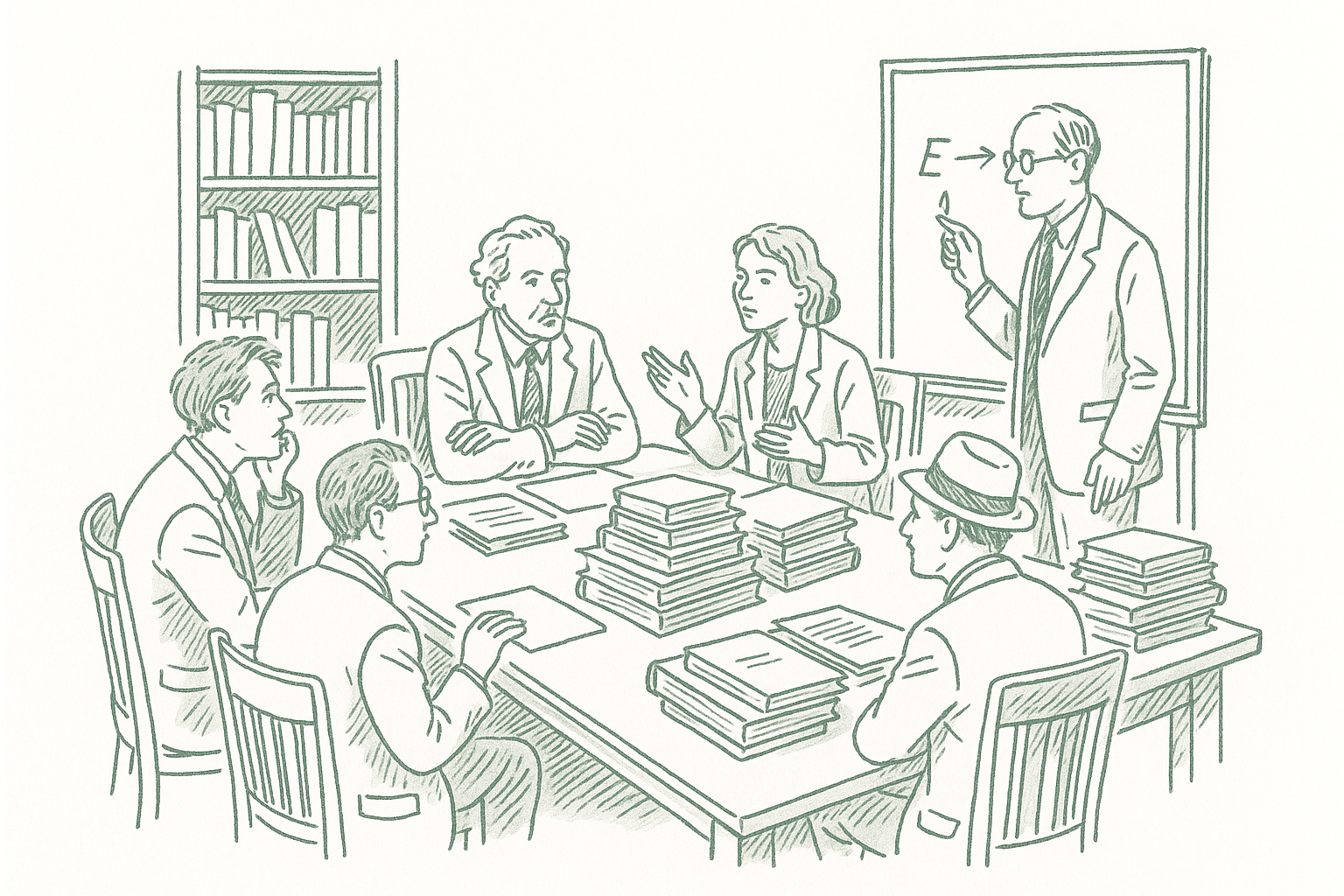
Most intellectual movements begin with a manifesto, a public argument, a declaration of principles. The Frankfurt School began with a week in the countryside.
In the spring of 1923, a young Argentine-German named Felix Weil organized what he called the First Marxist Work Week — an informal gathering at a hotel in Ilmenau, Thuringia. The attendees included Karl Korsch, Georg Lukács, Friedrich Pollock, and about a dozen other thinkers dissatisfied with how Marxist theory was being applied in the real world. No agenda. No institution. Just a group of people who agreed that the existing tools for understanding society were broken and who wanted to build better ones.
The week went well enough that Weil decided to make it permanent. His father, Hermann Weil, was a wealthy grain merchant. Felix used the family money to endow a new research center at the University of Frankfurt am Main. On February 3, 1923, the Institute for Social Research — the Institut für Sozialforschung — opened its doors. Carl Grünberg, an Austrian Marxist economist, became its first director.
It was, by every conventional measure, a small and unremarkable institution. A handful of scholars. A modest building. A journal nobody outside their circle read. Within three decades, the people who passed through that building would reshape philosophy, sociology, psychology, aesthetics, media theory, and political science. They would coin the term "critical theory." They would invent the concept of the "culture industry." They would produce landmark studies on authoritarianism that remain cited nearly a century later. And they would do most of this work not in Frankfurt, but in exile — scattered across New York, Los Angeles, and a handful of other cities, holding their circle together by sheer intellectual force.
The director who changed everything
The Institute's first seven years were conventional. Grünberg ran it as a traditional Marxist research center focused on labor history and economic analysis. It was respectable, productive, and forgettable.
That changed in 1930, when Max Horkheimer became director at the age of thirty-five. Horkheimer had a different vision. Where Grünberg saw the Institute as a place for Marxist economics, Horkheimer saw it as something unprecedented: a permanent, interdisciplinary research group that would combine philosophy, psychology, sociology, and cultural analysis into a single unified project. His 1931 inaugural lecture laid out a research program that no single discipline could have produced alone.
Horkheimer's first move was to recruit. He brought in Theodor Adorno, a philosopher and musicologist with an almost supernatural ability to connect aesthetic theory to social criticism. He brought in Erich Fromm, a psychoanalyst who was developing a Freudian approach to social character. He brought in Herbert Marcuse, a philosopher working on the relationship between Hegel, Marx, and Heidegger. He brought in Leo Löwenthal, a literary sociologist. He brought in Friedrich Pollock, an economist who had been with the Institute from the start. And he maintained an ongoing intellectual relationship with Walter Benjamin, the essayist and critic whose work on art, technology, and modernity would become some of the most influential writing of the twentieth century.
None of these people agreed with each other. That was the point. Horkheimer did not want a school of followers. He wanted a group of thinkers who could challenge each other across disciplinary boundaries — who could force a philosopher to confront psychological data, or make a sociologist reckon with aesthetic theory. The Institute's journal, the Zeitschrift für Sozialforschung, published from 1932 to 1941, was the material record of these collisions. Every issue contained essays from multiple disciplines, each one responding to, extending, or arguing with the others.
This is the detail that gets lost in the intellectual histories. The Frankfurt School was not a philosophy department. It was a small group of people who showed up regularly, challenged each other relentlessly, and produced work together that none of them could have produced alone.
Exile as accelerant
In January 1933, Adolf Hitler became Chancellor of Germany. By March, the Institute for Social Research was shut down by the government and its assets seized. Most of its members were both leftist and of Jewish descent. Staying was not an option.
Horkheimer had been careful. He had already moved much of the Institute's endowment to the Netherlands. The Institute briefly relocated to Geneva, then to Paris, and finally — in 1934 — to New York, where Columbia University offered it an affiliation. The Frankfurt School took up residence on Morningside Heights, occupying offices in a building at 429 West 117th Street. For the next fifteen years, a group of German-speaking social theorists would operate out of an American university that barely understood what they were doing.
The exile should have destroyed them. It did the opposite. Displacement compressed the group. In Frankfurt, members had their own apartments, their own social circles, their own separate rhythms. In New York, they had each other. The seminars — described by historian Rolf Wiggershaus as "virtually discussion groups for the Institute's associates" — became more intense, more frequent, more insular. The shared experience of losing their country, their language, their audience created a bond that pure intellectual interest could not have produced.
Adorno described the situation with a metaphor that captured both the isolation and the purpose: they were sending "messages in a bottle." Writing in German for an audience that did not yet exist. Publishing ideas whose recipients had not yet been born. The exile forced them to think long-term in a way that comfortable academics never do. When you have no audience, you stop writing for applause and start writing for truth.
Isolation changes how people think. But the Frankfurt School proved that isolation plus the right group changes how people think in a different direction entirely. They were isolated from the world but intensely connected to each other. That combination — external pressure, internal cohesion — produced an intellectual output that is almost difficult to believe given the size of the group.
The California years and the book that changed philosophy
In 1941, Horkheimer moved to Pacific Palisades, near Los Angeles. He built a bungalow in a neighborhood that had become an informal colony of exiled German intellectuals — Bertolt Brecht, Thomas Mann, Arnold Schoenberg, and others. Adorno followed. Marcuse and Pollock came too.
It was in Pacific Palisades, between 1942 and 1944, that Horkheimer and Adorno wrote Dialectic of Enlightenment. The book was composed through conversation. The two men would meet daily, discuss ideas for hours, and then Adorno would write — but the authorship was genuinely collaborative, with Horkheimer shaping the argument through sustained dialogue. Gretel Adorno, Theodor's wife, transcribed their discussions and typed the manuscripts.
Dialectic of Enlightenment argued that the Enlightenment project — the belief that reason, science, and progress would liberate humanity — had turned into its opposite. Reason, intended to free people from myth and superstition, had become a new kind of domination: instrumental rationality, in which everything, including human beings, was reduced to a means for achieving some other end. The book's most famous chapter, "The Culture Industry," argued that mass entertainment — movies, radio, popular music — was not an expression of popular taste but a system of control that standardized thought and suppressed genuine individuality.
The book was published in 1947 in a small edition. Almost nobody read it. It was written in dense, allusive German prose that resisted translation. Its arguments were so far outside the mainstream of American academic life that most scholars did not know what to do with it.
Today it is considered one of the most important works of twentieth-century philosophy.
The other program: studying authoritarianism empirically
While Horkheimer and Adorno were writing philosophy in California, Pollock was directing a parallel research program in New York focused on authoritarianism and prejudice. This program culminated in The Authoritarian Personality, published in 1950, which Adorno co-authored with a team of psychologists at UC Berkeley.
The study developed the "F-scale" — a questionnaire designed to identify personality types susceptible to authoritarian ideology. It measured traits like rigid conformity, deference to authority, hostility toward those perceived as different, and a preoccupation with power. The research team found that authoritarianism was not simply a political position but a deep psychological disposition rooted in early family dynamics and reinforced by cultural forces.
The Authoritarian Personality had an immediate and enormous impact on political sociology. It was criticized, debated, revised, and extended for decades. Its core insight — that political extremism has psychological roots that can be studied empirically — remains a foundation of political psychology today.
What makes this remarkable is that the same group, at the same time, was producing both abstract philosophical critique and large-scale empirical research. This was Horkheimer's original vision made real. A network of a few dozen people, working across disciplines, holding together through exile, war, and the collapse of their entire world — producing work that ranged from aesthetic theory to statistical psychology without losing coherence.
What the group lost (and what it tells us about groups)
Not everyone survived. Walter Benjamin, the most elusive and perhaps most brilliant member of the circle, refused to leave Europe. He spent the 1930s in Paris, living on a stipend from the Institute, working on what would become his masterwork: the Arcades Project, a massive, unfinished study of nineteenth-century Parisian modernity. In September 1940, attempting to flee France through Spain, he was stopped at the border town of Port-Bou. Believing he would be sent back to Nazi territory, he took his own life with a lethal dose of morphine. He was forty-eight.
Hannah Arendt crossed the same border a few months later, carrying Benjamin's last manuscript — his Theses on the Philosophy of History — which she delivered to Adorno. The work was published posthumously. Benjamin never saw a single line of it in print.
The loss of Benjamin illustrates something that every group eventually confronts: a small group's greatest vulnerability is that each member is irreplaceable. When someone leaves a group, the gap is not proportional to the number of people remaining. It is proportional to what that person uniquely contributed to the group's intellectual chemistry. Benjamin's combination of literary criticism, theological thinking, and Marxist materialism existed nowhere else. When he died, that particular intersection of ideas died with him.
The return and the second generation
In 1949, Horkheimer accepted an invitation to reopen the Institute for Social Research at the University of Frankfurt. He returned to Germany in 1950 and delivered the Institute's inaugural address on November 14, 1951. One week later, he was inaugurated as rector of the university. Adorno followed in 1953.
The Institute they returned to was not the Institute they had left. The lively intellectual community of the 1930s had been reduced to a small team of overextended academics. Horkheimer was consumed by administrative duties. Adorno was pulled between teaching, research, and periodic trips back to California. Marcuse, who had stayed in the United States and taken a position at Brandeis University, never returned. The physical dispersion of the group diluted the intensity that exile had paradoxically concentrated.
But the ideas survived. And they found a new carrier: Jürgen Habermas, who arrived at the Institute in the 1950s as a young research assistant. Habermas became the leading figure of the Frankfurt School's second generation, extending critical theory in directions — toward language, communication, and democratic theory — that Horkheimer and Adorno had not anticipated. He went on to become one of the most influential philosophers of the late twentieth century, and he credited the Institute's interdisciplinary model as the foundation of everything he built.
The Frankfurt School is now in its fourth generation of scholars. The Institute for Social Research still operates at Goethe University Frankfurt. The tradition of critical theory that Horkheimer outlined in 1931 — an interdisciplinary project combining philosophy, social science, and empirical research in the service of understanding how power works — remains one of the most active intellectual programs in the world.
The group dynamics that made it work
Strip away the philosophy. Strip away the politics. What remains is a structural story about how a small group of people produced an outsized impact on the world.
The Frankfurt School had every ingredient that the research on peer effects and group performance now identifies as essential:
Small size. At its core, the group never exceeded about a dozen active members. This was not a department. It was not a conference. It was a circle small enough for every voice to be heard and every absence to be felt.
Recurring commitment. The members did not meet once and disperse. They showed up for decades — through exile, through war, through the collapse of their entire social world. Like Franklin's Junto, the regularity of their meetings created a rhythm that sustained the work even when individual motivation flagged.
Interdisciplinary tension. Horkheimer deliberately recruited people who would not agree with each other. A philosopher next to a psychoanalyst next to a sociologist next to a music theorist. The collisions between their frameworks were not bugs. They were the mechanism by which new ideas emerged.
Shared adversity. The exile created a pressure that fused the group together. They could not go home. They could not find a natural audience. They had only each other and the work. This is the same dynamic that the PayPal Mafia would later experience — a shared crucible that binds people more tightly than any formal structure.
A director who curated, not controlled. Horkheimer's genius was organizational, not just intellectual. He selected the members, set the research agenda, managed the finances, and maintained the Institute's independence. But he did not impose a doctrine. He created the conditions for productive disagreement — which is the hardest thing any group leader can do.
Most groups fail because they lack one or more of these elements. They are too large, or too homogeneous, or too loosely committed, or too politely agreeable. The Frankfurt School succeeded because it got all of them right — not by design, in many cases, but because the circumstances forced it.
What a hundred years of critical theory started with
A week in the countryside. A dozen people. A shared conviction that the existing tools were inadequate and a willingness to build new ones from scratch.
Everything else — the books, the concepts, the four generations of scholars, the reshaping of entire academic disciplines — followed from that starting condition. Not from a grant. Not from a university appointment. Not from a publication in the right journal. From a group.
The Frankfurt School did not produce critical theory because its members were unusually brilliant, though many of them were. It produced critical theory because it created a structure — small, recurring, interdisciplinary, brutally honest — that made brilliance productive. The ideas needed the group. The group needed the commitment. The commitment needed the structure.
A century later, the structure is still the part most people skip.