In the autumn of 1864, the British scientific establishment was having an identity crisis. The British Association for the Advancement of Science had just asked its members to sign a declaration affirming that science and scripture were in agreement. Darwin's On the Origin of Species had been published five years earlier, and the old guard was losing ground. The question was not whether science would be liberated from religious orthodoxy. The question was who would do it, and how.
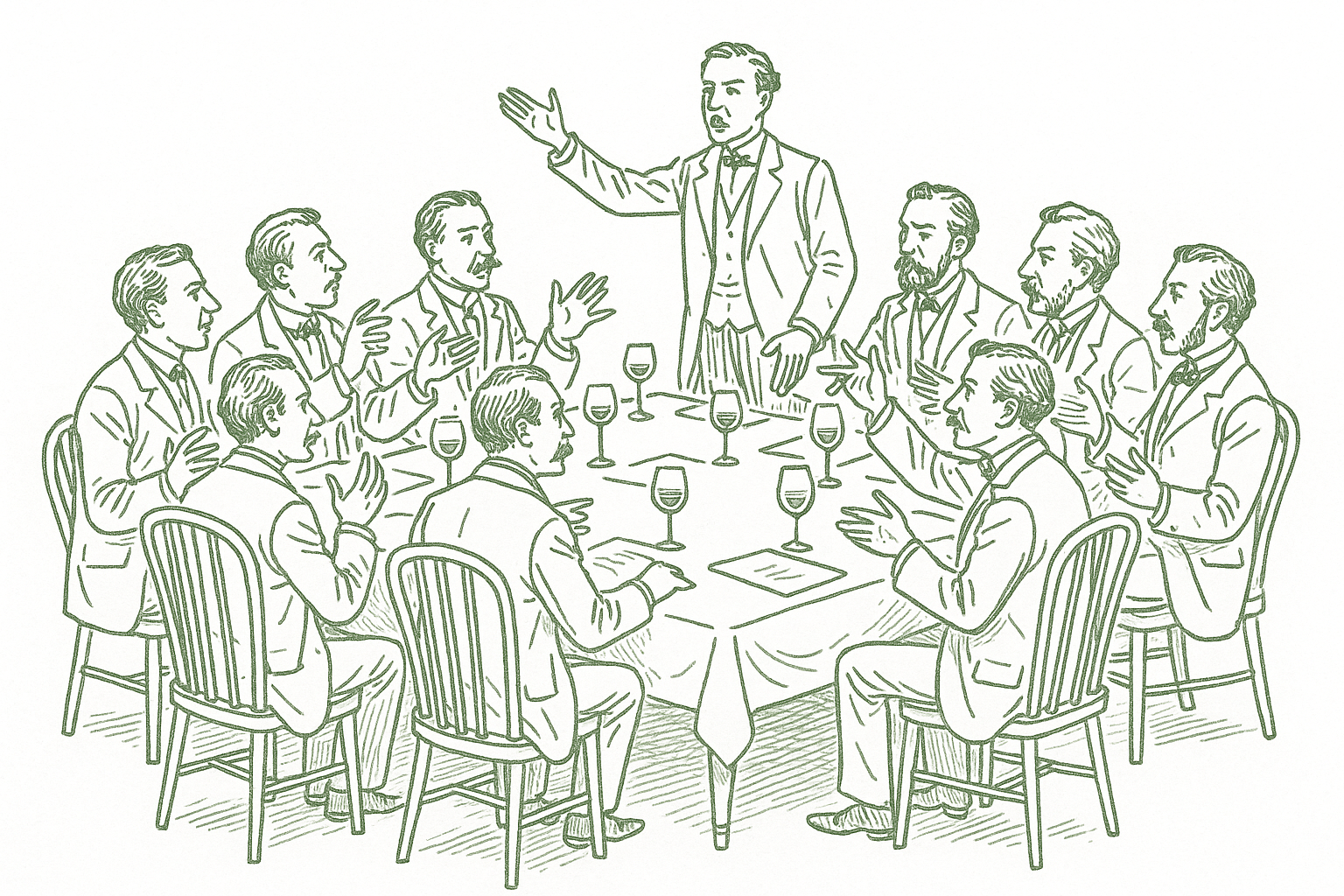
Thomas Henry Huxley — biologist, anatomist, and the man the press called "Darwin's Bulldog" — decided the answer was dinner. He invited eight friends to St. George's Hotel on Albemarle Street in London on November 3, 1864. Eight came to the first meeting. A ninth, William Spottiswoode, joined in December. And that was it. Nine members. The group decided at the first meeting that there would be no more.
They considered several names. Huxley jokingly proposed the "Blastodermic Club," a reference to the embryonic layer from which all organisms develop — a metaphor for their ambition to be the origin point of something larger. Another suggestion was the "Thorough Club," after a movement for intellectual freedom. They eventually settled on the X Club, proposed by mathematician Thomas Hirst, because, as one member put it, "it committed the members to nothing."
The name was a joke. What they built was not.
The nine men who reshaped British science
The X Club's membership reads like a roster of Victorian science's most consequential figures. But what made the group unusual was not individual brilliance — it was the range. These nine men spanned disciplines, classes, and institutions in ways that no single scientific society of the era could match.
Thomas Henry Huxley was the group's instigator and its engine. A comparative anatomist and public lecturer, he had grown up poor — the son of a mathematics teacher at a failing school — and fought his way into science through sheer ability. He was Darwin's most aggressive public defender and one of the most effective science communicators who has ever lived. He coined the word "agnostic."
Joseph Dalton Hooker was a botanist, the director of Kew Gardens, and one of Darwin's closest confidants. While Huxley fought the public battles, Hooker managed the institutional ones. He was the quieter operator — the one who understood how institutions actually worked and how to bend them.
John Tyndall was an experimental physicist who had grown up in rural Ireland and worked as a railway surveyor before earning his doctorate in Germany. His research on radiant heat and the absorption of infrared radiation by atmospheric gases made him one of the first scientists to explain the greenhouse effect. He was also a gifted public lecturer and a fierce advocate for scientific education.
Herbert Spencer was the group's philosopher — a sociologist who developed a sweeping theory of evolution that predated Darwin's and applied evolutionary thinking to society, economics, and ethics. He was the most famous member of the group during his own lifetime, though his reputation has not aged as well as the others.
John Lubbock was a banker, politician, ethnologist, and entomologist — the only member of the group who was independently wealthy. He used his political position to advance the group's causes in Parliament, pushing through landmark legislation including the Bank Holidays Act of 1871, which created England's first public holidays. The holidays were initially called "St. Lubbock's Days" by a grateful public.
Edward Frankland was a chemist who helped develop the theory of chemical valency and did pioneering work on water quality analysis — practical science that saved lives during London's recurring cholera outbreaks. William Spottiswoode was a mathematician, physicist, and the Queen's Printer, whose publishing connections gave the group influence over how science reached the public. George Busk was a retired naval surgeon and comparative anatomist. Thomas Archer Hirst was a mathematician who had studied under the great German mathematicians and brought Continental methods to English science education.
Six ambitious professionals. Three wealthy amateurs. All of them Fellows of the Royal Society, except Spencer. And all of them united by what one observer called "a devotion to science, pure and free, untrammelled by religious dogmas."
The format that made it work
Dining clubs were common in Victorian London. What was uncommon about the X Club was its discipline. The group met monthly during the London "season" — October through June — from 1864 until 1892. They met before the monthly meetings of the Royal Society, timing their dinners so they could coordinate strategy before the main event. This was not accidental. They understood that the real decisions in any institution are made before the meeting, not during it.
The X Club had no constitution, no written agenda, and — deliberately — kept only sketchy records. The informality was strategic. Without minutes, there was no paper trail. Without a formal purpose, there was nothing to attack. Huxley himself described the club's purpose as "the purely personal object of bringing together a few friends who did not want to drift apart."
This is a pattern that appears in every effective peer group throughout history. The stated purpose is modest. The actual function is transformative. Franklin's Junto was described as a "club for mutual improvement." The Lunar Society met for "friendly philosophical intercourse." The language of friendship and personal connection is the surface. Underneath, there is a coordinated effort to shape outcomes that none of the members could achieve alone.
The X Club's format exploited something that modern research on transactive memory has since confirmed: a small, stable group with complementary expertise develops a shared cognitive system that exceeds what any individual member knows. Huxley understood biology and public rhetoric. Hooker understood institutional politics and botany. Lubbock understood Parliament. Frankland understood chemistry and public health. Spottiswoode understood publishing. Together, they constituted a distributed intelligence system that could identify opportunities, coordinate action, and execute strategy across multiple domains simultaneously.
How nine dinners became institutional control
The X Club's influence was not accidental, and it was not subtle. Between 1870 and 1878, three X Club members simultaneously held office in the Royal Society — Hooker as president, Spottiswoode as treasurer, and Huxley on the Council. Between 1873 and 1885, the presidency of the Royal Society passed from Hooker to Spottiswoode to Huxley — three consecutive X Club presidents at the helm of Britain's most prestigious scientific institution.
Five of the nine members served as president of the British Association for the Advancement of Science. Others chaired the Chemical Society, the Mathematical Society, and the Geological Society. Busk served as president of the Royal College of Surgeons. By the 1870s, historian Roy MacLeod calculated, there were at least three X Club members on the Royal Society Council at any given time — enough to steer policy, control appointments, and determine the direction of British science from the inside.
They did not seize power. They populated it. The difference matters. Each appointment was earned on individual scientific merit. But the coordination — the strategic decision about who should stand for which office, when, and with whose support — that happened at dinner. The X Club was a campaign committee that never held a campaign. Its members did not need to conspire. They simply had dinner once a month, talked about what mattered, and then acted.
This is what real accountability looks like at scale. Not a system of rewards and punishments, but a group of people who meet regularly, know each other's objectives, and hold each other to the standard of actually pursuing them. The X Club members did not need someone to check their homework. They needed a room where the conversation naturally generated the social pressure to follow through. The monthly dinner provided it.
Launching Nature and reshaping education
In 1869, the X Club's orbit helped produce one of the most consequential publications in the history of science. The journal Nature was founded in November of that year by Norman Lockyer, an astronomer closely connected to the X Club's network. Huxley wrote the very first article published in its pages — an essay on Goethe's approach to nature. Other X Club members contributed early articles, and the journal's editorial stance reflected the group's core conviction: that science should be communicated to the public without religious interference, and that scientific authority should rest on evidence, not tradition.
Nature would become one of the two most influential scientific journals in the world. It still is. And while the X Club did not "found" it in a formal sense, the journal emerged from the intellectual ecosystem the X Club had created — a network of scientists who believed that public science communication was not a side project but a central obligation of the profession.
Education was the other front. Huxley and his X Club allies campaigned relentlessly for the inclusion of science in school curricula. In Victorian England, education was dominated by the classics — Latin, Greek, rhetoric, and theology. The idea that a student could be educated by studying chemistry or biology was genuinely controversial. Huxley served on numerous government education commissions and boards, arguing that "scientific reasoning trains the mind as effectively as a classical education and leads to a true understanding of the natural world." His X Club colleagues supported these efforts through their own lectures, textbooks, and institutional positions.
Meanwhile, Lubbock was working Parliament. As a Liberal MP, he used his political connections to push legislation that aligned with the group's values. His Bank Holidays Act of 1871 was not a scientific achievement, but it demonstrated the X Club's reach — one of their members could move legislation through Parliament while the others controlled the scientific establishment. The group's influence was not limited to science. It extended into politics, publishing, and public culture.
Why the small group won
The Victorian scientific establishment was not lacking in institutions. The Royal Society had existed since 1660. The British Association had been meeting since 1831. There were dozens of specialized societies, academies, and clubs. What was lacking was coordination. Each institution operated independently, pursuing its own agenda, protecting its own turf. The X Club provided something none of these institutions could: a unified strategic vision held by a small group of people who trusted each other completely and met often enough to act on it.
This is the advantage of a peer group over an institution. Institutions are slow. They have bylaws, committees, factions, and procedural overhead. A dinner club of nine people has none of that. It can process information faster, reach consensus faster, and execute faster than any formal body. The X Club could decide at dinner what the Royal Society would deliberate on for months.
The trust was real because the relationships were real. These nine men had known each other for years before the club was formalized. They went on holidays together, attended each other's lectures, reviewed each other's papers, and supported each other through professional crises. When Tyndall's alpine research was attacked by critics, the other X Club members rallied publicly. When Huxley's health declined in the 1880s, the group arranged for his financial security. Isolation produces worse decisions — but it also produces worse outcomes in every other dimension. The X Club members were never isolated, and their careers reflected it.
The group also benefited from what researchers now call the Dunbar number constraint. At nine members, the X Club was small enough for every person to maintain a genuine relationship with every other person. There were no factions, no subgroups, no members who barely knew each other. Everyone had eaten dinner with everyone else hundreds of times. The result was a level of implicit coordination that larger groups can never achieve.
The decline — and what it teaches
The X Club met for the last time in March 1892. By then, several members had died — Spottiswoode in 1883, Hirst in 1892, Busk in 1886. Tyndall would die in 1893, Huxley in 1895. Spencer was increasingly reclusive. The group had been losing energy since the mid-1880s as health, age, and professional divergence took their toll. There were no new members. The group had decided in 1864 that nine was enough, and they never revisited that decision.
This is the one structural flaw in the X Club's design. By prohibiting new members, they guaranteed their own obsolescence. A peer group that cannot refresh itself eventually becomes a monument. The group's power peaked in the 1870s, when its members were in their forties and fifties — old enough to hold senior positions, young enough to exercise them vigorously. By the late 1880s, the members were aging out of influence, and there was no next generation to carry the work forward.
Compare this to the challenge every structured group faces: how to maintain the intimacy that makes a small group powerful while allowing for the renewal that makes it durable. The X Club chose intimacy over durability, and for twenty years it was the most powerful scientific network in England. But all networks that refuse to evolve eventually dissolve.
The lesson is not that the X Club failed. It succeeded spectacularly. The lesson is that even the most effective peer group needs a mechanism for renewal. The format — monthly dinners, complementary expertise, shared values, strategic coordination — was essentially perfect. The membership policy was the constraint that eventually limited its impact.
A dinner table that changed the world
Between 1864 and 1892, nine men who met monthly for dinner produced or facilitated an extraordinary list of outcomes. Three consecutive presidencies of the Royal Society. Five presidencies of the British Association. The launch of Nature. The separation of science from religion in English public life. The introduction of science into school curricula. Landmark environmental legislation. The Bank Holidays Act. The professionalization of science as a career rather than a gentleman's hobby.
None of these outcomes was produced by the X Club itself. It had no budget, no staff, no publications, and no authority. It had nine people, a dinner table, and a monthly commitment to show up. Everything else — the presidencies, the publications, the legislation, the cultural transformation — was produced by individuals who happened to belong to a group that made them more effective than they could have been alone.
Huxley once said that the club had "no purpose except the purely personal object of bringing together a few friends who did not want to drift apart." He was, characteristically, being strategic about what he said out loud. The X Club's purpose was written in its outcomes, not its minutes. It was a group of people who understood that the real work of changing the world does not happen in lecture halls or committee rooms. It happens at dinner, among people who trust each other, see each other regularly, and share the specific, uncomfortable conviction that things need to change.
The name committed them to nothing. The dinners committed them to everything.