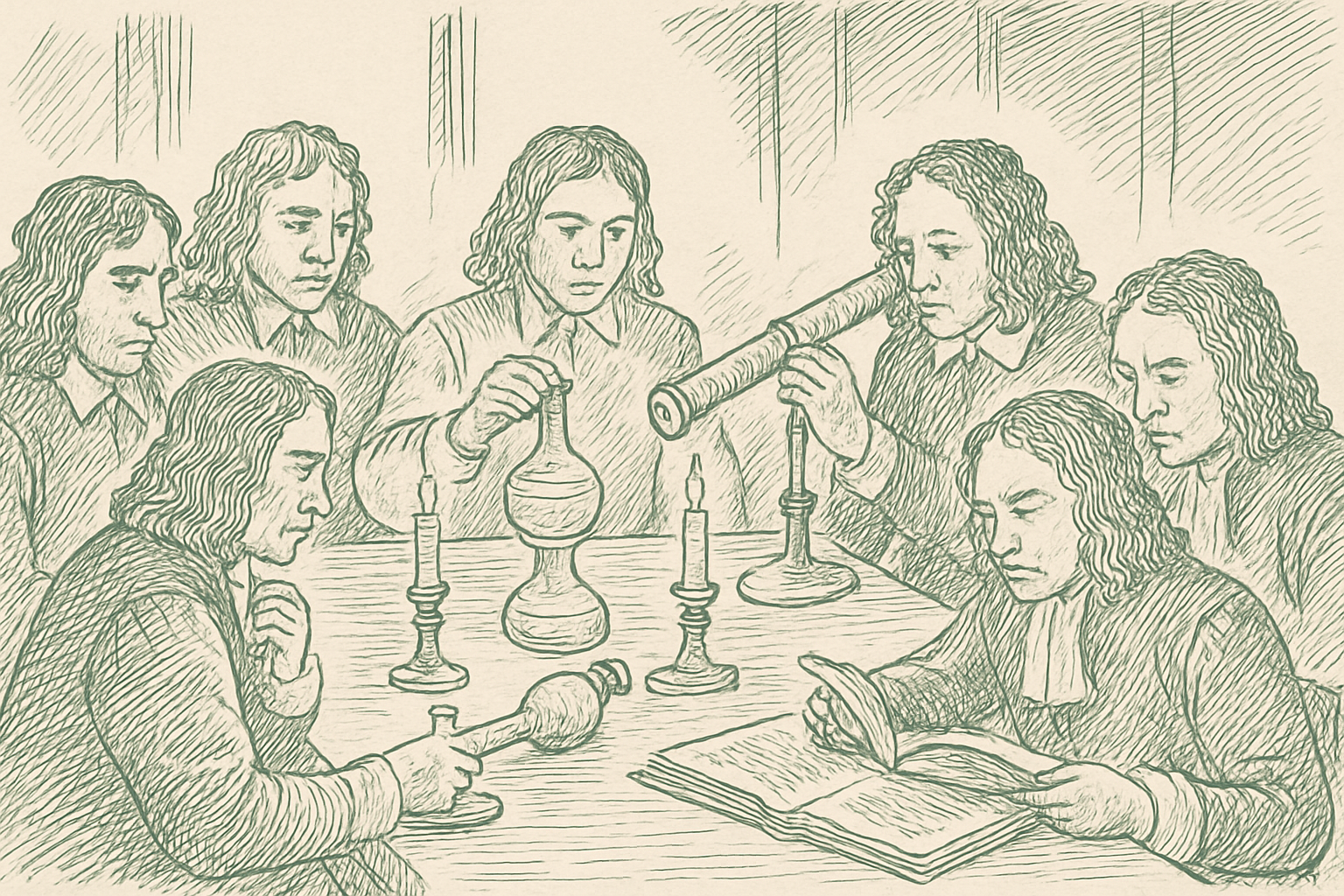
Before the Royal Society existed, science did not have a method. It had individuals. Brilliant, isolated individuals who observed nature, formed theories, and published books that other brilliant, isolated individuals sometimes read. There was no systematic way to share findings, test claims, or build on each other's work. If you discovered something important in Naples, a physician in London might not hear about it for years. Or ever.
Then twelve men walked out of a lecture on astronomy and decided to do something about it.
What they built — the Royal Society of London for Improving Natural Knowledge — became the oldest continuously operating scientific institution in the world. It published the first scientific journal. It laid the groundwork for peer review. It gave Isaac Newton the platform to publish the Principia Mathematica. It made Robert Hooke's Micrographia a bestseller. It turned natural philosophy from a gentlemen's hobby into a structured, collective enterprise that has produced every major scientific advance of the last 365 years.
And it started because a group of curious people decided to meet regularly and hold each other to a simple standard: show us the evidence.
The Invisible College
The Royal Society did not spring from nothing. Its roots trace back to the 1640s, when England was tearing itself apart in civil war and a small group of natural philosophers began meeting informally in London and Oxford to discuss the "New Philosophy" — the radical idea that knowledge should come from observation and experiment, not from ancient texts and Church authority.
Robert Boyle, the Anglo-Irish chemist who would later formulate Boyle's Law, called this loose network the "Invisible College." The name was deliberately self-deprecating. They had no building, no charter, no funding. They were geographically scattered, held together by nothing but letters, shared curiosity, and the occasional dinner. Boyle described them in 1646 as men who "take the whole body of mankind for their care" and "value no knowledge but as it hath a tendency to use."
The Invisible College was, in modern terms, a peer group. Not a university. Not a government body. Not a patron's court. A voluntary gathering of people who shared a problem — how to understand the natural world — and believed they could solve it faster together than alone.
During the upheaval of the English Civil War, the group split geographically. Some members, including John Wilkins, met regularly at Wadham College, Oxford. Others continued gathering at Gresham College in London, where public lectures in geometry, astronomy, and other subjects had been offered free since 1597. The two circles overlapped, corresponded, and waited for a moment when they could formalize what they had been doing informally for fifteen years.
That moment came on November 28, 1660.
Twelve men after a lecture
Christopher Wren — then known not as an architect but as the Gresham Professor of Astronomy — delivered a lecture that afternoon. When it ended, twelve of the attendees stayed behind and made a decision. The meeting minutes record their resolution to form "a Colledge for the Promoting of Physico-Mathematicall Experimentall Learning."
The twelve founding members included Wren, Boyle, John Wilkins (the Oxford mathematician and clergyman who had hosted the Wadham meetings), William Brouncker (who became the first president), Sir Robert Moray (a Scottish polymath who secured the royal charter), and seven others who ranged from physicians to aristocrats to clergymen. They agreed to meet every Wednesday at 3:00 in the afternoon at Gresham College. Each member would pay a shilling weekly toward expenses.
Two years later, King Charles II granted a royal charter formally establishing "The Royal Society of London for Improving Natural Knowledge." The charter was not a gift. Moray had lobbied for it aggressively, understanding that royal patronage would give the society legitimacy, access, and protection. Charles II, to his credit, was genuinely interested in science — he had his own chemistry laboratory at Whitehall. But the charter cost the Crown nothing. The Society received no government funding. It was self-sustaining from the start, run on member dues and the volunteer labor of people who believed the work mattered.
The motto they chose tells you everything about what they were building: Nullius in verba. Take nobody's word for it.
Take nobody's word for it
Nullius in verba was not a slogan. It was an operating principle, and a radical one. In the seventeenth century, intellectual authority came from tradition. If Aristotle said heavy objects fall faster than light ones, then heavy objects fall faster than light ones. If Galen said the heart's purpose was to generate heat, then the heart generated heat. Challenging established authorities was not just intellectually risky — it could be professionally and personally dangerous.
The Royal Society's founders rejected that framework entirely. Their position was simple: it does not matter who said it. What matters is whether you can demonstrate it. Show us the experiment. Let us see the evidence. Let us try to replicate it. If it holds up, we accept it. If it doesn't, we don't care how famous you are.
This was, in essence, an accountability structure applied to knowledge itself. The Society created a social environment where claims had to survive scrutiny. Not the scrutiny of a single authority, but the collective scrutiny of a room full of people who had agreed to judge ideas on evidence alone.
The weekly meetings at Gresham College were built around this principle. Robert Hooke, appointed as the Society's first Curator of Experiments in 1662, was responsible for preparing and demonstrating experiments at every meeting. This was not a ceremonial role. Hooke was expected to produce three or four new experiments per week — a pace that would be punishing even by modern standards. The members would observe, question, challenge, and debate. If a claim could not be demonstrated, it was not accepted.
The format was — whether they knew it or not — the same format that makes every effective peer group work. Not lectures from authority. Not passive consumption. Active engagement, structured challenge, and a shared commitment to raising the standard.
The first scientific journal
In March 1665, the Royal Society's secretary Henry Oldenburg published the first issue of Philosophical Transactions. It was, by any measure, the most consequential periodical in human history.
Before Philosophical Transactions, scientific knowledge spread through books (expensive, slow), personal letters (private, unverifiable), and word of mouth (unreliable). Oldenburg's journal solved all three problems simultaneously. Discoveries could be published quickly, read by anyone with access, and — critically — attributed to their authors in a dated, public record.
This last point was revolutionary. Priority disputes had plagued natural philosophy for centuries. Who discovered what first? Without a public record, there was no way to settle the question. Philosophical Transactions created that record. If you published your finding in its pages, you had a timestamped claim. This single innovation changed the incentive structure of science. Suddenly, sharing discoveries was not just virtuous — it was strategic. The fastest way to establish your claim was to publish it.
Oldenburg was not a passive editor. He maintained a vast correspondence network across Europe, exchanging letters with Christiaan Huygens in the Netherlands, Giovanni Cassini in France, Marcello Malpighi in Italy, and dozens of others. He actively sought out important findings and solicited contributions. The journal became not just a publication but a network node — a central exchange point for the entire scientific world.
Philosophical Transactions is still published today. It is the longest continuously running scientific journal in the world. Three and a half centuries later, the model Oldenburg invented — submit a finding, have it reviewed, publish it with attribution and a date — remains the foundation of how science works.
Newton, Hooke, and the power of the room
Isaac Newton published his first scientific paper in Philosophical Transactions in 1672 — a study of light and color that he had been working on privately for years. Without the Royal Society's journal, there is no obvious mechanism by which Newton's optical discoveries would have reached the scientific community when they did. Newton was famously reclusive. He did not seek attention. The Society gave him a structured outlet for work he might otherwise have kept to himself.
Newton's Principia Mathematica — arguably the most important scientific book ever written — was published in 1687 under the Royal Society's imprimatur. The publication was made possible by Edmond Halley, who paid for the printing out of his own pocket after the Society ran out of funds (they had overinvested in a lavishly illustrated book about fish). Without Halley's patronage and the Society's institutional framework, the Principia might not have been published at all, or might have been published decades later.
Robert Hooke's Micrographia, published in 1665 with the Society's endorsement, became an immediate bestseller. Samuel Pepys called it "the most ingenious book that ever I read in my life." The book contained Hooke's detailed illustrations of objects seen through a microscope — including his observation of the honeycomb-like structure of cork, which he named "cells." The term stuck. Every biology student in the world uses it today because a Curator of Experiments at the Royal Society needed a word for what he saw.
But Newton and Hooke also demonstrated the less flattering dynamics of a high-stakes peer group. They clashed bitterly over priority claims — who discovered the inverse-square law of gravity first, who deserved credit for theories of light. Their feud was personal, petty, and prolonged. Newton reportedly waited until Hooke died before publishing his Opticks in 1704, partly to avoid another round of arguments.
The lesson is uncomfortable but honest. The same structure that produces extraordinary breakthroughs also generates friction. Putting ambitious, opinionated people in a room together creates both the conditions for collaboration and the conditions for conflict. The Royal Society did not eliminate ego. It created a framework where ego had to compete with evidence — and evidence usually won.
The invention of peer review
The modern peer review system — where submitted papers are evaluated by qualified experts before publication — did not emerge fully formed at the Royal Society's founding. But the seeds were planted there, and the soil was Nullius in verba.
Oldenburg's editorial process for Philosophical Transactions involved seeking opinions from Fellows with relevant expertise before publishing contentious findings. This was informal and inconsistent, more like asking a knowledgeable friend to look something over than a formal review process. But the principle was established: a claim should be evaluated by qualified peers before it enters the public record.
The practice formalized gradually. By 1831, William Whewell proposed that papers submitted to the Society should be reviewed by two Fellows, whose signed reports would accompany the publication. This was the prototype for modern peer review — the idea that individual claims gain credibility by surviving structured scrutiny from peers who have no reason to be polite about it.
The logic is identical to what happens in an effective peer advisory group. A founder walks into a room with a plan. The plan sounds good in their head. Then five people who have no stake in flattering them ask hard questions. The plan either survives the gauntlet and gets sharper, or it doesn't survive and the founder avoids a costly mistake. The value is not in the size of the network. It is in the quality of the scrutiny.
What the Society built
The Royal Society's influence on the modern world is almost impossible to overstate. A partial accounting:
Its members include Isaac Newton, Charles Darwin, Albert Einstein, Stephen Hawking, Michael Faraday, James Clerk Maxwell, Dorothy Hodgkin, and Jocelyn Bell Burnell. Over 280 Fellows have been awarded Nobel Prizes. The Society has been involved in some of the most consequential scientific undertakings in history, from Captain James Cook's 1769 transit of Venus expedition to the development of vaccination.
But the Society's greatest contribution is not any single discovery. It is the infrastructure it created for discovery itself. Before the Royal Society, science was a solo activity. After the Royal Society, it was a collective one. The journal, the peer review process, the weekly meetings, the culture of open exchange and structured challenge — these are the operating system on which modern science runs. They were not invented by a genius working alone. They were invented by a group of people who decided to meet every Wednesday and hold each other to a higher standard.
The meeting is the method
The pattern appears throughout history, and it always looks the same. Ben Franklin's Junto was twelve tradesmen in a tavern. The Lunar Society was fourteen industrialists at a dinner table. The Inklings were four writers in a pub. The Impressionists were rejected painters in a Parisian cafe. The Homebrew Computer Club was thirty-two hobbyists in a garage.
The Royal Society was twelve natural philosophers in a lecture hall. They had no budget, no building, and no guarantee that anyone would take them seriously. What they had was a commitment to showing up every week, sharing what they were working on, and subjecting every claim — including their own — to the honest evaluation of their peers.
Nullius in verba. Take nobody's word for it. Not even your own.
Three hundred and sixty-five years later, it is still the best advice anyone has ever given about how to think clearly, work effectively, and build something that lasts. The question is not whether the method works. The question is whether you have the peers to hold you to it.