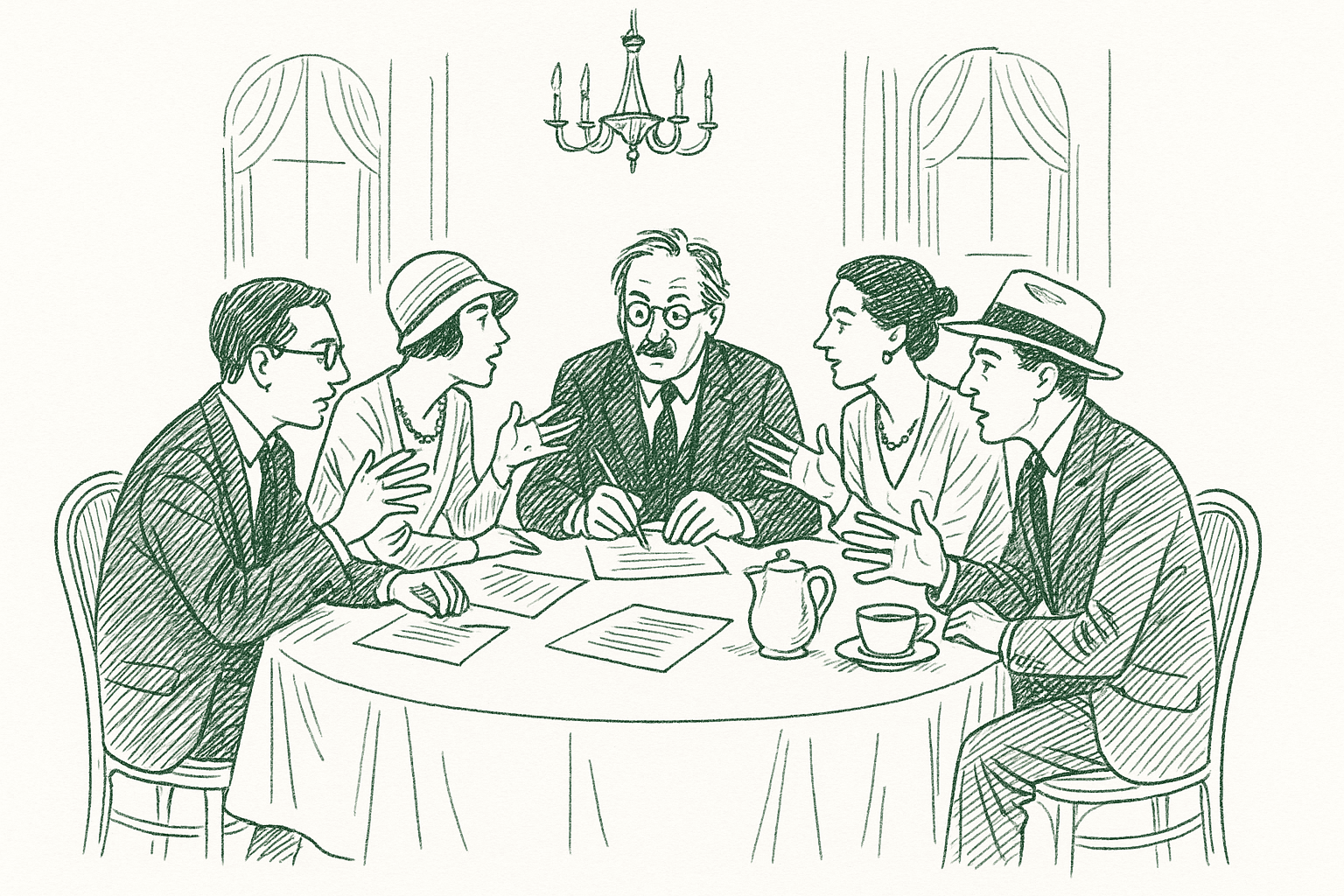
It started with a practical joke.
In June 1919, a theatrical press agent named John Peter Toohey organized a luncheon at the Algonquin Hotel on West 44th Street, ostensibly to welcome New York Times drama critic Alexander Woollcott back from his service as a war correspondent. In reality, Toohey used the occasion to roast Woollcott mercilessly. Woollcott, to his credit, laughed along. The lunch was such a success that Toohey suggested the group meet again the next day.
They kept meeting every day for ten years.
What became known as the Algonquin Round Table — or, as the members called themselves, the Vicious Circle — was not a formal institution. There were no membership dues, no agenda, no minutes. Just a round table in the Rose Room of the Algonquin Hotel, a standing reservation that Algonquin manager Frank Case kept open, and a rotating cast of New York's sharpest minds showing up to compete for the wittiest line of the afternoon.
By the time the group dissolved in the early 1930s, its members had founded one of the most influential magazines in the history of American journalism, collected at least five Pulitzer Prizes between them, helped define the voice of modern American humor, and built a cross-referral network that made careers out of lunch conversations.
None of that was the point. It was a side effect of showing up to the same table every day.
Who Was in the Room
The core group included Dorothy Parker, whose caustic wit and precise observations would make her one of the most quoted women of the twentieth century. Robert Benchley, the humorist who became the New Yorker's first drama critic and eventually a beloved film actor. Harold Ross, an unglamorous editor from Colorado who had a vision for a magazine unlike anything then in print. George S. Kaufman, the playwright who would collaborate his way to the most prolific career in Broadway history. Marc Connelly, Franklin Pierce Adams, Heywood Broun, Robert Sherwood, and Alexander Woollcott himself, whose newspaper column syndicated the group's best lines to readers across the country.
Associates floated in and out: Edna Ferber, the Pulitzer Prize-winning novelist. Noel Coward, on his visits from London. Harpo Marx, whose silence at the table became its own running joke among the most verbally competitive people in New York.
Membership was fluid. There was no application. You got invited because someone already there thought you could hold your own, and you kept coming because the conversation was worth returning to.
The Structure That Wasn't
It would be wrong to call the Algonquin Round Table a mastermind group in the formal sense. The structured mastermind tradition has a different lineage — Napoleon Hill's interpretation of Carnegie, the formal peer advisory formats that evolved through the twentieth century. The Vicious Circle was looser, messier, and more social. Lunch bled into afternoon cocktails. The group played poker and croquet together. Woollcott ran a regular card game that pulled in the same cast.
But the structure was there, even if nobody designed it. The daily frequency meant that the group maintained a depth of familiarity that most professional networks never achieve. The research on network depth consistently shows that size is not the variable that matters — frequency and intimacy are. The Round Table had both. These people didn't meet once a quarter at a conference and exchange business cards. They saw each other every day, knew each other's projects, tracked each other's careers, and held informal stakes in each other's success.
The wit competition was, in effect, a daily performance review. You showed up and you had to be sharp. The group's standards were high and unforgiving, which meant that anyone who kept coming was continuously being calibrated against the best of their peers. Woollcott's newspaper column regularly quoted the table's best lines — which meant the competition wasn't just internal. The whole country was watching.
What the Room Produced
The most consequential thing to emerge from the Algonquin Round Table was a magazine.
Harold Ross had been carrying the idea for The New Yorker for years before it launched in 1925. The magazine's founding vision — sophisticated, urban, witty, urbane — was not assembled in isolation. It was the written distillation of what happened at the round table every day. Ross had been sitting in that room for six years, absorbing what a certain kind of conversation sounded like, before he committed it to print. The voice he gave The New Yorker was the voice of the Vicious Circle.
Then Ross hired his peers. Dorothy Parker became a regular book reviewer. Robert Benchley became the drama critic. The magazine's founding contributors were people Ross had already trusted for years, whose quality he knew, whose judgment he'd watched under pressure at that table. The network didn't just inspire the magazine — it staffed it.
The cross-pollination ran in every direction. George Kaufman collaborated with Edna Ferber on several successful stage productions, including The Royal Family and Dinner at Eight — collaborations that began because two people who happened to sit near each other at lunch found they thought well together. Kaufman also collaborated with Marc Connelly on his early Broadway successes. Benchley's film career launched after Irving Berlin spotted him performing in a revue the group produced together — a one-off collective project called No Sirree! that became an unexpected talent showcase.
By the end of the group's run, Round Table members and their close associates had collected Pulitzer Prizes for drama (Kaufman, Connelly, Sherwood — who won four). Edna Ferber had won the Pulitzer for fiction. The body of work that emerged from people who shared a table for lunch is one of the more striking examples in cultural history of what proximity and cross-disciplinary exposure can produce.
The Solidarity Factor
One moment illustrates something important about how the group actually functioned.
In 1920, Dorothy Parker was fired from Vanity Fair — where she had been a theater critic — after her reviews of prominent productions angered theater producers who were major advertisers. Her editor, Frank Crowninshield, let her go rather than face the advertiser pressure. Benchley, who was managing editor, resigned in protest. Robert Sherwood resigned alongside him.
Two senior editors walking off their jobs in solidarity with a fired colleague is not a normal professional response. It happened because the relationships at the round table had created obligations that ran deeper than the ones on the org chart. Parker wasn't just a colleague — she was a fixture in a community that had become, for these people, the primary professional reference group of their lives.
This is what real accountability structures produce at their best: not just nudges toward your goals, but people who have genuine stakes in your wellbeing and will act on them. The Algonquin group wasn't designed around accountability. It happened anyway because the relationships were real.
Why It Worked — and Why It Ended
The Round Table worked for the reasons that most effective small groups work. The members were peers — not mentors and students, not employers and employees, but people at roughly similar stages dealing with roughly similar problems. The absence of hierarchy is what makes peer groups safe enough for honest conversation. You can afford to be wrong in front of your equals in ways you can't afford to be wrong in front of your boss or your board.
The group was also small enough to maintain real relationships. The research on optimal group size is consistent: once a group grows beyond a certain threshold, depth degrades. The Algonquin Round Table had a fluid membership but a stable core. The people who mattered to the group's output were a dozen, not a hundred. The wider circle of associates who rotated in and out were additions to a foundation that remained constant.
And then it fell apart. Alcohol was a serious problem for several members. Fame began to pull people toward more prestigious rooms. The 1929 crash changed the economic landscape of New York publishing and entertainment. Parker left for Hollywood. Others scattered. By the early 1930s, the daily lunches had become occasional, and then not at all.
This is also consistent with what we know about peer groups. They require structure to survive. The Algonquin Round Table ran on the informal structure of a hotel table and daily habit — strong enough for ten years, not strong enough to survive dispersal. The groups that persist longest are the ones that build in deliberate mechanisms for continuity: a recurring format, a commitment to attendance, a reason to return when life gets complicated.
The Lesson That Isn't About Wit
The Algonquin Round Table is mostly remembered as a collection of famous one-liners. Parker's quips fill wall calendars. Woollcott's correspondence is studied in journalism schools. Benchley's short films still circulate.
The wit was real. But it wasn't the product — it was the mechanism. The daily performance pressure of sitting at a table with the sharpest people in New York forced everyone there to work harder, think faster, and communicate more precisely than they would have otherwise. The one-liners weren't the output. The careers were.
What the Vicious Circle built, accidentally, was one of the most productive peer networks in American cultural history. Harold Ross founded The New Yorker because he'd spent six years in a room where he understood exactly what a certain kind of conversation sounded like. Kaufman wrote thirty-eight Broadway plays, many of them collaborations that began at that table. Benchley became a film actor because the group staged a revue and Irving Berlin happened to be in the audience. None of this was planned. It emerged from the accumulated weight of daily proximity with people who were as serious about their work as they were.
The Bloomsbury Group was doing the same thing in London at roughly the same time — small, consistent, intellectually demanding, producing work of lasting significance. The Lost Generation was doing it in Paris cafés and bookshops, editing each other's manuscripts until they'd produced The Great Gatsby and The Sun Also Rises. The Inklings were doing it at Oxford a decade later, reading unfinished manuscripts in a pub until they'd produced Narnia and Middle-Earth. The PayPal alumni did it in Silicon Valley eighty years later. Different contexts, same mechanism: the right people in the same room, often enough, with high enough standards.
The question isn't whether the model works. It's who your round table is.
GoodGrowth builds structured peer groups for founders, operators, and professionals who want the depth of the Algonquin Round Table without waiting for a practical joke to get started. Read more on the history of peer groups, or see what isolation does to decision quality.