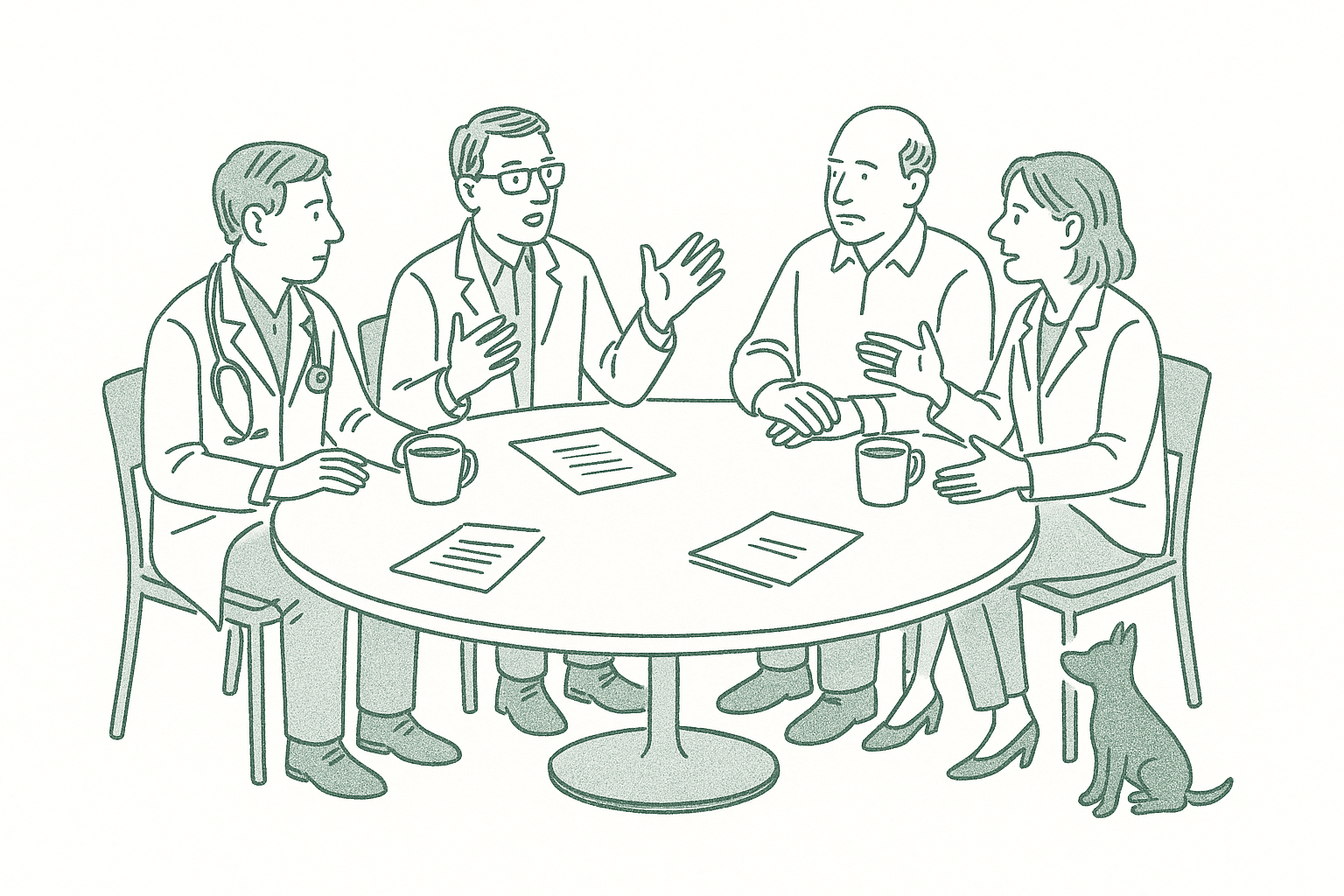
The veterinary services market hit $119 billion globally in 2025. Pet ownership is at record levels. Americans spent more on veterinary care last year than in any previous year in history. By every top-line metric, veterinary medicine is booming.
And yet the people inside the profession are breaking. The 2024 Merck Animal Health-AVMA Veterinary Wellbeing Study surveyed over 10,000 veterinary professionals and found that approximately 50% of veterinarians report experiencing burnout. Two-thirds of veterinary technicians meet the criteria for burnout in at least one clinical dimension. Serious psychological distress among veterinary professionals rose from 6.4% in 2019 to 9.7% in 2021. The CDC reports that veterinarians are three to five times more likely to die by suicide than the general population.
The industry is growing. The people running it are not okay. And the gap between those two realities is almost entirely structural.
The paradox of caring for everyone except yourself
A veterinary practice owner's day looks something like this: arrive at 7 AM, perform two surgeries, see 18 appointments, handle a euthanasia, manage a client who can't afford treatment, negotiate with a pharmaceutical rep, review the P&L, deal with a technician who just gave notice, and close at 7 PM. Then chart for another hour. Repeat five or six days a week.
Veterinarians are surrounded by people all day. Staff, clients, patients. But almost nobody in the building is asking the questions that actually matter to the owner: How are your margins? Is your associate compensation structure sustainable? Should you take that PE buyout offer? Why are you still doing clinical work 40 hours a week when you should be running the business?
This is the same isolation trap that hits every founder, but veterinarians get a particularly brutal version of it. Most entered the profession because they wanted to help animals. Nobody told them that practice ownership would be 70% business management and 30% medicine. The emotional weight of daily euthanasia decisions and compassion fatigue compound the ordinary pressures of small business ownership into something genuinely dangerous.
A 2015 AVMA survey found that one in six veterinarians had considered suicide. Not burnout. Not stress. Suicide. The profession that spends its days saving lives has one of the highest mortality rates of any healthcare field.
The numbers nobody shares
Most veterinary practice owners track their own revenue, their own payroll percentage, their own cost of goods. But they have no idea how those numbers compare to anyone else's. Is a 22% profit margin good? Is $1.1 million in annual revenue underperforming for their location and staff size? Is their associate compensation model competitive, or is it the reason they can't retain DVMs?
The Veterinary Management Groups (VMG), a peer-based organization for independent practice owners, addresses this directly. Their study groups of 18 to 24 members share quarterly financial data through a benchmarking system that tracks revenue, expenses, cost of goods, and efficiency metrics. Members can see exactly where their practice falls relative to peers of similar size and patient orientation.
The results are not subtle. When five owners who run comparable practices put their real numbers side by side, the gaps become immediately visible. One discovers their network is too broad and too shallow to surface this kind of operational intelligence. Another realizes the lease terms they accepted are wildly above market because nobody told them otherwise. A third learns that their revenue per DVM is 30% below what peers at similar facilities generate, and the fix is a scheduling change, not a new hire.
This is the kind of insight that conferences cannot deliver. A keynote speaker can tell you that the average veterinary practice operates at 15 to 20% profit margins. Only a peer who runs a practice your size, in a market like yours, can tell you that your specific margins are low because your inventory management is bleeding cash.
The consolidation pressure
Independent veterinary practice owners are navigating a market that is actively trying to buy them out. Mars Veterinary Health operates VCA Animal Hospitals, Banfield, and BluePearl, making it the largest single owner of veterinary practices in the United States. Behind Mars sits a roster of private equity-backed platforms: National Veterinary Associates, Mission Pet Health, VetCor, PetVet Care Centers, Thrive Pet Healthcare, AmeriVet, and more. In Q1 2026, the weighted average EBITDA multiple for practice sales hit 13.3x, up from 12.5x in 2025. Top-tier practices are achieving 16x multiples.
The supply of practices available for sale is at a ten-year low. Demand from buyers outpaces supply. For any independent owner, this means the phone is ringing. The question is not whether you will receive an acquisition offer. The question is whether you will evaluate it alone or with people who understand the math.
Sell versus stay is the most consequential financial decision a practice owner will make, and it is also the decision most likely to be made in isolation. Most owners are first-time sellers facing experienced acquisition teams with defined playbooks. The asymmetry is structural. Earnout structures, clawback provisions, equity rollovers, and post-sale employment terms are not concepts most veterinarians learned in school. A peer group that includes owners who have navigated these conversations, accepted offers, rejected offers, or regretted their decisions, provides context that no consultant or broker can replicate.
Why veterinary medicine specifically needs peer groups
Every industry benefits from peer learning. But veterinary medicine has characteristics that make the accountability gap particularly dangerous.
First, the emotional toll is uniquely severe. Veterinarians perform euthanasia regularly. They make life-and-death decisions under time pressure while managing the grief of pet owners. Compassion fatigue is not an abstract concept in this profession. Research shows 58.9% of veterinarians have high secondary traumatic stress scores. Only 30% seek professional mental health support, in part because the culture prizes resilience over vulnerability.
A peer group of other practice owners who understand this specific kind of emotional labor creates a space that no therapist, spouse, or business coach can fully replicate. Not because those resources aren't valuable. They are. But because the person sitting across from you in a peer group has performed the same euthanasia, fielded the same angry call from an owner who couldn't afford treatment, and gone home to the same unanswerable question of whether they made the right call. That shared experience changes the quality of the conversation entirely.
Second, the staffing crisis is existential. Veterinary support staff turnover exceeds 30% annually. The cost of replacing a single veterinary technician runs approximately $24,000. Staffing shortages don't just create operational headaches. They shift clinical and administrative burden onto the owner, accelerating burnout in a profession already running on fumes.
Third, the knowledge gap at entry is enormous. Veterinary school teaches medicine. It does not teach business. Practice owners are trained clinicians who suddenly need to understand lease negotiation, HR compliance, inventory optimization, SaaS-style metrics for recurring revenue, and financial modeling for exit planning. The history of peer groups is, at its core, a history of skilled practitioners who needed business judgment they were never trained to develop.
What veterinary practice owners actually talk about
The most effective veterinary mastermind groups are not motivational. They are operational. Here is what the conversations actually look like:
Pricing and fee schedules. Most practice owners set their prices based on what they charged last year plus a small increase. In a peer group, they discover that practices in comparable markets charge 20 to 40% more for the same services and have not lost clients. The conversation is not about theory. It is about one owner saying "I raised my dental cleaning fee from $280 to $420 and my volume didn't change."
Associate compensation models. The veterinary profession is in a recruiting war. Associates command starting salaries above $100,000, and the compensation structures that attract talent vary wildly. ProSal versus straight salary versus production-based pay. A peer group lets owners compare what they are paying, what retention looks like under each model, and what the hidden costs are.
Practice valuation and exit planning. With EBITDA multiples at historic highs, every practice owner needs to understand what their business is worth, whether they are selling this year or in ten. Peer groups include owners at every stage: pre-sale, post-sale, and those who decided to stay independent. The range of perspectives is the value.
Burnout and boundaries. Perhaps most importantly, veterinary peer groups create a space where owners can say the thing they cannot say to their staff, their clients, or their families: I don't know if I can keep doing this. In a profession where one in six has considered ending their life, having a structured space for that conversation is not a luxury. It is a clinical intervention.
What to look for
Not all peer groups are built for veterinary practice owners. The ones that work share specific characteristics:
Geographic separation. The best veterinary peer groups ensure members are far enough apart that they are not competing for clients. VMG builds this into their study group design by default. When competitive pressure is removed, the conversation changes. Owners share real numbers, real strategies, and real mistakes because there is no risk that the person across the table will use that information against them.
Financial benchmarking. Talk is useful. Data is better. Groups that require members to share standardized financial metrics create a foundation of accountability that casual networking cannot match. If you're choosing a mastermind group, look for one that treats numbers as a requirement, not an option.
Practice-size matching. A solo practitioner generating $600,000 in annual revenue faces fundamentally different challenges than a multi-DVM hospital doing $4 million. The best groups match members by practice size, patient orientation, and business objectives so the advice is immediately applicable.
Facilitation. Peer groups without structure devolve into social clubs. The most effective veterinary masterminds use trained facilitators who keep conversations focused, ensure every member gets airtime, and push past surface-level check-ins into the operational problems that actually determine whether a practice thrives or fails.
The math that matters
A veterinary practice owner who discovers through peer benchmarking that their pricing is 25% below market and adjusts accordingly adds $150,000 to $300,000 in annual revenue without seeing a single additional patient. An owner who avoids a bad PE deal because a peer explained the earnout trap saves potentially millions. An owner who implements a retention strategy shared by a peer and reduces technician turnover by one position saves $24,000 per year in direct costs and far more in operational disruption.
But the most important number may be the hardest to measure. In a profession where half the practitioners report burnout and one in six has considered suicide, the value of having five people who understand your exact situation and will tell you the truth is not a line item on a P&L. It is the difference between staying in the profession and leaving it.
The veterinary industry is worth $119 billion. The practices that capture their share of that growth will not be the ones with the best equipment or the most aggressive marketing. They will be the ones whose owners had someone to call when the hard question surfaced.