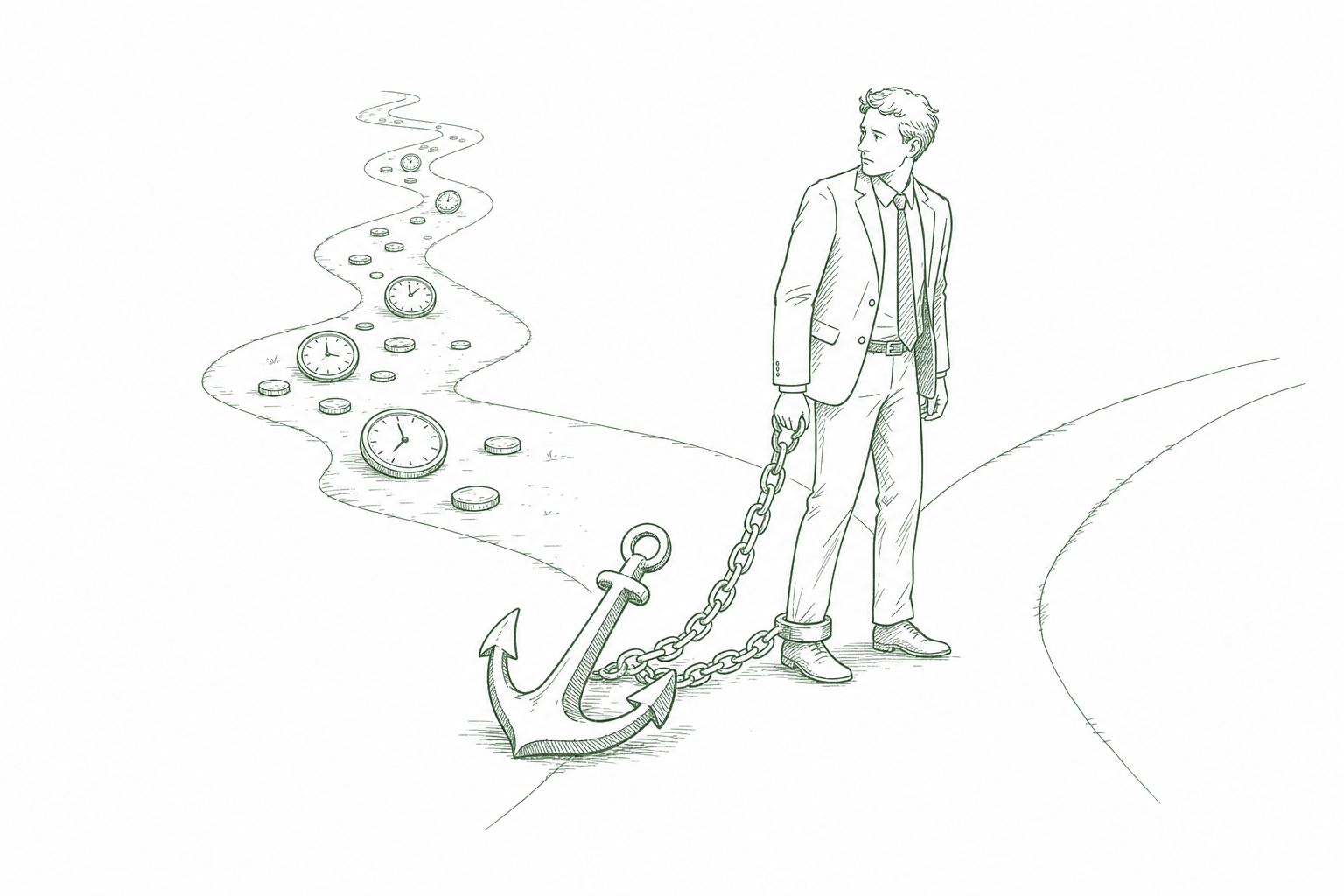
Every founder has a Concorde. A product feature that consumed six months and serves twelve users. A hire who was wrong from month two but received three more quarters of chances. A market that stopped responding nine months ago but still gets the majority of the budget because switching means admitting the original thesis was wrong.
Economists have a name for what is already spent and cannot be recovered: a sunk cost. The rational response to sunk costs is to ignore them entirely. The only question that matters is whether the next dollar, hour, or unit of effort will produce a return. What has already been invested is gone regardless of what happens next. This is not a contested principle. It is introductory economics. And yet four decades of research show that almost nobody — executives, entrepreneurs, trained economists — actually behaves this way.
What the research actually shows
In 1985, psychologists Hal Arkes and Catherine Blumer published "The Psychology of Sunk Cost" in Organizational Behavior and Human Decision Processes. Their experiments demonstrated something that economics alone could not explain: people do not merely fail to ignore sunk costs — they actively use them as justification for continued investment. Participants who had incurred a sunk cost consistently inflated their estimates of a project's likelihood of success compared to participants evaluating the same project without prior investment. The money already spent did not just fail to disappear from the decision calculus. It distorted the calculus itself.
The finding has been replicated relentlessly. Howard Garland's 1990 study in the Journal of Applied Psychology showed that as the percentage of a budget already consumed increased, participants' willingness to fund the remaining work increased in an almost perfectly linear relationship — even though the incremental cost-benefit analysis was identical regardless of what had been spent. People were not rationally evaluating whether the next million would pay off. They were emotionally evaluating whether the last nine million would be "wasted" if they stopped.
Barry Staw, the pioneer of escalation-of-commitment research, demonstrated as early as 1976 that decision-makers who were personally responsible for the initial investment escalated their commitment significantly more than those who inherited the project. The mechanism is not just economic. It is psychological: admitting the sunk cost was wasted requires admitting that the original decision was wrong. And for a founder, whose identity is often fused with their company, that admission threatens something deeper than a balance sheet.
The most recent and rigorous confirmation came from Wharton finance professor Marius Guenzel, whose 2025 paper "In Too Deep" in The Journal of Finance analyzed real corporate acquisition data at scale. Guenzel found that companies systematically failed to ignore sunk costs in losing ventures. The higher the sunk cost, the lower the probability of divestiture — even when the investment was clearly underperforming. The distortion was most pronounced in firms led by the CEO who initiated the acquisition. When the person who made the original bet was still in charge, the organizational capacity to cut losses essentially collapsed.
Why founders are more vulnerable than anyone
The sunk cost fallacy is universal. It affects students buying movie tickets, judges evaluating cases, and Fortune 500 boards managing billion-dollar portfolios. But founders face a uniquely concentrated version of the problem, for three specific reasons that the research supports.
Personal responsibility amplifies the bias. Staw's original 1976 finding showed that decision-makers who chose the initial course of action escalated commitment far more than those who did not. A founder is, almost by definition, the person who chose the initial course of action — for the product, the market, the strategy, the team. Every sunk cost in the company traces back to a decision the founder made. Every abandonment of a sunk cost requires the founder to look at something they built and say: this was wrong. The research predicts exactly what happens: they do not say it. They double down.
Identity fusion makes the cost feel existential. Confirmation bias is one dimension of this. But the sunk cost problem is deeper. Research on entrepreneurial identity, including work by Cardon and colleagues in Personnel Psychology, shows that founders frequently merge their personal identity with their venture. When your company is not just what you do but who you are, abandoning a failing strategy does not feel like a portfolio rebalancing. It feels like self-destruction. The sunk cost becomes a load-bearing wall in the founder's identity architecture.
Isolation removes the corrective. This is where the research on de-escalation becomes critical. The Kirby and Davis (1998) finding is direct: accountability in the form of external monitoring reduced escalation of commitment. When decision-makers had to justify their continued investment to an outside party, the sunk cost effect weakened significantly. The mechanism is straightforward — external accountability forces the founder to articulate the case for continuing, and articulation exposes the logical gap between "we have already spent X" and "the next dollar will generate a return." In isolation, that gap never gets exposed. The internal monologue loops: we have invested too much to stop. Without an external voice disrupting that loop, it continues indefinitely.
The Concorde problem is not ancient history
The Concorde flew for twenty-seven years and retired in 2003 having never repaid its development costs. But the pattern shows up in startup post-mortems constantly.
CB Insights analyzed 110+ startup failure post-mortems and found that "ran out of cash" and "no market need" were the two most common causes of death — and critically, the founders almost always knew there was no market need before they ran out of cash. They knew. They just could not stop. An EPFL University study found that 73% of startups ultimately pivot to a different market — but many of them pivoted far too late, staying in a failing market not because the evidence was ambiguous but because the cost of what they had already built made leaving feel impossible.
A survey reported by Forbes found that 68% of executives admit to making decisions influenced by prior investments, even when current data suggests a different direction. Not 68% of executives experiencing the bias unconsciously — 68% who could identify and name what they were doing and still could not stop doing it. Knowing about the sunk cost fallacy does not fix it. Arkes and Blumer's original 1985 study showed exactly this: participants who had taken economics courses were just as susceptible as those who had not. The IKEA effect is the same pattern in a different costume — you overvalue what you built, regardless of what it is worth to anyone else.
Intellectual awareness is not a corrective for sunk cost bias. Structural intervention is.
What actually de-escalates commitment
The escalation-of-commitment literature is large, and the findings on de-escalation point to a small number of reliable interventions. Almost all of them involve other people.
External accountability. Kirby and Davis (1998) demonstrated that when decision-makers had to justify their choices to an outside observer, escalation decreased. The mechanism is not that the outside observer is smarter or has better information. The mechanism is that the requirement to explain the decision out loud forces the decision-maker to construct a forward-looking justification — and forward-looking justifications for continuing a failing investment are weak. They sound weak. The founder hears how weak they sound. The sunk cost reasoning ("but we already spent...") is revealed for what it is: a rearview argument in a situation that requires a forward-looking one.
Distributed responsibility. Guenzel's finding that the sunk cost effect was strongest when the original decision-maker was still in charge implies the converse: distributing the decision across people who did not make the original bet reduces the bias. A peer group in a hot seat is precisely this. The peers evaluating your situation did not make your original decision. They have no identity stake in its vindication. They can evaluate the forward-looking case on its merits because they have no backward-looking case to protect.
Pre-commitment devices. Heath's 1995 work on mental budgeting showed that explicit budgets — set before the investment begins — reduced escalation. If a founder says to their peer group at the start: "I will spend $50,000 and three months testing this market, and if it does not produce X by that date, I will stop," accountability has something concrete to work with. The budget creates a bright line that sunk cost reasoning cannot blur.
Promotion-focused framing. Molden and Hui's 2011 study at Northwestern found that activating a growth and advancement mindset — what they called "promotion focus" — reduced sunk cost effects more effectively than traditional oversight methods. Instead of trying to prevent the loss, you refocus the decision-maker on what they could gain by reallocating the resources. A peer group does this naturally. When one member says, "What would you do with that $50K and those three months if you freed them up tomorrow?" — that is a promotion-focused reframe. It shifts the question from "should I abandon what I built?" to "what could I build instead?"
The question the founder cannot ask themselves
Here is the core problem. The sunk cost fallacy does not feel like a fallacy from the inside. It feels like persistence. It feels like conviction. It feels like the grit that every startup book, podcast, and conference speech tells founders they need more of — because survivorship bias ensures that the only founders giving those speeches are the ones for whom persistence happened to work. The advice paradox makes this worse — the people closest to the founder are often invested in the same narrative and provide the same backward-looking justifications.
The critical question — "If you were starting from scratch today, with no prior investment, would you make this same bet?" — is almost impossible to answer honestly when you are the one who made the original bet. Your brain has spent months or years constructing the case for continuing. It has filtered incoming data through confirmation bias. It has reframed setbacks as "learning" and declining metrics as "temporary." It has done this not because you are irrational but because you are human, and this is what human brains do with sunk costs.
The question requires someone who is not invested in the answer. Someone who respects you enough to ask it directly and hold space for the silence that follows. Someone who will not let you answer "but we already spent..." and leave it there.
Solomon's paradox demonstrates that people consistently give better advice to others than to themselves. The asymmetry is not about intelligence — it is about emotional distance. A peer group provides exactly that distance. The peers are close enough to understand the context but far enough from the investment to evaluate the forward case without the backward anchor.
The cost of not killing it
The real cost of the sunk cost fallacy is not the money already spent. That money is gone regardless. The real cost is the opportunity cost of what comes next — the resources, time, and energy that continue flowing into the failing investment instead of being redirected toward something that might work.
Guenzel's data showed that firms attached to sunk costs divested losing ventures significantly less frequently than firms without the attachment. These are not marginal differences. The distortion was large enough to show up in corporate financial data at scale. For a startup with limited runway, the implications are existential. Every month spent propping up a failing product is a month not spent on the pivot that might save the company.
The Kellogg School research by Sandeep Baliga and Jeffrey Ely added a less obvious dimension: organizational memory loss. When managers turn over, the original strategic vision for a project gets lost, but the sunk cost remains visible on the books. New managers inherit the expenditure without the context and may either escalate further (because the spent amount looks too large to abandon) or under-invest in genuinely promising projects (because the accounting makes them look more expensive than they are). Both pathways destroy value. Both are structural consequences of the sunk cost fallacy operating at the organizational level.
For a solo founder, there is no manager turnover to create this problem — but there is also no fresh perspective to counteract it. The founder is both the original decision-maker and the only evaluator. The bias and the evaluation live in the same brain, operating on the same depleted cognitive resources, protected by the same identity structure. Decision fatigue compounds the problem — by the time the founder has the bandwidth to evaluate a failing project honestly, they are too depleted to do the honest evaluation.
What the structural fix looks like
A recurring peer group does not eliminate the sunk cost fallacy. Nothing does — it is too deeply wired into how human brains process loss. But a well-structured peer group creates the conditions the research identifies as most effective for de-escalation:
External accountability — someone asks whether the continued investment makes forward-looking sense, and the founder has to answer out loud. Distributed evaluation — people who did not make the original bet assess the current situation without the backward anchor. Pre-commitment structure — the group can help set and enforce explicit decision criteria before emotions take over. And promotion-focused reframing — peers naturally ask "what would you do instead?" rather than "should you keep going?"
None of these interventions require the peers to be experts in the founder's industry. They do not require special training. They require only what Kirby and Davis identified as the active ingredient: accountability in the form of monitoring. Someone who will ask the question. Someone who will notice when the answer does not make sense. Someone who cares enough about the founder to challenge the narrative that "we just need a little more time."
Your network is too big to help you with this problem. A thousand LinkedIn connections will affirm your persistence. Five people who sit with your actual numbers, your actual timeline, and your actual decision criteria — they will tell you the truth. Not because they want you to fail. Because they can see what you cannot see from inside the investment.
The Concorde flew for twenty-seven years. It was, by every account, a magnificent aircraft. It was also a $20 billion monument to the human inability to say: this is not working, and the money we spent does not change that. The only people who could have stopped it were the ones who were not invested in it. Your worst idea deserves the same intervention — before it consumes three more quarters of runway on the strength of the quarters it already consumed.