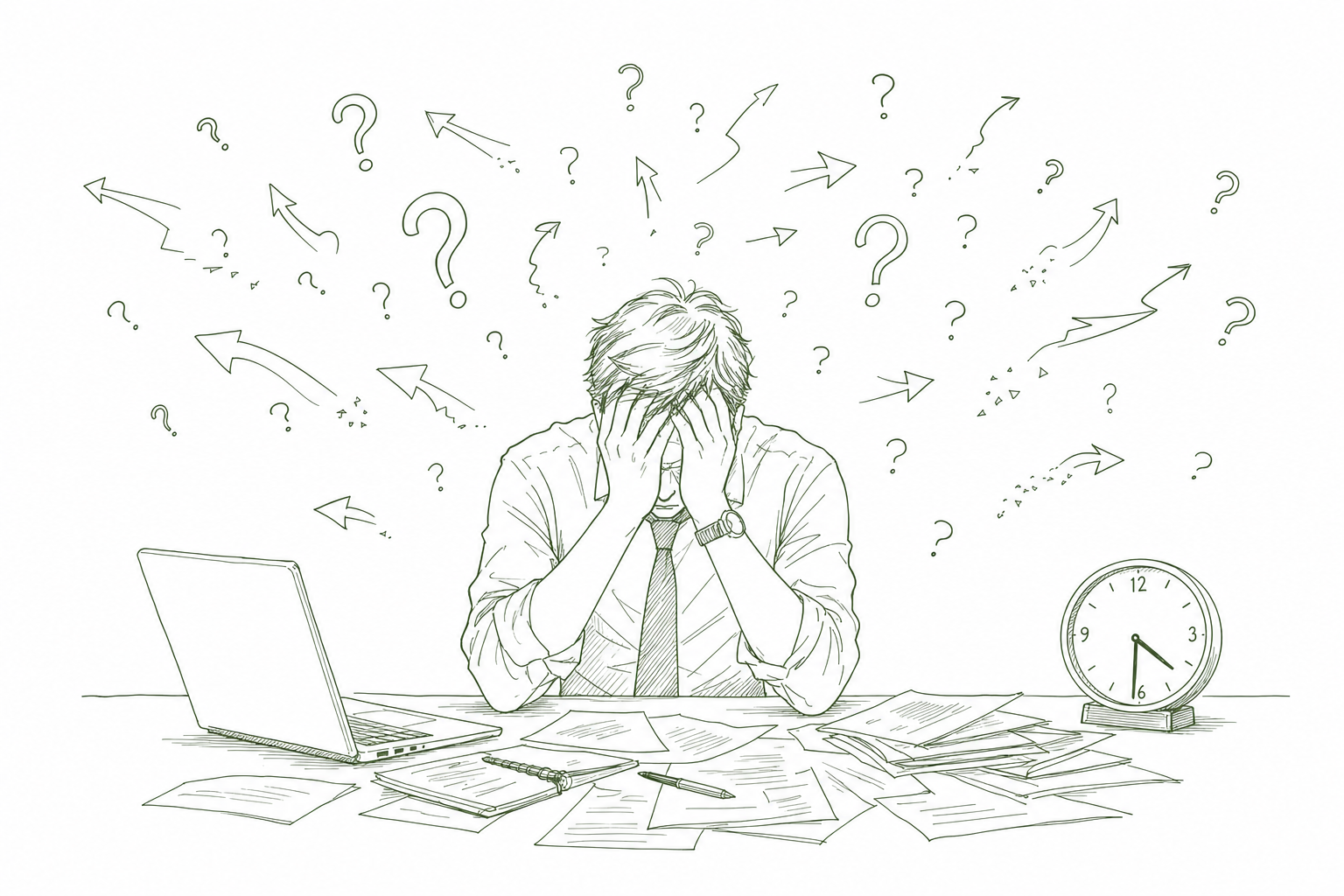
In 2011, Shai Danziger, Jonathan Levav, and Liora Avnaim-Pesso published one of the most unsettling studies in behavioral science. They analyzed 1,112 parole board rulings made by eight Israeli judges over fifty days. The legally relevant factors — crime severity, time served, rehabilitation progress — predicted outcomes moderately well. But one extraneous factor predicted them far better: the time of day.
At the start of a session, judges approved roughly 65% of parole requests. As the session wore on, approval rates dropped in a nearly linear decline, bottoming out at approximately 0% just before a food break. After the break, approval rates spiked back to 65%. Then the decline began again.
Published in the Proceedings of the National Academy of Sciences, the study was not measuring bias or incompetence. It was measuring what psychologist Roy Baumeister had been studying for over a decade: the finite nature of cognitive resources. Every decision you make draws down the same reservoir. When it runs low, your brain does not announce the deficit. It simply defaults to the easiest available option — which, for a parole judge, is the status quo: deny.
What Baumeister found about the tank running dry
Roy Baumeister's work on ego depletion, beginning in the late 1990s at Case Western Reserve University, established the foundational model. In one of his most famous experiments, participants were placed in a room with freshly baked chocolate chip cookies and a bowl of radishes. One group was told to eat only radishes — resisting the cookies required active self-control. A second group was told to eat the cookies — no willpower expenditure required.
Both groups were then given an unsolvable geometry puzzle. The cookie group persisted for an average of nineteen minutes. The radish group — already depleted from resisting the cookies — gave up after eight. The puzzle was identical. The cognitive tank was not.
Baumeister's model, published across dozens of papers throughout the 2000s, described willpower and decision-making capacity as drawing from a shared, depletable resource. The more decisions you make, the worse each subsequent decision becomes — not because you care less, but because the cognitive machinery that supports deliberate, rational evaluation literally runs out of fuel. The technical term is ego depletion. The common term is decision fatigue. The experience is universal.
The implications for founders are severe and specific. A McKinsey survey of 1,200 global business leaders found that executives spend roughly 37% of their time making decisions, and more than half of that time is spent ineffectively. For a typical Fortune 500 company, McKinsey estimated this translates to approximately 530,000 days of managers' time and $250 million in wages annually — wasted on decisions made poorly, slowly, or not at all.
Founders face an even more concentrated version of this problem. There is no C-suite to distribute decisions across. There is no board that meets quarterly to absorb the strategic load. There is one person — often operating on insufficient sleep, across multiple domains (product, finance, hiring, legal, culture, sales) — making every call, all day, on a steadily emptying tank.
The loan officers, the doctors, and the 4 PM problem
The parole study gets the attention, but decision fatigue shows up everywhere researchers look.
A 2021 study of loan officers found that as the day progressed, officers became increasingly likely to reject applications — not because afternoon applicants were less creditworthy, but because rejecting is cognitively easier than approving. Approving requires evaluation, risk assessment, and justification. Rejecting is a one-word answer. The researchers estimated the bank lost approximately $509,000 per month in revenue from qualified loans rejected by fatigued officers.
In medicine, the pattern is equally stark. A 2014 study published in JAMA Internal Medicine found that primary care physicians prescribed antibiotics at significantly higher rates in the final hours of their shifts — not because patients were sicker in the afternoon, but because prescribing is easier than explaining why a prescription is not necessary. The deliberative energy required to have a nuanced conversation about why an antibiotic will not help a viral infection simply was not available after seven hours of continuous clinical decision-making.
The pattern is consistent: as decision volume increases, the quality of each subsequent decision decreases. And the decline is not random. It follows a specific trajectory. Early decisions get deliberation. Late decisions get defaults. Important decisions made late in the sequence get treated like unimportant ones — not because the decision-maker has changed their values, but because the cognitive infrastructure that supports those values has been exhausted.
For founders, this means something precise and uncomfortable: your most important decisions — the ones about strategy, hiring, pricing, pivots — are not being made by the same brain that showed up at 8 AM. They are being made by the depleted version. The one that has already processed fifty emails, three customer escalations, a payroll issue, and a product debate. The one that is, neurologically speaking, operating at a fraction of its capacity. And it does not feel different. That is the danger. Confirmation bias is one trap. Decision fatigue is another — and it is invisible.
Why the standard advice does not work
The usual prescriptions for decision fatigue are well-meaning and structurally insufficient.
Make important decisions first thing in the morning. This is excellent advice for people who control their schedules, which excludes most founders. Crises do not schedule themselves. Customer emergencies arrive at 2 PM. The hire you need to let go says something at 4 PM that forces the conversation. The strategic decisions that need your sharpest thinking do not politely queue up for the 8 AM slot.
Reduce the number of decisions you make. Steve Jobs wore the same outfit every day. Mark Zuckerberg adopted a similar approach. The principle is sound — eliminating trivial decisions preserves cognitive resources for important ones. But the decisions draining founders are not about what to wear. They are about whether to extend runway by cutting headcount, whether to pursue a partnership that could change the company's trajectory, whether the product direction that felt right six months ago still makes sense. You cannot automate or eliminate these. They are the job.
Sleep more. Exercise. Eat well. Baumeister's own research suggests that glucose replenishment partially restores depleted willpower — his studies showed that participants who consumed a glucose drink after ego-depleting tasks performed better on subsequent tasks than those who consumed a placebo. This is real. But it is a metabolic patch on a structural problem. Founders make worse decisions alone not just because they are tired. They make worse decisions alone because the architecture of solo decision-making is inherently depleting.
The structural fix: distributed cognition
The most effective intervention for decision fatigue is not individual optimization. It is structural redistribution. The research on this is consistent across organizational psychology, cognitive science, and group dynamics.
When a founder takes a decision into a peer group — a mastermind meeting, a hot seat, a structured peer advisory session — they are not just "getting input." They are doing something cognitive science would recognize as offloading. The transactive memory research shows that groups develop shared knowledge systems where different members hold different domains — and the group as a whole "knows" more than any individual. But the decision fatigue application is even simpler than that.
When you articulate a decision to a peer group, three things happen that do not happen when you deliberate alone:
The decision gets externalized. Internal deliberation is metabolically expensive — it loops through the same neural circuits, consuming resources without resolution. The generation effect shows that articulating a problem out loud forces deeper processing and breaks the rumination cycle. You stop spending cognitive energy maintaining the problem in working memory and start spending it on resolution.
The decision gets structured. A peer group forces you to frame the decision clearly enough for others to engage with it. "Should I fire my co-founder?" becomes a structured analysis: the relationship, the performance, the legal implications, the team impact, the alternatives. This structuring is itself a form of decision-making — and it happens before the deliberation even begins. The group's requirement for clarity does cognitive work that the founder's depleted brain cannot do alone at 4 PM.
The decision gets pressure-tested. The Abilene paradox shows that groups can agree on things nobody actually wants. But a well-structured peer group — one with psychological safety, diverse perspectives, and no shared incentives — does the opposite. It introduces friction into your thinking precisely when your depleted brain is most likely to default to the easy answer. It makes the easy answer harder to reach and the considered answer easier.
Why this matters more for founders than for anyone else
Decision fatigue research originated in studies of judges, consumers, and students. The implications scale with the volume and stakes of decisions — which means they hit founders harder than almost any other population.
The average CEO makes an estimated 35,000 decisions per day, according to research aggregated across organizational psychology studies. Most of these are micro-decisions — what to respond to, what to ignore, how to prioritize. But embedded in that daily avalanche are a handful of decisions that materially affect the company's trajectory. And those decisions arrive without announcement, without favorable timing, and without regard for whether the decision-maker has any cognitive reserves left.
Balderton Capital's research on startup founders found that founders work an average of 63 hours per week, with chronic sleep deprivation common. A 2025 survey found that 87% of founders report experiencing anxiety, depression, or burnout. These are not just wellness statistics. They are decision-quality statistics. Every hour of sleep debt, every week of chronic stress, every month of CEO isolation reduces the cognitive resources available for the decisions that actually determine whether the company survives.
The math is blunt. Depleted decision-makers default to the status quo, to the easy answer, to whatever requires the least cognitive effort. For a parole judge, that means saying no. For a loan officer, it means rejecting the application. For a founder, it means avoiding the hard conversation, delaying the pivot, keeping the underperformer, staying on the strategy that stopped working three months ago — the ostrich effect explains why they stop checking the numbers, the sunk cost fallacy compounds the problem, because changing course requires deliberation, and deliberation requires a resource that has been spent.
The recurring reset
The Danziger parole study had one more finding that matters here. The judges' decision quality did not decline permanently. It reset after breaks. After lunch, after a mid-morning pause, after any interruption that allowed cognitive recovery, the approval rate jumped back to baseline. The resource was depletable but renewable. The problem was not the judges. The problem was the structure — the relentless sequence of decisions without built-in recovery.
The spacing effect shows that distributed practice outperforms massed practice across virtually every domain of learning. The same principle applies to decision-making. A founder who faces their hardest decisions alone, in one continuous, depleting sequence, will make worse calls than a founder who encounters the same decisions with periodic resets — structured moments where someone else helps carry the cognitive load.
This is what a recurring peer group provides. Not a one-time retreat. Not an annual board meeting. A regular, structured interruption in the depleting sequence of solo decision-making. A place where the decision does not have to live entirely in one person's head, where the presence of peers itself reactivates deliberative processing, where the easy default gets challenged before it becomes the final answer.
The judges needed a lunch break. Founders need something more sophisticated — a recurring structure that does not just pause the depletion but actively counteracts it. That is what peer accountability groups are designed to do. Not because the peers have the right answers. Because the accountability structure forces the deliberative processing that depletion has shut down.
Your best thinking does not fail because you are not smart enough. It fails because you are asking the same depleted brain to make its two hundredth decision of the day with the same quality as its first. Decision fatigue is not a character flaw. It is a design flaw. And design flaws have structural fixes.