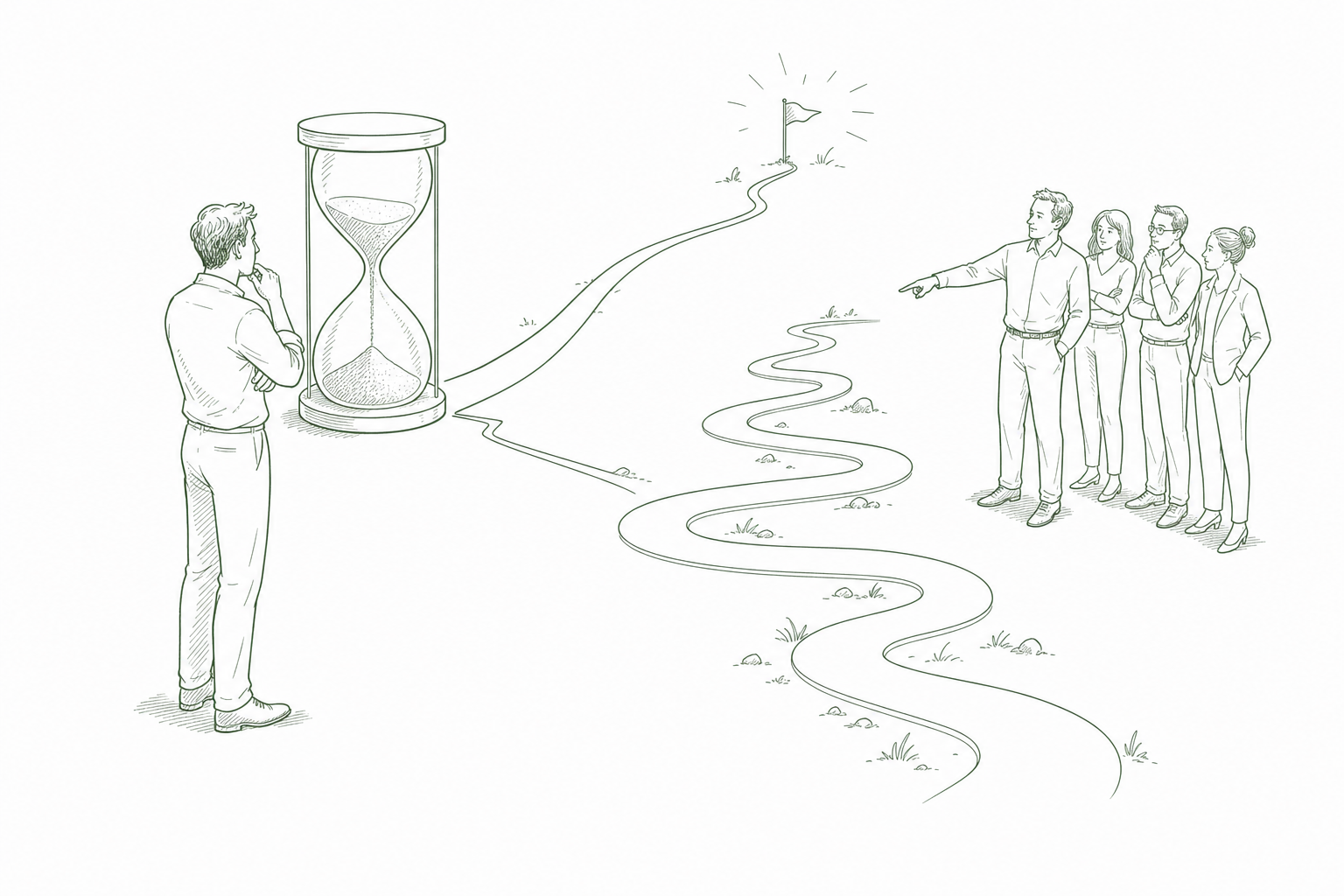
In 1979, Daniel Kahneman and Amos Tversky published a paper on intuitive prediction that identified something everyone already knew but nobody had named. They called it the planning fallacy: the systematic tendency to underestimate the time, cost, and risk of future actions while overestimating the benefits. Not occasionally. Not for novel tasks. For everything. Repeatedly. Even after being warned about it.
The finding was not that people are bad at planning. It was that people are predictably, reliably, structurally bad at planning — and that experience does not fix it. A person who has missed ten deadlines in a row will still predict that the eleventh project will come in on schedule. The bias survives failure. It survives evidence. It survives being told directly that you are subject to it.
If you have ever built a product, launched a company, estimated a sprint, or told an investor you would hit a milestone by Q3, you have lived inside the planning fallacy. The question is not whether it affects you. It is whether you have any structural mechanism for correcting it.
The inside view: why your plan always feels right
Kahneman later expanded the concept in his 2011 book Thinking, Fast and Slow, drawing a distinction between what he called the "inside view" and the "outside view" of any project.
The inside view is how founders naturally think. You look at your specific situation — your team, your product, your market, your advantages — and you construct a plan based on the scenario you imagine unfolding. You think about the steps required and estimate how long each one will take. You anticipate some obstacles but not others. The scenario you build in your head is coherent, logical, and optimistic. It has to be. You are constructing it from your own intentions, your own competence, your own sense of how things should go.
The outside view is what everyone else sees. It asks a different question entirely: what happened when other people tried to do something like this? Not you specifically. Not your company specifically. Other people, other companies, other projects of similar scope and complexity. The outside view does not care about your plan. It cares about the base rate — the statistical reality of how these things actually turn out.
The research is unambiguous about which view wins. In a landmark 1994 study published in the Journal of Personality and Social Psychology, Roger Buehler, Dale Griffin, and Michael Ross ran five experiments with 465 participants. They found that people's predictions of their own task completion times were "too optimistic for a variety of academic and nonacademic tasks." Participants focused almost exclusively on plan-based scenarios — the inside view — when making predictions. They ignored or actively dismissed their own past experiences of running late.
Here is the finding that matters most for founders: participants were accurate when predicting other people's completion times. The bias is not about intelligence or forecasting ability. It is about the difference between looking at your own project from the inside — where you can see your plan — and looking at someone else's project from the outside, where all you can see is the pattern.
The numbers are worse than you think
The planning fallacy is not a subtle effect. It is not a rounding error in estimation. The gap between what people predict and what actually happens is large enough to destroy companies.
Bent Flyvbjerg, a professor at the University of Oxford (now at the IT University of Copenhagen), has spent two decades building the largest database of project outcomes ever assembled — more than 16,000 projects across infrastructure, IT, energy, and defense. His findings: fewer than half of projects come in on budget. Only 8.5 percent come in on both budget and on time. And just 0.5 percent deliver on budget, on time, and with the promised benefits.
The mean cost overrun across his database is 62 percent. Not 10 percent. Not 20. Sixty-two. And the distribution has a fat tail — 18 percent of IT projects alone have cost overruns above 50 percent. These are not amateur operations run by first-time managers. They are major projects with professional teams, consultants, and oversight. They all fell victim to the same bias.
Flyvbjerg's explanation aligns with Kahneman's. Every project team takes the inside view. They look at their specific plan, their specific resources, their specific timeline. They do not ask: what happened to the last hundred projects of similar scope? Because if they did, the answer would be uncomfortable. The answer would be: you are going to be late and over budget, and the question is only by how much.
Why founders are especially vulnerable
The planning fallacy affects everyone. But founders occupy a unique position that amplifies it.
First, founders are selected for optimism. Venture capital, angel investment, even self-funding — all of it requires a founder to believe that their project will succeed when the base rate for startup success is roughly 10 percent. Optimism is a feature, not a bug, in entrepreneurship. But that same optimism makes founders particularly susceptible to the inside view. They have to believe their plan will work. That belief is load-bearing. Remove it and the venture collapses.
Second, founders operate in environments with weak feedback loops. An employee who misses a deadline gets a performance conversation. A founder who misses a milestone revises the milestone. The feedback desert that surrounds leadership means the planning fallacy compounds without correction. Each optimistic estimate that turns out to be wrong is attributed to specific circumstances — the API integration took longer than expected, the hire fell through, the market shifted — rather than to a systematic tendency to underestimate everything.
Third, founders are making decisions in isolation. The Buehler et al. research showed that people are accurate forecasters when assessing other people's timelines. The correction mechanism exists — it is the outside view. But solo founders and small founding teams do not have access to that correction. They are generating inside-view estimates in a closed loop. There is no one in the room whose job it is to say: "That timeline is wrong, and here is why."
Reference class forecasting: the academic fix
Kahneman proposed a specific corrective: reference class forecasting. Instead of building a plan from the inside and estimating how long it will take, you start from the outside. You identify a reference class — a set of similar projects completed by other people — and you use the statistical distribution of their outcomes as your baseline. Then you adjust from there, rather than from your plan.
Flyvbjerg turned this into a practical methodology. In 2006, he published a paper in Project Management Journal titled "From Nobel Prize to Project Management: Getting Risks Right," arguing that reference class forecasting should be mandatory for major projects. The British government adopted his methodology for transport planning. The American Planning Association endorsed it for infrastructure projects. It works.
But here is the problem for founders: reference class forecasting requires data about similar projects. If you are building something genuinely new — a product that does not exist yet, for a market you are still defining — the reference class is ambiguous. You cannot look up the base rate for "AI-powered peer matching for founders" because the category barely exists. Startups live at the edge of reference classes, where the data is thinnest and the inside view feels most justified.
Which is precisely why the correction has to come from people, not data.
Why the fix is not discipline — it is other people
The standard advice for the planning fallacy is to add a buffer. Multiply your estimate by two. Build in contingency. Plan for the worst case.
This does not work. Buehler, Griffin, and Ross tested it directly. Even when participants were explicitly asked to generate a "realistic" estimate and then a separate "worst-case" estimate, their worst-case estimates were still more optimistic than the actual outcomes. The bias is not about carelessness. It is about how the brain constructs plans. When you imagine your project, you imagine it working. The scenarios you simulate in your head are overwhelmingly success scenarios with complications, not failure scenarios with recovery. You cannot buffer your way out of a cognitive architecture that generates optimistic forecasts by default. And when decision fatigue compounds the problem — depleting the cognitive resources needed to override that default — the forecasts get even worse.
What does work is the mechanism that the 1994 study already identified: other people's assessments. Participants who estimated other people's completion times were accurate. They did not have access to better information. They did not use sophisticated models. They simply did not have the inside view. They looked at someone else's project and saw the pattern instead of the plan.
This is why accountability structures correct the planning fallacy in a way that self-discipline cannot. A peer who hears your timeline and says "That sounds aggressive — what happened the last three times you estimated something like this?" is not being pessimistic. They are applying the outside view. They are doing what your brain literally cannot do for your own projects: seeing the base rate instead of the plan.
The peer group as a living reference class
A well-designed peer group functions as something that neither a mentor, an advisor, nor a therapist can replicate: a living, recurring reference class.
Consider what happens in a hot seat. A founder presents a plan — a product launch, a fundraise, a hiring sprint — with a timeline. The peers in the room do not have the inside view of that plan. They see the pattern. They have attempted similar things, or watched others attempt them. They know, from experience, what the base rate looks like. And the structure requires them to say so.
This is not the same as getting advice. Advice comes from above — someone with more experience telling you what to do. The planning fallacy is not a knowledge gap. It is a perspective gap. You know intellectually that projects take longer than expected. You know your own track record. You still generate optimistic estimates because the inside view is the only view available when you are planning alone.
Peers supply the outside view. Not because they are smarter. Because they are outside.
The research on social facilitation supports this structural argument. Zajonc's foundational work showed that the mere presence of others changes cognitive processing — increasing arousal and shifting attention toward dominant responses. In the context of planning, "dominant response" maps to the inside view. But when peers actively challenge a timeline or ask probing questions, they interrupt the dominant response and force the outside view into the conversation.
The Kohler effect adds another dimension. When you know your peers will ask next month whether you hit the timeline you stated this month, you set a timeline you can actually defend — not one that sounds impressive. The accountability recalibrates the estimate at the moment of making it. You are still subject to the planning fallacy. But you are subject to it in a room full of people who will notice.
The correction that experience cannot provide
The deepest finding in the planning fallacy literature is that experience does not fix the bias. This is counterintuitive. You would expect that after missing five deadlines, a founder would start building in more buffer on the sixth. They do not. Kahneman called this the "singular" nature of the inside view — each new project feels unique, and past failures are attributed to specific causes that "will not happen this time."
This is not irrationality. It is how the brain processes narrative. When you recall a past project that ran late, you remember why it ran late — the specific, circumstantial reasons. The delayed shipment. The engineer who quit. The regulation change. You file the delay under those causes, not under "I systematically underestimate how long things take." Each failure is explained away. The pattern is never extracted.
A recurring peer group breaks this cycle because other people do not share your narrative. When you tell the same group for the third time that a project is taking longer than expected, they see the pattern even if you do not. They do not accept the singular explanation. They point at the trend. And because the relationship is recurring — not a one-off mentor call, not a conference conversation, not a Slack thread — the pattern has enough data points to become undeniable.
This is what confirmation bias looks like in planning: you seek evidence that supports your timeline and dismiss evidence that contradicts it. A peer group does not let you do that. The outside view is not a technique you can apply to yourself. It is a perspective that requires, by definition, someone else.
The cost of optimism without correction
The planning fallacy has a real body count in startups. Founders who underestimate timelines burn cash faster than projected. They overpromise to investors and underdeliver. They hire against an aggressive timeline and end up carrying payroll for people who do not have enough to do yet. They announce products before they are ready and damage trust with early customers.
CB Insights has analyzed post-mortems from more than a thousand failed startups, and "ran out of cash" consistently appears as the number one or two cause of death. Running out of cash is rarely a surprise in hindsight. It is the predictable consequence of planning fallacy: the timeline was wrong, the costs were higher, the revenue came later, and the runway ran out before the plan caught up with reality.
The correction is not pessimism. Nobody builds a company by assuming everything will go wrong. The correction is calibration — making plans that are closer to reality, not closer to hope. And the research is clear: calibration comes from the outside view. From other people who can see your plan without being inside it.
Every founder who has sat in a peer group and heard someone say "That timeline sounds like what I told myself two years ago, and here is what actually happened" has experienced reference class forecasting in its most practical form. No spreadsheet. No statistical model. Just another person who has been through something similar and can see what you cannot see about your own plan.
That is the correction that discipline cannot provide, that experience does not teach, and that no amount of solo reflection will deliver. You cannot take the outside view of your own inside view. You need someone else in the room.