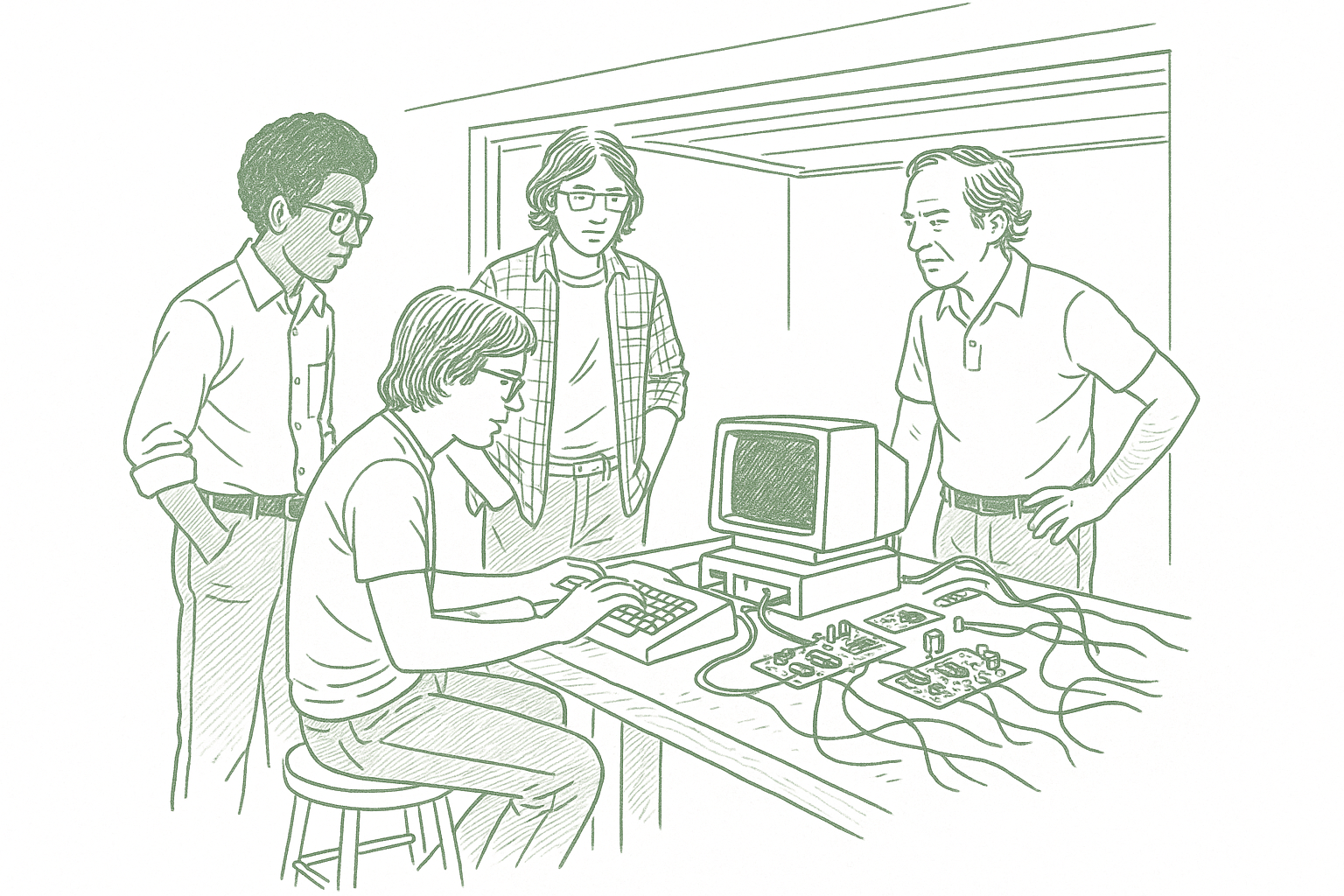
On the evening of March 5, 1975, it was raining in Silicon Valley. Thirty-two people showed up anyway. They crammed into Gordon French's garage in Menlo Park, California, sat on the cement floor, and passed around the first MITS Altair 8800 microcomputer anyone in the area had ever seen. The machine couldn't do much. It had no keyboard, no screen, no software worth mentioning. You programmed it by flipping toggle switches. But the people in that garage didn't see a primitive box of blinking lights. They saw the future.
The meeting was organized by French and Fred Moore, two hobbyists who had met at the Community Computer Center in Menlo Park. Moore was an activist with a philosophy degree and a passion for making technology accessible. French was an engineer who wanted a regular forum for people building computers at home. Neither of them imagined they were starting something that would produce Apple Computer, the first portable PC, the first cartridge-based video game console, and a dozen other companies that would define the technology industry.
They called it the Homebrew Computer Club. It met biweekly for eleven years, from 1975 to 1986. Steven Levy, who chronicled the group in his book Hackers, called it "the crucible for an entire industry." That's not hyperbole. The club's membership list reads like a founding document of personal computing.
The room
The first meeting outgrew French's garage almost immediately. By the second session, the club moved to Peninsula School in Menlo Park. Soon after, it landed at the Stanford Linear Accelerator Center (SLAC), where meetings were held in a proper auditorium. The format was simple and, in retrospect, remarkably well-designed for what it needed to do.
Each meeting had two parts. The first was "mapping time" — a structured session where members stood up and shared what they were working on, what problems they were hitting, and what they had learned since the last meeting. This was show-and-tell for adults who happened to be building the most consequential technology of the twentieth century.
The second part was "random access" — a free-form period where members circulated, swapped components, traded schematics, debugged each other's circuits, and argued about design choices. The terminology itself was a joke borrowed from computer memory architecture: random access, as opposed to sequential. You could talk to anyone about anything.
After the formal meetings at SLAC, a core group would reconvene at The Oasis, a bar and grill on El Camino Real in Menlo Park. At the suggestion of Roger Melen, the hobbyists would pile into wooden booths, order pitchers of beer, and keep going. Steven Levy described the scene: members "emboldened by the meeting's energy and pitchers of beer" extending the night's conversations into the small hours. The Oasis became, in the words of one member, "Homebrew's other staging area."
The club had no formal membership. No dues. No bylaws. Anyone who showed up once was considered a member and could sign up for the newsletter. At its peak, the newsletter went to over 1,500 people, though typical meeting attendance was several hundred. Lee Felsenstein, who served as the club's informal moderator, would open each session by announcing "the convening of the Homebrew Computer Club, which does not exist" — and everyone would applaud.
The informality was the point. This was not a professional organization. It was not a trade association. It was a room full of people who were obsessed with making computers work, who couldn't find that conversation anywhere else, and who showed up every two weeks because the alternative was figuring it out alone.
The people who showed up
Steve Wozniak was a 24-year-old engineer at Hewlett-Packard when he attended the first meeting. He credited that evening as the direct inspiration for designing the Apple I. "Without computer clubs there would probably be no Apple computers," Wozniak later wrote. "Our club in the Silicon Valley, the Homebrew Computer Club, was among the first of its kind. It was in early 1975, and a lot of tech-type people would gather and trade integrated circuits back and forth. You could have called it Chips and Dips."
Wozniak was shy. He didn't give speeches. He sat in the back, or he staked out the only seat with a power outlet so he could plug in whatever he was building that week. What he did was bring his designs to the meeting, show them during random access, and get feedback. The Apple I — the machine that would launch the most valuable company in human history — was designed specifically to impress the people in that room.
Wozniak later reflected on this in his autobiography iWoz: "I designed Apple's first products, the Apple I and II computers, because I wanted to use them and they didn't exist." He gave away the schematics freely, went to members' houses to help them build their own, and treated the whole project as a hobby. It was his friend Steve Jobs — who also attended meetings, watching from the side — who saw the commercial potential and insisted they start a company.
But Apple was just the most famous company to emerge from the club. The roster of Homebrew alumni is staggering:
- Steve Jobs and Steve Wozniak — founded Apple Computer, now the world's most valuable public company
- Lee Felsenstein — designed the Osborne 1, the first commercially successful portable computer, and the Sol-20, the first fully assembled personal computer
- Adam Osborne — founded Osborne Computer Corporation, pioneer of the portable PC
- Harry Garland and Roger Melen — co-founded Cromemco, which built high-end microcomputers used by military and industry worldwide
- Bob Marsh — founded Processor Technology, which created 4K memory boards for the Altair and the Sol-20
- George Morrow — founded Morrow Designs, a major early PC manufacturer
- Paul Terrell — founded the Byte Shop, one of the first retail computer stores in the world, and the first retailer to sell the Apple I
- Jerry Lawson — created the Fairchild Channel F, the first cartridge-based home video game console
- John Draper — "Captain Crunch," legendary hacker and phone phreaker who pioneered early computer security
- Li-Chen Wang — wrote Palo Alto Tiny BASIC, one of the first programming languages for microcomputers
- Jef Raskin — initiated the Macintosh project at Apple
At least twenty-three companies were founded by Homebrew members. The club didn't produce one success story. It produced an entire industry. And the mechanism was not funding, not mentorship, not any formal program. It was a biweekly meeting where people who were building the same kind of thing could talk to each other about it.
Why that room, at that time
Liza Loop, one of the first women members of the club, identified two factors that made Homebrew work: "One was where it was, because it was in Silicon Valley. The other thing was the California counter-culture which encouraged the free exchange of ideas."
She was right on both counts. Silicon Valley in 1975 was not yet "Silicon Valley" in the way we use the term today. There was no venture capital ecosystem to speak of. No startup culture. No accelerators or incubators. What there was: a concentration of engineers who worked at places like Hewlett-Packard, Intel, Xerox PARC, and the Stanford Research Institute, plus a counterculture movement that treated information as something to be liberated, not hoarded.
The Homebrew Computer Club lived at the intersection of those two forces. Its members had serious technical skills — most had backgrounds in electronic engineering or computer programming — but they also had a philosophical commitment to openness that would later become the foundation of the open-source movement. Schematics were shared freely. Software was passed around. When Wozniak designed the Apple I, he handed out the complete design to anyone who wanted it. The ethos was: if I figure something out, the room should know.
Not everyone agreed with this approach. Bill Gates, then a young programmer in Albuquerque, published his infamous "Open Letter to Hobbyists" in the Homebrew newsletter in 1976. His Altair BASIC was being copied and shared freely among club members, and Gates was livid. "Most of you steal your software," he wrote. "Who can afford to do professional work for nothing?" The letter was booed at the next meeting. The tension between open and proprietary would define the industry for the next fifty years — and it started in that room.
But the openness was not just philosophical. It was practical. When your network is tight enough that information flows freely, everyone moves faster. A problem solved by one member at Tuesday midnight was shared with 200 members by the next meeting. A circuit design that took someone weeks to perfect was available to everyone in the room within an hour of random access. The Homebrew Computer Club was, in effect, a distributed research lab with no budget, no management, and no walls.
The structure nobody noticed
The Homebrew Computer Club looked informal. It felt informal. Members would have told you it was informal. But it had structure — the kind of structure that works precisely because nobody thinks of it as structure.
The mapping-time and random-access format did something specific: it ensured that every member had a reason to show up with something to share. The social expectation was that you were building, experimenting, or learning between meetings. If you came with nothing to report during mapping time, you were still welcome — but the implicit standard was contribution, not observation.
The newsletter, produced by Moore and other volunteers, extended the conversation between meetings. It published technical articles, meeting summaries, and member announcements. It was hand-typed, photocopied, and mailed — but it served the same function as any knowledge base: it captured what the group knew and made it accessible to members who couldn't attend every session.
The biweekly cadence created rhythm without burnout. Members knew the next meeting was always coming. Projects had natural two-week sprint cycles. And the post-meeting gatherings at The Oasis created an inner circle of the most committed members, the kind of smaller group within the group that does the real work in any large organization.
Most importantly, the club created what the sociologist Mark Granovetter would call "strong ties" — deep, reciprocal relationships between people who share context and trust. These were not networking contacts. These were the people who came to your house to help you debug your circuit board at midnight. The people who lent you components. The people who told you honestly that your design had a fatal flaw, and then helped you fix it.
Networking events give you business cards. Peer groups give you co-conspirators. The Homebrew Computer Club was a room full of co-conspirators.
The $3 trillion garage
It's worth pausing to consider the scale of what came out of that garage.
Apple alone is worth over $3 trillion as of 2025. The Macintosh, initiated by Homebrew member Jef Raskin, defined the modern graphical user interface. The portable computing industry, launched by Homebrew member Adam Osborne and designed by Homebrew moderator Lee Felsenstein, led directly to the laptop. The video game console industry, catalyzed by Homebrew member Jerry Lawson's cartridge-based system, is now a $200 billion global market. Paul Terrell's Byte Shop was one of the first computer retailers, establishing the model for how personal computers would be sold to consumers.
And those are just the companies. The ideas that emerged from Homebrew — that computers should be personal, that hardware designs should be shared, that anyone with curiosity and soldering skills could participate in computing — shaped the entire trajectory of the technology industry. The open-source movement, the maker culture, the hacker ethic, the startup-in-a-garage mythology that defines Silicon Valley to this day: all of it traces a direct line back to that biweekly meeting at SLAC.
The irony is that the club itself was never a business. It never raised money. It never had a business model. Fred Moore, the co-founder, was a pacifist who had burned his draft card and lived communally. Gordon French was an engineer who just wanted to talk about computers. The club succeeded as an incubator for an industry precisely because it wasn't trying to be one. It was a room where people who cared about the same thing could push each other forward.
A pattern that keeps repeating
The Homebrew Computer Club disbanded in December 1986, after eleven years. By then, the personal computer industry was established, the hobbyists had become professionals, and the garage ethos had given way to corporate computing. But the pattern the club embodied — a small group of obsessed people meeting regularly to share what they know — didn't end. It just kept showing up in different forms.
The Ratio Club had done it in 1949, when twenty-one young British scientists met in a hospital basement and invented artificial intelligence over beer and sandwiches. The Fairchild Eight had done something similar two decades earlier, when eight semiconductor researchers left Shockley's lab together and seeded the entire chip industry. The PayPal Mafia would do it two decades later, when a group of PayPal alumni leveraged their shared experience into Tesla, LinkedIn, YouTube, Palantir, and Yelp. Ben Franklin's Junto had done it two centuries earlier with twelve tradesmen and a tavern room. The Lunar Society had done it across four decades of monthly dinners, producing the steam engine, the discovery of oxygen, and the Industrial Revolution itself.
The history of human achievement is the history of small groups. Not conferences. Not networks. Not LinkedIn connections. Small rooms where prepared people show up consistently, share what they're building, give honest feedback, and hold each other to a standard.
Wozniak understood this instinctively. "We had similar interests and we were there to help other people," he said, "but we weren't official and we weren't formal." The Homebrew Computer Club had no mission statement. It had no application process. It had no formal accountability structure. What it had was a room, a schedule, and a group of people who couldn't not show up — because the conversation they needed wasn't happening anywhere else.
That's the oldest formula in the world. And it still works.