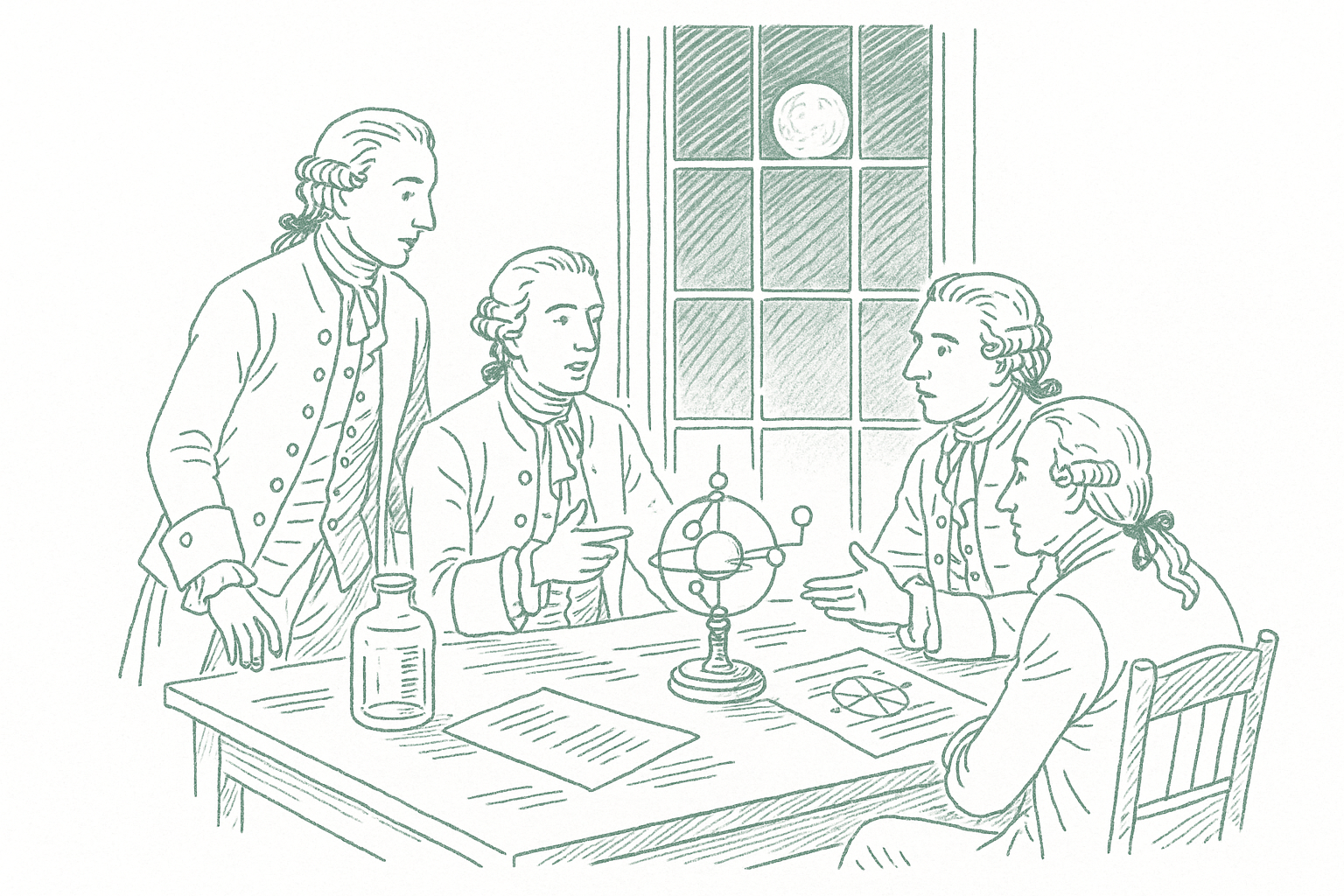
Birmingham, England, in the 1760s, was not where you would expect the future to be invented. London had the Royal Society. Edinburgh had the Scottish Enlightenment. Paris had the philosophes. Birmingham had a silversmith, a physician who wrote poetry, and a potter who couldn't spell.
But those three men — Matthew Boulton, Erasmus Darwin, and Josiah Wedgwood — and the small group they assembled around themselves would do more to reshape the material conditions of human life than any salon, academy, or university of their century. They called themselves the Lunar Society. Their enemies called them radicals. They called each other "Lunaticks," because they met on the Monday nearest the full moon. The moonlight was practical: without street lamps, you needed it to find your way home after dinner.
The society met regularly from about 1765 to 1813 — nearly fifty years. It never had more than fourteen core members. It produced no constitution, no minutes, no membership lists. No formal publication ever bore its name. And yet historian Jenny Uglow, who spent a decade chronicling the group in The Lunar Men, concluded that their collaborative efforts were "unmatched until the present, with the arrival of the Internet."
That is not an exaggeration. It might be an understatement.
The room at Soho House
The society's most frequent meeting place was Soho House in Handsworth, the home of Matthew Boulton. Boulton was the leading industrialist of the age — a manufacturer who had built the Soho Manufactory into the most advanced factory in England, producing everything from silverware to coins for the Royal Mint. His home was elegant but not ostentatious, the kind of place where dinner conversation ranged from metallurgy to philosophy without anyone thinking the transition was strange.
The format was simple. Members gathered for dinner, usually around 2:00 in the afternoon by eighteenth-century custom, and talked until 8:00 in the evening. The conversations covered science, technology, medicine, industry, education, politics, and whatever else the members happened to be pursuing at the time. There were no formal presentations. No agendas. No officers. The historian Robert Schofield described the meetings as "occasions for uninhibited argument and scientific experimentation conducted among friends."
The informality was deliberate. Unlike the Royal Society in London, which had formal membership, dues, and presentation protocols, the Lunar Society was built entirely on friendship and shared obsession. You didn't apply to join. You were invited because someone in the group thought you were interesting enough to argue with over dinner for six hours.
But the meetings were only the surface. The real work happened between them. Members local to Birmingham were in almost daily contact. More distant ones corresponded at least weekly. Letters flew between Lichfield, Birmingham, Staffordshire, and eventually across the Atlantic. The monthly dinner was the heartbeat. The daily exchange of ideas was the bloodstream.
Fourteen people who changed everything
The Lunar Society's core membership reads like a list of people you were supposed to learn about in school but somehow didn't.
Matthew Boulton (1728–1809) was the group's anchor. An entrepreneur and manufacturer, he built the Soho Manufactory into the model for industrial production worldwide. He pioneered modern coinage, introduced some of the first workers' insurance schemes and sick pay, and partnered with James Watt to bring the steam engine to the world.
James Watt (1736–1819) was, by temperament, a perfectionist engineer who might have tinkered with his steam engine designs forever. It was Boulton who told him to stop iterating and start producing. Their partnership — Boulton & Watt — manufactured steam engines that powered factories, mines, and mills across Britain and beyond. The unit of electrical power, the watt, bears his name.
Erasmus Darwin (1731–1802) was a physician, poet, inventor, and the intellectual engine of the group. He published a theory of biological evolution sixty years before his grandson Charles did the same. He developed a steering mechanism later adopted by Henry Ford. He designed a speaking machine, a copying device, and a canal lift. In his spare time he wrote epic poems about botany that became bestsellers.
Josiah Wedgwood (1730–1795) transformed English pottery from a cottage craft into a global industry. He built his factory at Etruria, Staffordshire, explicitly modeled on Boulton's Soho Manufactory — a direct transfer of ideas between Lunar members. He invented the pyrometer for measuring high temperatures in kilns, and he was among the most prominent abolitionists in England. He was also Charles Darwin's other grandfather.
Joseph Priestley (1733–1804) was a radical clergyman, political theorist, and scientist who discovered oxygen on August 1, 1774 — though he called it "dephlogisticated air." He also discovered carbon dioxide, nitrous oxide, and the process for carbonating water. He moved to Birmingham specifically to be closer to the Lunar Society and became one of its most active members.
William Withering (1741–1799) was a physician and botanist who discovered that digitalis, extracted from the foxglove plant, could treat heart disease — one of the most important pharmaceutical discoveries in medical history, still in use today.
James Keir (1735–1820) was a chemist who developed processes for manufacturing alkali and soap at industrial scale, making hygiene products affordable for ordinary people for the first time.
The other regular members — William Small, Richard Lovell Edgeworth, Thomas Day, John Whitehurst, Samuel Galton Jr., Robert Augustus Johnson, and Jonathan Stokes — contributed variously in mathematics, education, horology, arms manufacturing, and botanical classification. The group also maintained active correspondence and occasional meeting attendance from Benjamin Franklin, who was introduced to Boulton by John Michell in 1758.
Fourteen people. A monthly dinner. And from that table: the steam engine, the discovery of oxygen, the industrialization of ceramics, the foundation of evolutionary theory, the treatment for heart failure, the canal system that connected England's rivers, affordable soap, and modern industrial manufacturing practice. Not bad for a dinner club.
The catalyst and the crisis
The man who turned a loose circle of friends into a functioning intellectual engine was William Small. A Scottish physician and mathematician, Small had been Professor of Natural Philosophy at the College of William & Mary in Virginia, where he was the primary intellectual influence on a young Thomas Jefferson. Jefferson later wrote that Small "fixed the destinies of my life."
When Small moved to Birmingham in 1765, carrying a letter of introduction to Boulton from Benjamin Franklin, he became the catalyst that crystallized the group. Before Small, Boulton and Darwin were friends who shared interests. After Small, they were a society with a purpose. Small introduced new members, formalized the meeting schedule around the full moon, and created the gravitational pull that drew Watt, Wedgwood, and Priestley into the orbit.
Small died in 1775, probably of malaria, at the age of 40. Rather than dissolving, the group responded by becoming more organized. This is the moment when "the Lunar Circle" became "the Lunar Society" in members' correspondence — a deliberate tightening of identity in response to loss. William Withering was recruited to fill Small's seat. Priestley finally moved to Birmingham. The society entered its most productive era.
That pattern — a group that strengthens when tested — is one of the hallmarks of a psychologically safe, high-trust team. Casual networks scatter when a key member leaves. Real groups absorb the blow and get tighter.
Why it worked
The Lunar Society was not a club for people who wanted to discuss ideas in the abstract. It was a club for people who were building things and needed other builders to argue with.
Consider what happened when Watt joined. He had been working on improving the Newcomen steam engine for years, mostly alone in Glasgow. The engine worked, but barely. Watt's key insight — the separate condenser — was brilliant in theory but nightmarish in practice. He couldn't find anyone capable of manufacturing the precision cylinders his design required. He was stuck.
Boulton solved the manufacturing problem. Erasmus Darwin provided intellectual encouragement and helped work through theoretical challenges. Keir advised on the chemistry of metals. The Lunar Society didn't invent the steam engine. Watt did that. What the society did was surround him with people who could help him make it real. The partnership of Boulton & Watt, formalized in 1775, was a direct product of the Lunar dinner table.
The same dynamic played out across the group. Wedgwood needed high-temperature measurement for his kilns and developed the pyrometer with input from the group's scientists. Darwin's ideas on biological evolution were sharpened through decades of dinner arguments with Priestley and Withering. Priestley's experiments on gases were conducted using apparatus manufactured at Boulton's factory. The people around you don't just influence your thinking. They determine what you're able to build.
A paper presented at the Science Museum in London put it precisely: "Of all the provincial philosophical societies it was the most important, perhaps because it was not merely provincial. All the world came to Soho to meet Boulton, Watt or Small, who were acquainted with the leading men of Science throughout Europe and America."
The riot and the end
The Lunar Society's members were, almost to a man, political radicals. They supported the American Revolution. Most of them supported the French Revolution. Priestley was an outspoken Unitarian who publicly attacked the Church of England. In conservative Birmingham, this made them targets.
On July 14, 1791 — the second anniversary of the storming of the Bastille — a mob attacked Priestley's house and laboratory, destroying his scientific instruments, library, and years of unpublished research. The rioters moved on to Withering's home. Boulton and Watt armed their factory workers to defend the Soho Manufactory. The Priestley Riots, as they became known, lasted three days and fundamentally changed the group's trajectory.
Priestley left Birmingham, eventually emigrating to the United States in 1794. The remaining members continued to meet, but the original energy was fading. The founding generation was aging. Boulton was in his sixties. Darwin died in 1802. Their sons — Gregory Watt, Matthew Robinson Boulton, Thomas Wedgwood, James Watt Jr. — tried to keep the meetings going, but they were a different generation with different interests.
The last recorded meeting appears to have been around 1813. The Lunar Society dissolved not with a collapse but with a quiet exhalation. The men who had built it had changed the world, and then they died.
Dinner is the format
The historian Jacob Bronowski wrote of the Lunar Society: "What ran through it was a simple faith: the good life is more than material decency, but the good life must be based on material decency." These were not aristocrats philosophizing. They were tradesmen, manufacturers, physicians, and chemists who believed that practical problems deserved collective intelligence, and that a monthly dinner with the right people was the best technology available for producing it.
The pattern repeats throughout history. Ben Franklin's Junto met weekly in a Philadelphia tavern and built a city's institutions. The Inklings gathered in an Oxford pub and produced the most enduring fantasy literature of the twentieth century. The Homebrew Computer Club met biweekly in a garage and launched the personal computer revolution. The Bloomsbury Group reshaped modern art and literature from a London living room. The Vienna Circle rewrote the rules of science from a Thursday evening seminar in Vienna.
The constant is not the century, the country, or the discipline. The constant is the structure: a small group of committed people who show up regularly, share what they're working on, hold each other accountable, and push each other past what any of them could achieve alone. The Lunar Society had no budget, no institutional backing, no formal authority. It had a dinner table, a full moon, and fourteen people who refused to work in isolation.
Two and a half centuries later, the formula hasn't changed. The question is whether you're sitting at that table or eating alone.