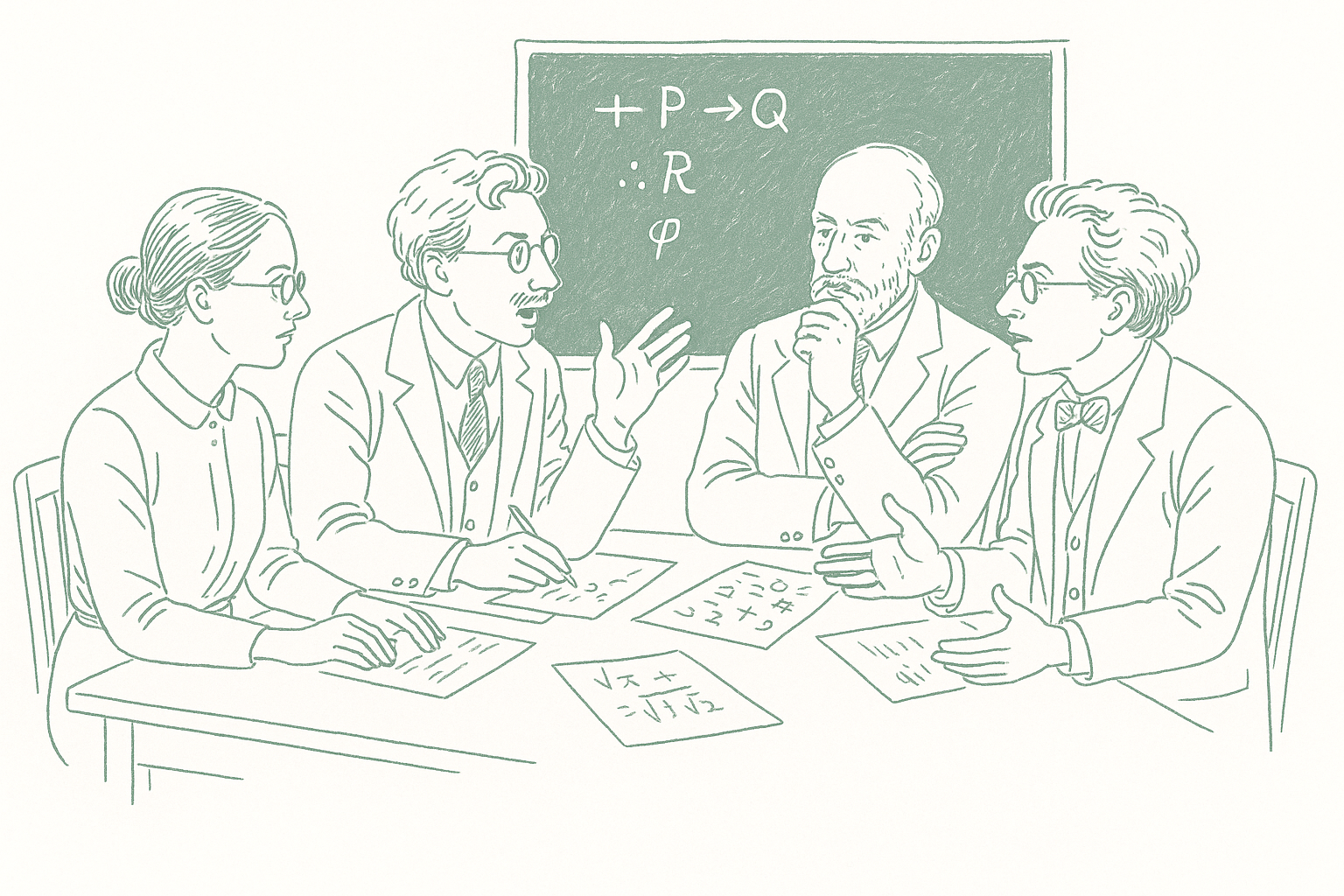
In 1922, the University of Vienna appointed a German physicist named Moritz Schlick to a prestigious chair in the philosophy of science — the same position once held by Ernst Mach, the man whose ideas about perception and observation had influenced Albert Einstein. Schlick was 40, slight, courteous, and intensely serious about one question: what can we actually know, and how do we know it?
Within two years, Schlick had gathered a group of roughly a dozen thinkers who began meeting every Thursday evening in a ground-floor room at the university's Mathematical Institute on Boltzmanngasse 5. Philosophers. Mathematicians. Physicists. Social scientists. They called themselves the Wiener Kreis — the Vienna Circle.
The group met weekly for twelve years. In that time, they produced a philosophical revolution that reshaped the foundations of science, birthed an entirely new discipline (the philosophy of science as we know it), and laid the intellectual groundwork for computer science, analytical philosophy, and the formalization of knowledge that now powers artificial intelligence. They published manifestos, journals, and book series. They organized international congresses from Prague to Cambridge. They attracted — or provoked — some of the greatest minds of the century.
Then their leader was murdered on the university steps, fascism devoured Austria, and the Circle was destroyed. Its members fled to England and America, where they seeded the departments and disciplines that would dominate twentieth-century thought. The room was gone. The ideas were everywhere.
The room on Boltzmanngasse
The Vienna Circle's membership was deliberately cross-disciplinary. Schlick, the organizer and chair, was a physicist-turned-philosopher who had written one of the first philosophical commentaries on Einstein's theory of relativity. Hans Hahn was a mathematician whose work on functional analysis remains foundational. Philipp Frank was a theoretical physicist. Otto Neurath was a political economist and sociologist with enormous intellectual ambition — he would later devise the Isotype system of pictorial statistics that influenced modern data visualization and infographics. Rudolf Carnap, who joined in 1926, was a logician whose work on formal languages and the structure of scientific theories would make him arguably the most important philosopher of science in the twentieth century.
Then there were the younger members. Friedrich Waismann, a mathematician and philosopher who served as the group's unofficial liaison with Ludwig Wittgenstein. Herbert Feigl, one of Schlick's first doctoral students, who would later transplant logical empiricism to American universities. Gustav Bergmann. Viktor Kraft. And, attending some meetings as a quiet young visitor, a 24-year-old logician named Kurt Godel — who in 1931 would publish two incompleteness theorems that shattered the foundations of mathematics and remain among the most important results in the history of logic.
The group's periphery was even more remarkable. Wittgenstein, whose Tractatus Logico-Philosophicus the Circle studied line by line for two years, attended private meetings with Schlick and Waismann but refused to join the group formally. Karl Popper, who would become the century's most influential philosopher of science, interacted closely with Circle members — and built his career partly by arguing against them. The Berlin Circle, led by Hans Reichenbach, operated as a sister group. Albert Einstein corresponded with several members. Bertrand Russell's work was foundational to their project.
This was not a social club. It was a small group of carefully selected minds, meeting with regularity and purpose, producing collaborative work that none of them could have achieved alone.
What they were trying to do
The Vienna Circle's project was radical: they wanted to eliminate nonsense from intellectual life. Not rudeness or vulgarity — they meant metaphysical claims that could never, even in principle, be tested against experience. Statements about the nature of Being, the essence of the soul, the purpose of existence. The Circle argued that these statements were not merely wrong. They were meaningless. They used words that looked like they meant something, but when you examined them carefully, they failed the only test that mattered: they couldn't be verified by any possible observation.
This was the verification principle — the idea that the meaning of a statement is its method of verification. If you can't even specify what evidence would count for or against a claim, the claim isn't false. It isn't even a claim. It's noise dressed up as philosophy.
The practical implications were enormous. The verification principle gave scientists a tool for distinguishing real questions from pseudo-questions. When Niels Bohr and Werner Heisenberg developed the Copenhagen interpretation of quantum mechanics, they drew directly on the Circle's ideas. Bohr's defense against Einstein's objections to quantum theory's "incompleteness" was essentially verificationist: if you can't specify an observation that would reveal a particle's simultaneous position and momentum, the question of whether it "has" both simultaneously is not a scientific question.
The Circle also pursued the unity of science — the idea that all genuine knowledge, from physics to sociology, shares a common logical structure and should be expressible in a single formal language. Carnap's The Logical Structure of the World (1928) attempted to show how all scientific concepts could be built up from elementary experiences using logical construction. Neurath pushed for an International Encyclopedia of Unified Science, a massive collaborative project to demonstrate the interconnection of all empirical knowledge — a predecessor, in ambition if not in form, to Wikipedia.
The scope of their ambition is staggering. A weekly discussion group of twelve to fifteen people set out to rebuild the foundations of knowledge itself. And they made extraordinary progress.
How the room worked
The Circle's meetings followed a consistent structure. They met on Thursday evenings during academic terms — roughly weekly from October through June. Schlick chaired, though "chaired" might overstate his role. He was gentle, diplomatic, more likely to ask a clarifying question than to impose a direction. The group discussed problems, not personalities. They read papers aloud, debated propositions, and worked through logical puzzles collectively.
The format was neither lecture nor seminar. It was closer to what a modern organizational psychologist would recognize as a psychologically safe team engaged in structured problem-solving. Members brought diverse expertise — Hahn brought mathematical rigor, Neurath brought social science breadth, Carnap brought logical precision, Frank brought physical intuition — and the collision of perspectives produced ideas that no individual field could have generated.
Crucially, the Circle tolerated — and even thrived on — internal disagreement. The standard portrait of the Vienna Circle as a monolithic movement with a single doctrine is wrong. Schlick, Carnap, and Neurath had fundamentally different views on the nature of protocol sentences (the basic observational statements that ground scientific knowledge). Carnap was a syntactic formalist; Neurath was a holistic pragmatist; Schlick held a more traditional empiricist position. These disagreements were not destructive. They were generative. The Circle's most important ideas emerged from the friction between competing perspectives within a shared commitment to rigor.
The philosopher Thomas Uebel, one of the leading scholars of the Circle, has documented how the group's internal debates drove its intellectual development. The "protocol sentence debate" of 1932-1934 — a fierce disagreement about the foundation of empirical knowledge — produced some of the most sophisticated epistemology of the century. It happened because people with different training sat in the same room every week and refused to let each other get away with vagueness.
Going public
In 1929, Hahn, Neurath, and Carnap published a manifesto: Wissenschaftliche Weltauffassung: Der Wiener Kreis — "The Scientific Conception of the World: The Vienna Circle." It was a declaration of intellectual war against metaphysics, and it named the group's influences (Mach, Russell, Wittgenstein, Einstein) and its enemies (speculative philosophy, irrationalism, obscurantism). The manifesto was dedicated to Schlick, who was reportedly embarrassed by its polemical tone.
The public phase of the Circle's work was remarkably productive. Between 1928 and 1937, they published ten books in a series called Schriften zur wissenschaftlichen Weltauffassung (Papers on the Scientific World-Conception). Seven more appeared in a second series, Einheitswissenschaft (Unified Science). In 1930, Carnap and Hans Reichenbach of the Berlin Circle began editing Erkenntnis, a journal of epistemology and philosophy of science that ran for a decade and published landmark papers.
They organized international congresses — Prague in 1929, Konigsberg in 1930 (where Godel quietly announced his incompleteness results, one of the most important mathematical discoveries of all time), Paris in 1935, Copenhagen in 1936, Cambridge (England) in 1938, Cambridge (Massachusetts) in 1939. These congresses created a network of like-minded thinkers across Europe and North America. They were, in effect, scaling a small group's ideas without diluting them — the same pattern Ben Franklin used when he told Junto members to start satellite clubs.
The Ernst Mach Society, the Circle's public-facing organization, ran lectures for general audiences in Vienna. This was not an ivory-tower group. Neurath in particular insisted that the Circle's ideas had political and social implications — that clear thinking was a bulwark against the irrationalism rising across Europe. He was right. And he was too late.
The murder and the scattering
On June 22, 1936, Moritz Schlick was climbing the steps of the University of Vienna on his way to deliver a lecture. A former student named Johann Nelböck was waiting for him. Nelböck pulled a pistol and shot Schlick four times, killing him on the steps of the institution where he had taught for fourteen years.
Nelböck had been a troubled student who blamed Schlick for personal failures. But what happened after the murder revealed something darker. The Austrian press — already sympathetic to fascism — turned the story into an indictment of Schlick's philosophy. Newspapers argued that Schlick's rejection of metaphysics had undermined moral values, that his philosophy was responsible for his own murder. A professor at the University of Vienna wrote that the shooting was a predictable consequence of allowing "Jewish philosophy" (Schlick was not Jewish) to corrupt Austrian culture. Nelböck was sentenced to ten years but was pardoned after two, following the Nazi annexation of Austria in 1938.
The murder ended the Vienna Circle in Vienna. But the diaspora had begun even earlier. Feigl emigrated to the United States in 1930. Carnap left for Prague in 1931 and then for Chicago in 1935. After the Anschluss in March 1938, the remaining members fled. Neurath escaped to Holland, then to England. Frank went to Harvard. Bergmann to Iowa. Waismann to Oxford. Godel, after agonizing delays, made it to Princeton in 1940, where he spent the rest of his career at the Institute for Advanced Study alongside Einstein.
Every one of them carried the Circle's ideas into new institutions. And every one of them spent the rest of their careers in productive dialogue with each other and with the broader communities they seeded. They were not the only intellectual circle scattered by fascism — the Frankfurt School, founded just a year earlier, followed a remarkably similar arc from German seminar room to American exile to global influence. The accountability and structure of those Thursday evenings had forged intellectual habits that outlasted the room.
The legacy you use every day
The Vienna Circle's direct influence on twentieth-century thought is difficult to overstate.
In philosophy, the Circle created the philosophy of science as a formal discipline. Before them, philosophy of science was a scattered set of remarks by working scientists and speculative philosophers. After them, it was a rigorous field with its own journals, departments, and research programs. Carnap's work on formal languages, logical syntax, and probability influenced virtually every philosopher of science who followed — from Popper (who built his career arguing against the Circle) to Kuhn to Quine to modern Bayesian epistemology. The analytical philosophy tradition that dominates English-speaking philosophy departments today descends directly from the Vienna Circle.
In science, the verification principle shaped the Copenhagen interpretation of quantum mechanics and influenced the methodological self-understanding of entire fields. The social scientists in the Circle — Neurath, Hempel — helped establish rigorous empirical standards in sociology and political science. Popper's concept of falsifiability, developed in close dialogue with the Circle, became the informal gold standard for what counts as "real" science.
In computing and artificial intelligence, the lineage runs through Carnap's formal semantics and Godel's logic to the theoretical foundations of computer science. Carnap's work on the logical structure of languages influenced the development of programming languages and formal verification. His probability logic influenced early AI research. The Circle's project of formalizing knowledge — expressing all meaningful claims in a precise logical language — is the philosophical ancestor of knowledge representation, expert systems, and the entire tradition of symbolic AI.
In data visualization and public communication of science, Neurath's Isotype system — a method of representing statistical information through standardized pictorial symbols — influenced the entire field of infographics and information design. The icons you see on airport signs and public restrooms are descendants of Neurath's work.
All of this from a Thursday evening discussion group in a seminar room.
What the Circle teaches about how groups produce greatness
The Vienna Circle's story confirms a pattern visible in every case study of high-performing groups throughout history. Franklin's Junto. The Lunar Society. The Homebrew Computer Club. The Inklings. The PayPal Mafia. The Impressionists. The mechanism is always the same:
A small group. A consistent meeting cadence. Cross-disciplinary composition. An expectation of prepared contribution. A tolerance for productive disagreement within a shared commitment. And a convener who creates the conditions for honest exchange rather than performing authority.
Schlick was not the smartest person in the Circle. Carnap was more logically rigorous. Neurath was more ambitious in scope. Godel was a once-in-a-century mind. But Schlick was the one who created the room, set the norms, and maintained the conditions that made the collaboration possible. When he was killed, the room died with him — because no one else had invested in the structure the way he had.
The Circle also demonstrates something subtler: the power of productive diaspora. When the group was destroyed by external forces, its ideas didn't die. They propagated faster. Each scattered member became a node in a new network, carrying shared intellectual DNA into different institutions and different countries. Carnap influenced generations of students at Chicago and UCLA. Feigl built the Minnesota Center for Philosophy of Science. Hempel shaped philosophy at Princeton and Pittsburgh. Reichenbach seeded the tradition at UCLA. The destruction of the Circle's physical room was devastating to its members. It was an accelerant for its ideas.
That's the deepest lesson from Boltzmanngasse 5. The room matters — it's where the ideas are forged, tested, and refined. But the relationships and intellectual habits built in that room outlast any room. The Vienna Circle met for twelve years. Its influence has lasted a century.
Twelve people. A seminar room. Thursday evenings. The discipline to keep showing up and the courage to keep disagreeing honestly. That was the entire infrastructure behind one of the most consequential intellectual movements of the modern era.