In 1978, psychologists Norman Slamecka and Peter Graf ran a deceptively simple experiment at the University of Toronto. They gave participants lists of word pairs. One group read both words — "rapid — fast." The other group received the first word and a fragment — "rapid — f___" — and had to generate the second word themselves.
Across five separate experiments, the result was the same. Words that participants generated were remembered significantly better than words they merely read. Cued recall, free recall, recognition — every measure showed the same pattern. The act of producing information created a stronger memory trace than the act of receiving it.
Slamecka and Graf called this the generation effect. It has been replicated hundreds of times since, across languages, age groups, and types of material. It is one of the most robust findings in the history of memory research. And it has implications that extend far beyond vocabulary lists — into boardrooms, founder conversations, and every peer group meeting where someone stands up and says, "Here is what I am dealing with."
Why generating is different from receiving
The generation effect works because producing information requires deeper cognitive processing than consuming it. When you read a word, you process it at the surface level — recognition, meaning, done. When you have to produce a word, your brain has to search its own networks, retrieve the right candidate from competing options, verify it against the context, and commit to an answer. More cognitive steps. More neural pathways activated. Stronger encoding.
Psychologists call this the levels-of-processing framework, proposed by Fergus Craik and Robert Lockhart in 1972. Shallow processing — recognizing a word's shape or sound — creates weak memory traces. Deep processing — engaging with meaning, generating connections, producing output — creates durable ones. The generation effect is the most direct evidence that this framework is correct: the same information, processed deeply through generation, outlasts the same information processed shallowly through reception.
This matters far beyond laboratory experiments. Every founder who has ever left a conference talk thinking, "That was brilliant, I should apply that," and then forgotten the insight by Tuesday has experienced what happens when information is received but not generated. The talk was good. The processing was shallow. The memory dissolved.
Now compare that to a founder who walks into a hot seat session and spends twenty minutes articulating a challenge to five peers. They have to organize the problem. Sequence the events. Separate symptoms from causes. Choose which details matter and which are noise. By the time they are done talking, they have already begun solving it — because the act of generating a clear articulation of the problem forced the deep processing that passive thinking never triggers.
The self-explanation effect: generation's more powerful cousin
In 1989, cognitive scientist Michelene Chi and her colleagues at the University of Pittsburgh published research that pushed the generation effect further. They studied students learning physics from worked examples — textbook problems with solutions already shown. The students who performed best were not the ones who read the examples most carefully. They were the ones who explained each step to themselves as they went.
Chi called this the self-explanation effect. Students who self-explained — pausing to articulate why each step followed from the previous one — developed deeper understanding and better problem-solving skills than students who simply read and re-read the same material. The self-explainers generated more inferences, caught more of their own misunderstandings, and built more coherent mental models of the physics involved.
A follow-up study by Chi, de Leeuw, Chiu, and LaVancher in 1994 made the finding even more striking. When students were explicitly prompted to self-explain while reading — to stop after each section and articulate what they had just learned — their comprehension improved dramatically compared to students who read without self-explaining. The content was identical. The time spent was similar. The difference was the act of generation: converting received information into articulated understanding.
This is what happens in a good peer group, whether anyone in the room realizes it or not. When a founder describes a pricing problem, they are not just "sharing." They are self-explaining. They are taking a tangle of intuitions, data points, customer conversations, and competitive pressures and converting it into a coherent narrative. That conversion — the generation — is where the cognitive work happens. Founders who think alone skip this step entirely, and their decisions suffer for it.
Rubber duck debugging: the accidental proof
In 1999, Andrew Hunt and David Thomas published The Pragmatic Programmer, one of the most influential software engineering books ever written. In a now-famous passage, they described a technique they called rubber duck debugging: when your code is not working and you cannot figure out why, get a rubber duck, place it on your desk, and explain the code to it line by line.
The technique works — not because the duck offers feedback, but because the act of articulation forces the programmer to process their own logic at a deeper level than silent reading allows. You cannot explain something clearly without understanding it clearly. And the moment you try to explain something you do not fully understand, the gap becomes visible. The duck did not find the bug. The generation did.
Research by Logan Fiorella and Richard Mayer at the University of California has formalized this phenomenon. In a series of studies published between 2013 and 2014, they found that students who prepared to teach a lesson — and then actually taught it — performed significantly better on comprehension tests than students who studied the same material for a test. The teaching effect was strongest (d = .56) when students both prepared to teach and then taught, compared to those who only studied (Fiorella & Mayer, 2014). Even the mere expectation of having to teach improved learning on immediate tests.
The mechanism is generation. Teaching is generation. Self-explanation is generation. Describing your business problem to a peer group is generation. The form varies. The cognitive principle is the same: you understand things better when you have to produce an articulation of them, not just receive one.
Why an audience matters (even a silent one)
There is a version of the generation effect that works in isolation. Self-explanation, journaling, talking to a rubber duck — all of these trigger deeper processing. But research consistently shows that the effect is stronger with an audience.
A 2023 study at the Italian Institute of Technology investigated the rubber duck concept directly. Researchers had 101 participants solve problems while thinking aloud, directing their words either to an inanimate rubber duck or to a social robot that displayed listening behaviors — nodding, making eye contact, offering brief acknowledgments. The presence of a responsive listener increased engagement in the thinking-aloud process and changed how participants approached the problems.
This aligns with the broader research on social facilitation — the finding that the mere presence of others improves performance on well-learned tasks. But in the context of the generation effect, the audience does something more specific: it raises the stakes of articulation. When you explain something to yourself, you can be vague. When you explain something to another person — especially a peer who will ask follow-up questions — you have to be precise. That precision is the mechanism. It forces you to confront the parts of your thinking that are underdeveloped, hand-wavy, or wrong.
This is why accountability structures that involve regular articulation outperform every alternative. An app that asks "Did you do it?" requires a yes or no. A peer group that asks "Walk us through what happened" requires generation. The difference is not motivation. It is cognitive depth.
The founder application: stop thinking, start talking
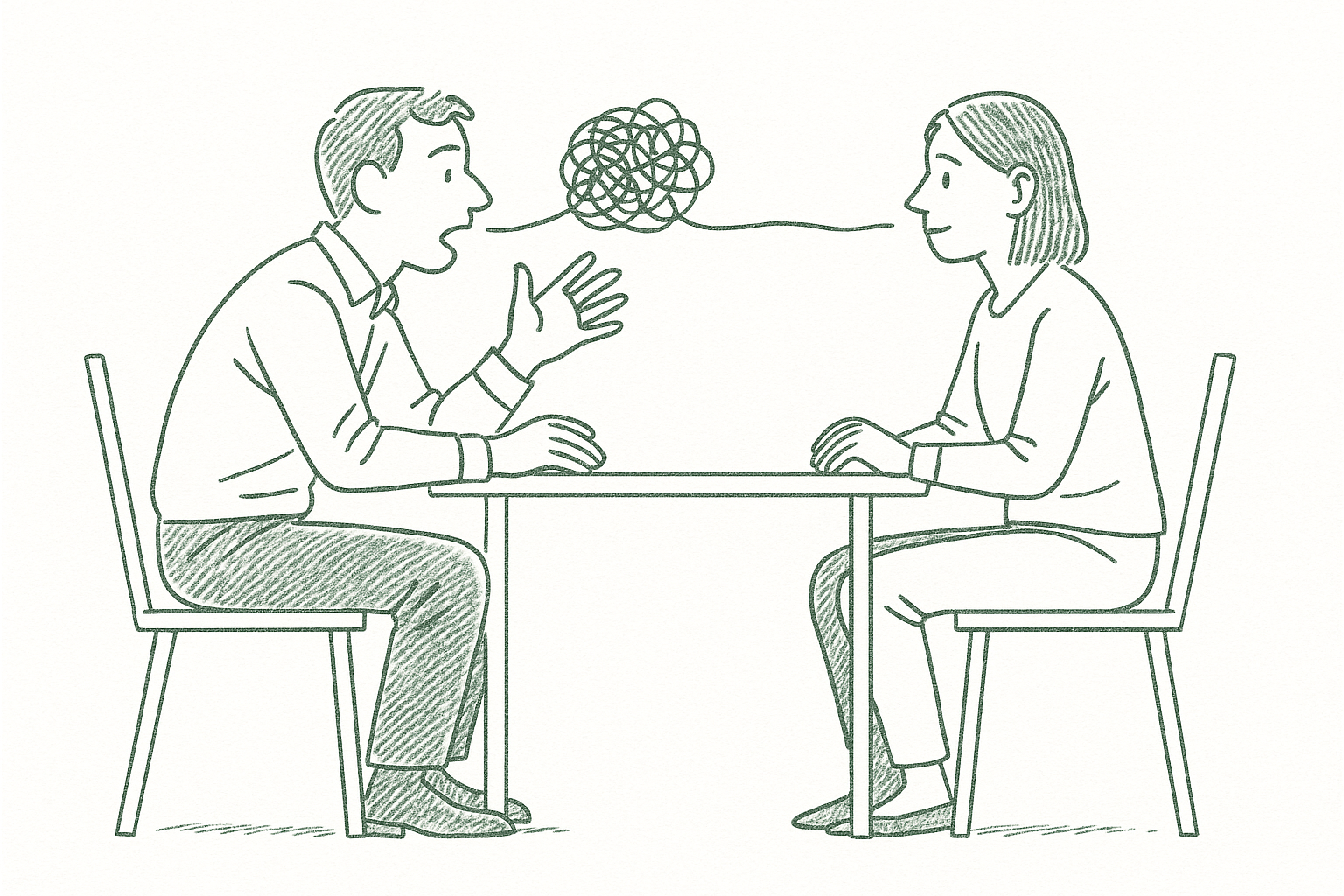
Most founders believe they think about their business constantly. They do. But they think about it in a specific way: rapid, fragmented, recursive. The same worries cycle through the same neural pathways without resolution. This is not deep processing. This is rumination — the cognitive equivalent of reading the same word pair over and over without ever being asked to generate the answer.
The generation effect suggests a specific intervention: structured articulation. Take the problem out of your head and put it into words — not in a journal entry you will never reread, but in a format that requires precision and coherence. The most effective format is speaking to a small group of peers who will hold you to clarity.
Here is what changes when you move from internal rumination to external articulation:
You discover what you actually think. Most founders have a position on every issue in their business, but they have never articulated half of those positions. The act of stating a position out loud — "I think we need to fire this person" or "I think we should raise our prices 40%" — forces a commitment that internal deliberation does not. And commitment is the prerequisite for action.
You see the gaps. Chi's self-explanation research showed that the biggest benefit of articulation is not confirming what you know — it is exposing what you do not know. When you explain your go-to-market strategy to five founders in a mastermind meeting, the places where your explanation gets vague are the places where your thinking is weakest. Those gaps were invisible while the strategy lived entirely in your head.
You process at a different level. Slamecka and Graf's experiments showed a specific neurological difference between reading and generating. Generating activates more associative pathways, more retrieval cues, and more elaborative processing than reading. When you articulate a business problem, you are literally processing it with more of your brain than when you think about it silently. The same problem. Fundamentally different cognitive engagement.
You create something retrievable. Internal thoughts are ephemeral — they fade, distort, and blend with subsequent thoughts. An articulated position is durable. Your peers heard it. They may reference it next month. The observation itself creates a record and a commitment that silent deliberation never does.
The peer group as a generation machine
A well-run peer group is, at its core, a generation engine. Every element of its design — hot seats, check-ins, progress reviews, accountability loops — forces participants to convert internal states into external articulations. You cannot show up to a peer group and just think about your business. You have to talk about it. And that talking is not a communication exercise. It is a cognitive one.
The common objection to peer groups is "Nobody in the room has my specific expertise." This objection misunderstands the mechanism. The protege effect demonstrates that the person who benefits most from explaining something is the person doing the explaining. The group does not need to have your answer. It needs to be the audience that forces you to generate it.
Slamecka and Graf showed this in 1978 with word pairs. Chi showed it in 1989 with physics problems. Fiorella and Mayer showed it in 2014 with teaching tasks. Software engineers show it every day with rubber ducks. The evidence is overwhelming and consistent: you understand your own problem better when you generate a clear articulation of it than when you merely think about it.
Confirmation bias keeps founders hearing what they already believe. Pluralistic ignorance keeps them thinking they are the only one struggling. Solomon's paradox explains why they give better advice than they take. But the generation effect explains something more fundamental: why the simple act of talking to a small group of people you trust produces better decisions than any amount of private deliberation.
The answer is in your head. But it is trapped in shallow processing — cycling through the same loops, never forced into the deep encoding that articulation requires. The peer group is the mechanism that unlocks it. Not by providing the answer. By forcing you to generate it.