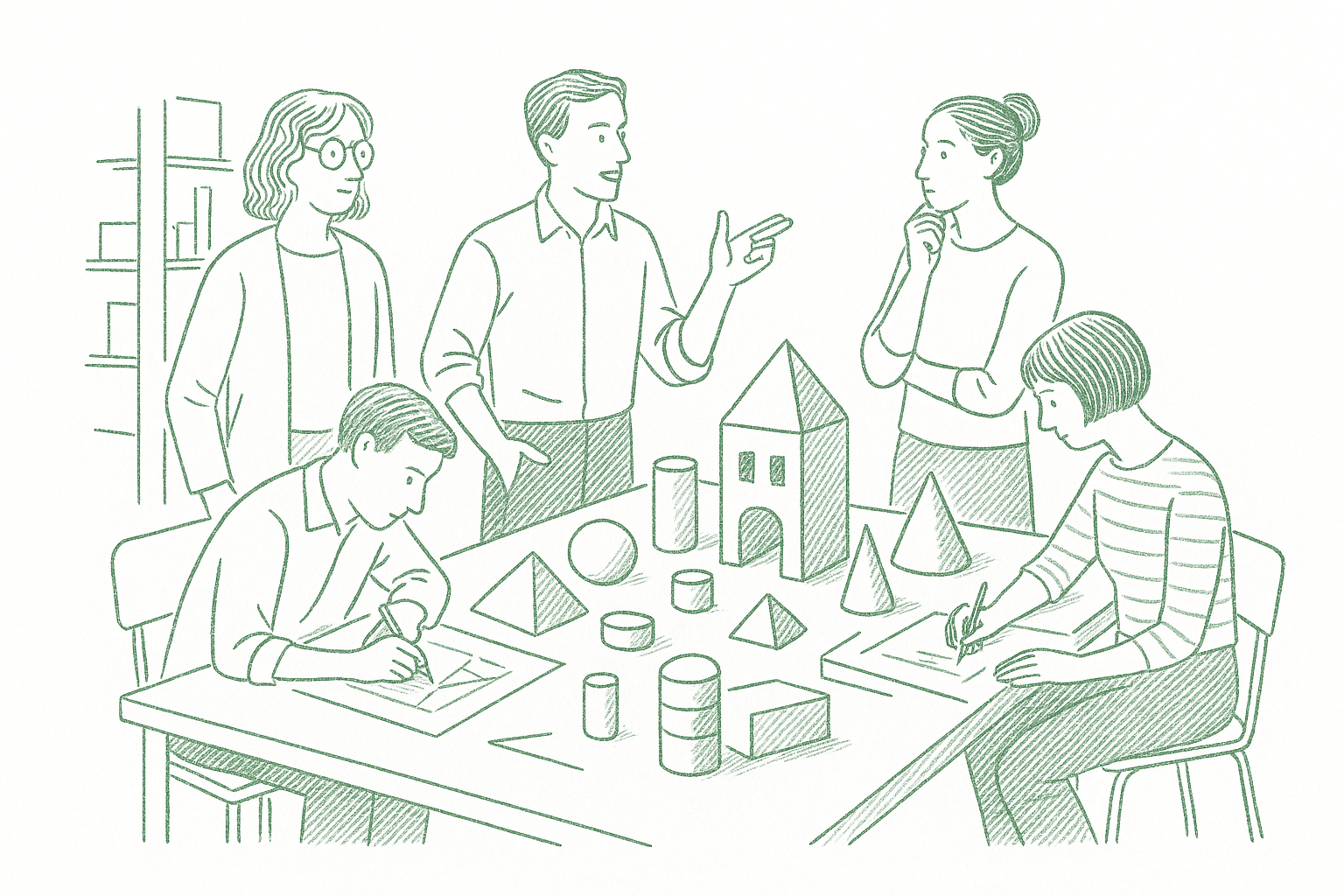
In April 1919, a 35-year-old architect named Walter Gropius published a four-page manifesto in Weimar, Germany. The document called for "a new guild of craftsmen, without the class distinctions that raise an arrogant barrier between craftsman and artist." He proposed merging two existing art schools into a single institution. He called it the Staatliches Bauhaus — literally, "state building house."
The school opened with 150 students and a faculty of artists who had no business being in the same building. Painters sat next to weavers. Sculptors collaborated with carpenters. A Russian abstract artist taught alongside a Swiss mystic. The entire operation ran on a shoestring budget in post-war Germany, under constant political pressure, and was forcibly shut down by the Nazis in 1933.
In those 14 years, this tiny school produced the foundational vocabulary of modern design. The glass-and-steel skyscrapers that define every major city skyline. The clean sans-serif typography you are reading right now. The tubular steel chair. The open floor plan. The idea that form should follow function. The Bauhaus did not invent all of these things, but it synthesized them into a coherent philosophy and taught the people who brought them to the rest of the world.
The standard explanation is genius. Gropius was brilliant. Klee was brilliant. Kandinsky was brilliant. That explanation is accurate and completely insufficient. The 20th century was full of brilliant artists and architects working in isolation. Most of them are forgotten. What made the Bauhaus different was not the talent. It was what the talent did together — and the structure Gropius built to make sure they actually did it.
The room Gropius built
The Bauhaus manifesto is a remarkable document, not because of its artistic vision but because of its organizational design. Gropius was not just founding a school. He was designing a peer structure — one that owed an explicit debt to the Vienna Secession and the Wiener Werkstätte, which had dissolved the boundary between fine art and applied design two decades earlier.
The first decision was to abolish the traditional hierarchy between "fine artists" and "craftsmen." In every other art school in Europe, painters held the prestige. Potters and weavers were second-class. Gropius eliminated the distinction entirely. At the Bauhaus, every student went through the same preliminary course — the Vorkurs — regardless of medium. You did not get to specialize until you had worked with materials, color theory, and spatial composition at a fundamental level.
The second decision was the workshop model. Instead of lecture halls, the Bauhaus ran workshops in metal, wood, weaving, pottery, mural painting, and typography. Each workshop had two masters: a "Master of Form" (typically a fine artist) and a "Master of Craft" (a practicing artisan). Paul Klee, one of the most important painters of the 20th century, co-taught bookbinding, stained glass, and mural painting. Wassily Kandinsky, the pioneer of pure abstract art, led the wall-painting workshop and taught analytical drawing to students who would go on to design furniture.
The third decision — and the one most often overlooked — was mandatory social life. Gropius's manifesto explicitly required "encouragement of friendly relations between masters and students outside of work; therefore plays, lectures, poetry, music, costume parties." He called for the "establishment of a cheerful ceremonial at these gatherings." This was not an afterthought. It was a core principle, listed alongside curriculum requirements.
The Bauhaus parties became legendary. Students designed their own costumes, built stage sets, composed music, and choreographed performances. Oskar Schlemmer's Triadic Ballet — performed by dancers in geometric costumes that looked like walking architecture — was born from these events. The parties were not breaks from the work. They were extensions of it. When a metalworker, a weaver, and a painter collaborate on a theatrical production, they develop a shared creative language that transfers directly back to the workshop the following Monday.
This is a pattern that appears in nearly every historically significant peer group. Ben Franklin's Junto met at a tavern. The Algonquin Round Table gathered over lunch. The Inklings met in a pub. The Lost Generation gathered in Paris cafés and a bookshop. The social container is not incidental to the intellectual output. It is the mechanism that builds the trust required for honest feedback and genuine collaboration.
What happens when disciplines collide
The most consequential output of the Bauhaus was not any single building, painting, or chair. It was the systematic demolition of the boundary between art and everything else.
Consider the Haus am Horn. In 1923, the Bauhaus needed to prove its relevance to a skeptical Weimar government that was threatening to cut funding. Gropius organized a public exhibition. The centerpiece was a prototype house — a single-story, flat-roofed structure designed by Georg Muche, the youngest Bauhaus master, and constructed with contributions from every workshop in the school.
The metal workshop, led by László Moholy-Nagy, designed the lighting fixtures. Marcel Breuer, then still a student, designed the built-in furniture. Benita Koch-Otte designed the kitchen — a compact, rationalized workspace that would later inspire the Frankfurt Kitchen of 1926, widely considered the ancestor of the modern fitted kitchen. Theodor Bogler produced the labeled ceramic storage containers. Alfred Arndt planned the interior color scheme. The textiles came from Martha Erps-Breuer. The house used experimental materials, including prefabricated concrete panels and an insulating layer of peat-based Torfoleum.
One building. Every workshop. Every discipline contributing to a single, integrated outcome. This was Gropius's Gesamtkunstwerk — the "total work of art" — realized not through a single genius but through structured collaboration across specialties. The Haus am Horn was, in effect, an architectural hot seat: every workshop brought its best work to the table, and the building itself was the artifact that emerged.
The results were not always harmonious. The masters argued constantly. Johannes Itten, who designed the original Vorkurs, clashed with Gropius over the school's direction — Itten wanted mystical, introspective art education while Gropius wanted engagement with industry and mass production. Itten left in 1923. Moholy-Nagy, who replaced him, brought a radically different approach: constructivist, technological, forward-looking. The tension between artistic purity and industrial application was never resolved at the Bauhaus. It was productive precisely because it remained unresolved.
This is a critical insight for anyone building a peer group of any kind. The groups that fail are the ones that optimize for agreement. The ones that produce extraordinary work are the ones where people with genuinely different frameworks are forced to confront each other's assumptions — within a structure that prevents the disagreement from becoming destructive. Gropius did not resolve the tension between Itten and Moholy-Nagy. He replaced one with the other and let the school evolve. The Bauhaus was not a consensus machine. It was a collision engine.
The curriculum that changed everything
The Vorkurs — the preliminary course every student was required to complete — is arguably the Bauhaus's most enduring contribution to education. Before the Bauhaus, art schools taught technique within established traditions. Painting students painted. Sculpture students sculpted. Nobody asked a painter to think about the tensile properties of steel or the psychology of color in architectural space.
Itten's original Vorkurs was six months of radical material exploration. Students handled wood, metal, wire, glass, fabric, and stone — not to make finished objects but to understand what each material wanted to do. They studied contrast, rhythm, and texture through exercises that deliberately crossed discipline boundaries. A typography student might spend a week working with nothing but wire. A furniture student might spend a week doing nothing but color studies.
When Josef Albers took over elements of the preliminary course, he pushed this further. Albers was famous for giving students a single sheet of newspaper and asking them to create a three-dimensional structure without cutting, gluing, or adding any other material. The constraint forced creativity. The exercise taught that the most important design decisions are not about what you add but about what you do with what you already have.
Kandinsky's contribution to the curriculum was equally distinctive. His course on analytical drawing required students to observe complex still-life arrangements and reduce them to their essential tensions — not to draw what they saw, but to draw the forces acting within what they saw. This was not art instruction. It was training in how to see underlying structure. A student who learned to identify the tension in a still life could, three years later, identify the tension in an architectural facade or a typographic layout.
The pedagogical insight is profound and directly applicable: when you force people to work outside their area of expertise, they develop transferable ways of thinking. The most powerful moments in a mastermind meeting often come when someone from a completely different industry offers a perspective that the specialist never considered. A SaaS founder solving a churn problem gets a reframe from a restaurant owner who thinks about customer retention in a fundamentally different way. The Bauhaus industrialized this kind of cross-pollination.
Three cities, three directors, one identity
The Bauhaus operated in three cities over its 14 years. Each phase was defined by a different director, a different political environment, and a different set of constraints. The remarkable thing is that the school's core identity survived all of them.
Weimar (1919–1925). The founding years under Gropius. The school was experimental, idealistic, and financially precarious. The local government grew hostile to the modernist aesthetic and the school's progressive social politics. When Thuringia's new conservative government slashed funding in 1924, Gropius made the decision to relocate rather than compromise the school's vision.
Dessau (1925–1932). The golden age. The city of Dessau offered land, funding, and purpose-built facilities. Gropius designed the iconic Bauhaus Dessau building — a glass-and-concrete complex that embodied every principle the school taught. This period saw the school's most commercially successful work, including Breuer's Wassily Chair (1925) and the expansion of the typography and advertising workshop under Herbert Bayer. Gropius stepped down as director in 1928 and was succeeded by Hannes Meyer, a committed functionalist who pushed the school toward social housing and industrial production. When Meyer's Marxist politics created friction with the Dessau city government, he was dismissed in 1930 and replaced by Ludwig Mies van der Rohe.
Berlin (1932–1933). When the Nazis gained control of the Dessau city council, they closed the Bauhaus. Mies van der Rohe relocated the school to a former telephone factory in Berlin as a private institution. It operated for less than a year. In April 1933, under pressure from the Gestapo, the faculty voted to dissolve the school. The Bauhaus closed on July 19, 1933.
A school that lasted 14 years. Three directors. Three cities. Political persecution. Constant funding crises. Internal ideological battles. By any conventional measure, it was an institutional failure. By its actual output, it was the most consequential design school in history.
The diaspora that conquered the world
When the Bauhaus closed, its members scattered. And here is where the story becomes a case study in the power of networks.
Walter Gropius emigrated to the United States in 1937 and became chairman of the architecture department at Harvard University. He shaped the education of an entire generation of American architects, including I.M. Pei and Philip Johnson. Harvard's own Graduate Center, designed by Gropius's office in 1950, was the first modernist building on the campus.
Ludwig Mies van der Rohe arrived in Chicago in 1938 and became director of the architecture program at the Armour Institute (later the Illinois Institute of Technology). He went on to design the Seagram Building in New York and the Farnsworth House in Illinois — two of the most influential buildings of the 20th century. His dictum "less is more" became the operating principle of an entire architectural movement.
László Moholy-Nagy founded the New Bauhaus in Chicago in 1937, which evolved into the Institute of Design at the Illinois Institute of Technology. Josef Albers went to Black Mountain College in North Carolina, where he taught a young Robert Rauschenberg, and then to Yale, where his book Interaction of Color (1963) became the definitive text on color theory for generations of art students. Marcel Breuer joined Gropius at Harvard before establishing his own practice. Herbert Bayer settled in Aspen, Colorado, where he helped found the Aspen Institute.
The pattern is unmistakable. The Bauhaus did not produce isolated talents who happened to succeed individually. It produced a cohort of people who had spent years in deep collaboration, developed shared principles and vocabulary, and then carried those principles into every major institution they touched. They did not merely emigrate. They replicated. Every school they joined, every firm they founded, every student they taught became an extension of the peer environment that had formed them.
This is exactly what happened with the PayPal Mafia six decades later. The alumni of a single intense peer experience went on to found or lead Tesla, LinkedIn, YouTube, Palantir, Yelp, and SpaceX. The mechanism is the same: a small group, intense collaboration, shared intellectual frameworks, and a diaspora that carries the group's DNA into new institutions. The Bauhaus was the PayPal Mafia of modernism.
What the Bauhaus teaches about peer groups
You do not need to be building a design school to learn from the Bauhaus. The organizational principles that made it work are identifiable, replicable, and directly applicable to any structured peer group.
Diversity of expertise within a shared mission. The Bauhaus masters were painters, sculptors, weavers, architects, typographers, and metalworkers. They had nothing in common except a commitment to integrating art and industry. That combination — diverse skills, shared purpose — is the formula for productive collaboration. The research on optimal group dynamics consistently shows that homogeneous groups converge too quickly. The best groups include enough difference to generate friction and enough shared context to make the friction productive.
Structure that forces interaction. The workshop model was not optional. The Vorkurs was not optional. The social events were not optional. Gropius understood that creative collaboration does not happen spontaneously between people with different backgrounds and methods. It requires structure — shared exercises, shared projects, shared meals, shared stakes. Community without structure produces pleasantness. Structure without community produces compliance. The Bauhaus had both, and that combination produced the modern world.
Productive tension over comfortable consensus. The Itten-Moholy-Nagy conflict. The Gropius-Meyer transition. The constant argument between art-for-art's-sake and design-for-industry. These were not failures of leadership. They were features of the system. Gropius did not try to make everyone agree. He tried to make sure the disagreements were about ideas, not personalities, and that the structure of the school channeled the tension into work rather than politics.
An alumni network that multiplies the original impact. The Bauhaus's influence was not complete when it closed. It was just beginning. The 14-year experiment produced a generation of practitioners who carried its principles into Harvard, Yale, IIT, Black Mountain College, the Aspen Institute, and dozens of architecture and design firms worldwide. The school's greatest product was not any building or chair. It was the people — and the network they maintained after dispersing.
Look at any major city skyline. The glass curtain walls. The steel frames. The rejection of ornamentation in favor of proportion and material honesty. That is the Bauhaus. Look at the font on your phone. The layout of your kitchen. The chair you are sitting in. If it is clean-lined, functional, and devoid of unnecessary decoration, a line can be traced back to a small school in Weimar where 150 people — painters, potters, carpenters, and architects — decided to stop working in silos and start working together.
Fourteen years. Three cities. Never more than 200 students at a time. The group did not need to be large. It needed to be structured, diverse, honest, and committed to something beyond individual achievement.
The Bauhaus did not redesign the world because it had the best artists. It redesigned the world because it put the right people in the right room with the right structure and refused to let them work alone.