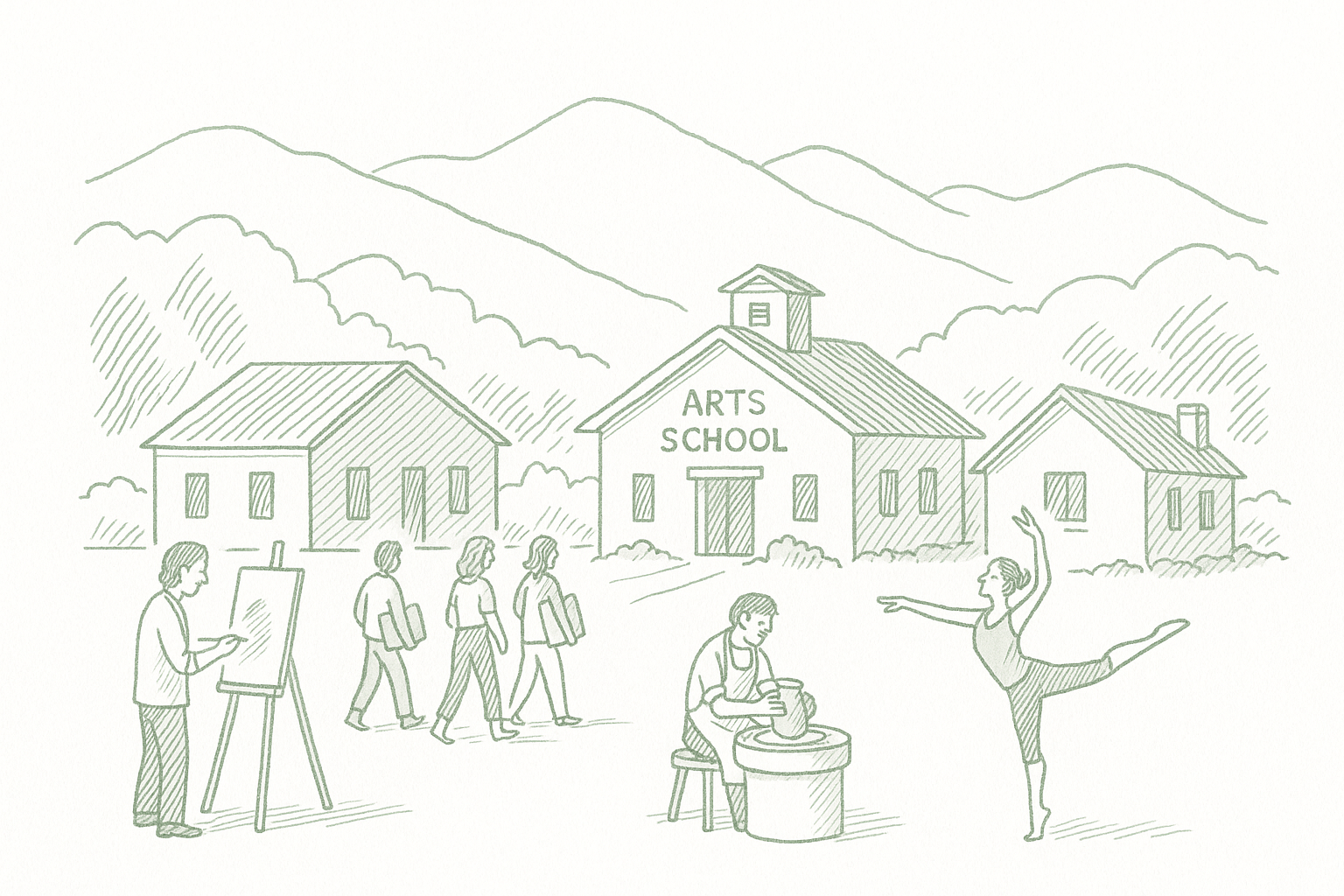
Here is a fact that should bother anyone who thinks about how institutions produce talent: Black Mountain College never received accreditation. It never had more than about 120 students at any one time. Over its entire twenty-four-year existence, it enrolled fewer than 1,200 people total, and only 55 of them actually graduated with formal degrees. By every metric that modern education cares about — retention rates, graduation rates, endowment size, alumni giving — it was a failure.
And yet. The people who passed through that school include Robert Rauschenberg, Cy Twombly, Ruth Asawa, Kenneth Noland, Robert Creeley, and dozens of other artists whose work hangs in the Guggenheim, the Whitney, MoMA, and the Tate. Its faculty included Josef and Anni Albers, Willem and Elaine de Kooning, Franz Kline, John Cage, Merce Cunningham, Buckminster Fuller, and Charles Olson. Its advisory board at one point included John Dewey, Albert Einstein, and Walter Gropius.
A school with no grades, no requirements, and no accreditation — tucked into the Blue Ridge Mountains of North Carolina, perpetually broke, running on donated labor and borrowed buildings — produced more significant artists per capita than any institution in American history.
How? And what does it tell us about how groups actually produce creative breakthroughs?
A school born from a revolt
Black Mountain College started with a firing. In 1933, John Andrew Rice, a classics professor at Rollins College in Winter Park, Florida, was dismissed for insubordination. His crime was pedagogical: he believed that education should be experiential, that students learned more from doing than from listening, and that the rigid departmental structure of American universities was killing intellectual curiosity. Several faculty members resigned in solidarity.
Rice and his allies rented a few buildings from the Blue Ridge Assembly, a YMCA retreat center about twenty minutes outside Asheville, North Carolina. With no endowment, no campus, and no accreditation, they opened Black Mountain College in the fall of 1933. The founding principles were radical for the time — and many remain radical today: no required courses, no grades shared with students, no separation between faculty and students in the governance of the school, and the arts placed at the absolute center of the curriculum. As Rice put it, art was not a department. It was the spine of the entire institution.
The timing was accidental and consequential. The same year Rice was founding his experimental school in North Carolina, Adolf Hitler was closing the Bauhaus in Germany. Josef Albers, who had been teaching at the Bauhaus since 1920 and serving as a professor alongside Paul Klee and Wassily Kandinsky, found himself suddenly without a position. Philip Johnson, then at the Museum of Modern Art in New York, recommended Albers to Rice. In November 1933, Josef and Anni Albers arrived at Black Mountain College. Albers spoke almost no English. When a student asked what he was going to teach, he replied with the only sentence he had prepared: "To open eyes."
The Albers method: practice before theory
Albers taught at Black Mountain from 1933 to 1949 — sixteen years that shaped the school's identity more than any other single factor. He brought with him the Bauhaus principles of "practice before theory," "learning by doing," and "study, not art." But at Black Mountain, freed from the institutional constraints that had begun to calcify even at the Bauhaus, he pushed those ideas further.
In Albers's classes, students did not study art history. They did not analyze masterworks. They experimented with materials. They folded paper, bent wire, arranged colored squares, stacked found objects. The goal was not to produce finished art but to develop what Albers called "disciplined seeing" — the ability to perceive relationships between forms, colors, textures, and spaces that most people walked past without noticing.
This sounds soft. It was not. Albers was a demanding teacher who regularly told students their work was terrible — then explained exactly why, then made them do it again. Ruth Asawa, who studied under Albers from 1946 to 1949 and later became one of San Francisco's most important public sculptors, described the experience as transformative not because Albers was kind but because he was honest. "For the first time," she said, "I was expected to have an opinion."
The connection to peer dynamics is not metaphorical. Albers did not run a lecture hall. He ran what amounted to a structured critique session — a small group of people examining each other's work in real time, with a facilitator who refused to let anyone hide behind politeness or abstraction. The classroom looked more like a mastermind meeting than a university course.
The summer institute: when the real magic arrived
Black Mountain's academic year was important. Its summer sessions were legendary.
Starting in 1944, the college began hosting a Summer Art Institute that brought in visiting faculty from across the arts world. The guest list over the years reads like a roll call of mid-century genius: John Cage, Merce Cunningham, Willem de Kooning, Buckminster Fuller, Robert Motherwell, Walter Gropius, Jacob Lawrence, Beaumont Newhall. These were not drive-by lectures. Visiting faculty lived on campus, ate in the communal dining hall, worked alongside students, and participated in the daily life of the school — including the farm work, kitchen duty, and building maintenance that everyone shared.
The effect was a density of creative talent compressed into a small physical space with almost no institutional structure to separate them. A painter might eat breakfast with an architect, take a dance class from a choreographer, spend the afternoon watching a poet set type for a literary magazine, and then sit around a campfire arguing about Zen Buddhism with a composer. The group was small enough that everyone knew everyone. The barriers between disciplines did not exist because nobody had bothered to build them.
Elaine de Kooning described the atmosphere when Buckminster Fuller arrived for the 1948 summer session: "Bucky whirled off into his talk, using bobby pins, clothespins, all sorts of units from the five-and-ten-cent store to make geometric mobile constructions, collapsing an ingeniously fashioned icosahedron by twisting it and doubling and tripling the modules down to a tetrahedron." Fuller, with the help of students, attempted to build the first large-scale geodesic dome that summer. It collapsed. He came back in 1949, tried again, and succeeded. The structure that would later appear at world's fairs, military installations, and Epcot Center was first proven in a meadow in rural North Carolina because an architect was embedded in a community of artists who did not know enough about engineering to tell him it was impossible.
The night everything changed: August 16, 1952
On a summer evening in 1952, John Cage organized what would later be recognized as the first "happening" in American art history. He called it Theater Piece No. 1.
The setup was this: the audience sat in the center of the dining hall, their chairs arranged on diagonals so they could not see everything happening around them simultaneously. Cage stood on a stepladder and delivered a lecture on music and Zen Buddhism. Merce Cunningham danced through the aisles, at one point chased by a dog. Robert Rauschenberg played Edith Piaf records on a gramophone while his White Paintings hung from the ceiling. David Tudor performed piano compositions. Charles Olson and M.C. Richards read poetry from different parts of the room. None of the performers knew what the others would do. The whole thing lasted about forty-five minutes.
Theater Piece No. 1 was not planned in the way a theatrical production is planned. It was organized using chance methods — Cage gave each performer time brackets but no directions about content. The result was a simultaneous collision of unrelated artistic actions that created meaning through proximity rather than narrative. It anticipated Fluxus, performance art, multimedia installation, and essentially every interdisciplinary art form that followed.
This could not have happened at a university with departments. It happened at Black Mountain because the people involved were already living together, eating together, working together, and arguing together. Cage and Rauschenberg and Cunningham were not strangers collaborating on a project. They were members of a small, committed group who had spent weeks in close proximity, absorbing each other's ideas through osmosis as much as through formal exchange.
No grades, real outcomes
The most counterintuitive thing about Black Mountain was its grading system — or rather, its complete absence of one. Students received no letter grades. There were no required courses and no exams. Grades were recorded internally for students who needed to transfer, but they were never shown to the students themselves. The only formal requirement was a comprehensive review at the end of the junior year, in which a student had to demonstrate to a panel of faculty that they had developed enough to proceed to senior studies.
The theory behind this was John Dewey's progressive education philosophy, which Rice and the founding faculty took seriously: if you remove external rewards and punishments, students will learn because they are genuinely interested — or they will leave. Both outcomes were considered acceptable. Black Mountain was not interested in retention. It was interested in transformation.
The result was a radical self-selection effect. Students who came to Black Mountain and stayed were the ones who were intrinsically motivated — who wanted to make art or think about ideas badly enough to do farm chores and live in modest quarters in rural North Carolina with no prospect of a credential that any employer would recognize. The absence of grades did not make the school easier. It made it harder, because there was no external structure to hide behind. The only accountability was the work itself and the small community that watched you produce it.
NCpedia records that of the fewer than 1,200 students who attended Black Mountain over its lifetime, a disproportionate number went on to significant careers in art, education, and letters. The school produced major figures in painting (Rauschenberg, Twombly, Noland, Kenneth Snelson), sculpture (Asawa, John Chamberlain), dance (Cunningham's company was literally founded there), poetry (Olson, Creeley, Robert Duncan, Denise Levertov), and music (Cage's entire experimental trajectory was shaped by his summers there). Art historian Mary Emma Harris, author of the definitive history of the college, called it "the most influential college you've never heard of."
Why it died — and what the death tells us
Black Mountain College closed in 1957. It had been declining for years. Enrollment dropped into the teens. The school was perpetually broke. Charles Olson, who had become rector in the early 1950s, shifted the focus from visual arts to poetry and lost many of the faculty and students who had been drawn to the art program. By the end, the school consisted of a handful of students and faculty rattling around a campus they could no longer maintain.
The proximate cause of death was financial: the school simply ran out of money. But the deeper cause was structural. Black Mountain had always depended on the specific chemistry of its people. It had no endowment large enough to survive lean years. It had no alumni base large enough to generate donations. It had no institutional reputation independent of the individuals who happened to be teaching there at any given moment. When the right people left, the magic left with them.
This is the vulnerability that every small, high-intensity group faces. The same intimacy that makes a group powerful makes it fragile. A group of a hundred can absorb departures. A group of twelve cannot. When Albers left in 1949, the art program lost its anchor. When the summer visitors stopped coming, the cross-pollination stopped. When Olson narrowed the focus, the interdisciplinary collisions that had generated the school's most important work dried up.
The lesson is not that Black Mountain failed. The lesson is that it lasted twenty-four years, which is twenty-four years longer than most experimental communities survive. And in those twenty-four years, it produced a creative output that entire university systems with billions in endowment have not matched.
The structural secret
Strip away the art. Strip away the celebrity names. What made Black Mountain College work was a set of structural conditions that the research on group dynamics now confirms:
Small size. Never more than about 120 students and a dozen faculty. Small enough for every person to know every other person. Small enough for every absence to matter. The research on optimal group size consistently finds that the most productive groups are far smaller than institutions prefer to build.
Shared work beyond the work. Students and faculty cooked, cleaned, farmed, and built together. This was partly necessity — the school had no money for staff. But it was also pedagogical. When a world-class painter peels potatoes next to a first-year student, the hierarchy that kills honest feedback in most institutions dissolves. You can tell someone their painting is terrible if you just saw them burn the rice.
Interdisciplinary collision. There were no departments. A painter sat next to a poet who sat next to a physicist who sat next to a dancer. The collisions were constant and unplanned. Cage's Theater Piece No. 1 did not emerge from a cross-departmental committee. It emerged from people who already lived in each other's worlds.
Intrinsic motivation only. No grades. No credential. No career path. The people who stayed were the people who wanted to be there badly enough to accept the sacrifice. This self-selection filter is the single hardest thing for any group to replicate — and the single most important factor in its success. Most groups fail because they let anyone in. Black Mountain succeeded because its conditions ensured only the committed stayed.
A facilitator, not a dictator. Rice, then Albers, then Olson — the leaders of Black Mountain set the conditions but did not control the outcomes. Albers was demanding but not prescriptive. He told students what was wrong with their work. He did not tell them what to make. The best peer groups operate the same way: structure that enables, not structure that constrains.
Fifty-five graduates. An entire art movement.
Fifty-five people graduated from Black Mountain College. That is not a rounding error — that is the entire output of a twenty-four-year institution. If you judged Black Mountain by its graduation rate, you would shut it down on day one.
But those fifty-five graduates, and the hundreds of other students who attended without graduating, and the visiting faculty who spent summers there absorbing and contributing to its culture, collectively reshaped American art, music, dance, poetry, architecture, and education. Rauschenberg's combines. Twombly's calligraphic canvases. Asawa's wire sculptures. Cunningham's dance company. Cage's experimental compositions. Fuller's geodesic domes. Olson's projectivist verse. Creeley's minimalist poetry. These were not parallel developments. They were the products of a single small community where people lived together, worked together, argued together, and made each other better.
The evidence is not that Black Mountain College had good teachers, though it did. The evidence is that the structure itself — the smallness, the proximity, the shared labor, the absence of external validation, the relentless cross-pollination — created conditions under which almost any talented person who showed up could produce their best work.
The school has been gone for nearly seventy years. The Black Mountain College Museum and Arts Center in Asheville preserves its archives. Art historians write about it with a reverence usually reserved for Renaissance workshops or Parisian salons. But the most important thing about Black Mountain is not what it was. It is what it proved: that a small group of committed people, in the right structure, with the right kind of pressure, will consistently outperform institutions a thousand times their size.
Fifty-five graduates. An entire art movement. The math does not make sense — unless you understand how groups work.