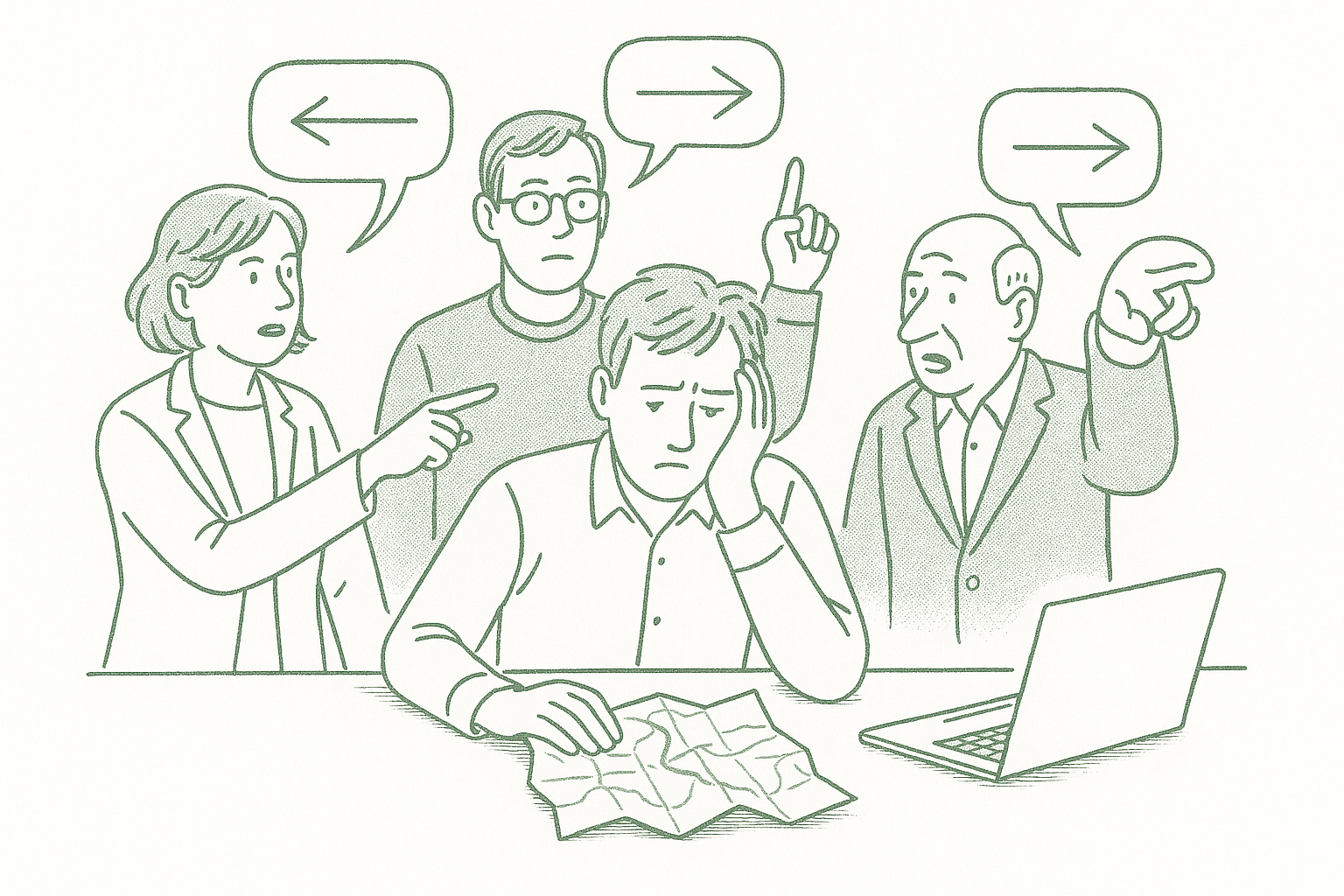
There is a moment every founder recognizes. You are at a conference, or on a podcast, or in a conversation with someone who has already built the thing you are trying to build. They tell you exactly what to do. It is specific, confident, and delivered with the authority of lived experience. You take notes. You go home. You try to apply it.
It does not work.
Not because the advice was wrong. Not because you executed poorly. Because the advice was never yours to use. It was a set of instructions from a different machine, running different software, in a different factory. And the person who gave it to you had no idea that was the case — because from where they sat, the instructions looked universal.
This is the transfer problem. And it is quietly responsible for more failed pivots, bad hires, and wasted quarters than any single tactical mistake a founder can make.
The survivorship problem is worse than you think
Survivorship bias in startup advice is well-documented but poorly internalized. The concept is simple: we study what worked for the people who succeeded and ignore the thousands who did the same thing and failed. Abraham Wald's WWII bomber analysis is the classic illustration — the bullet holes on the returning planes showed where armor was not needed, because the planes that were hit in the missing spots never came back.
In the startup world, this means every piece of advice from a successful founder is, by definition, drawn from the one outcome that happened to work. Mark Zuckerberg dropped out of Harvard. So did thousands of other people who did not build Facebook. The behavior is identical. The outcome is not. The difference is context — timing, market, team, luck, a hundred variables that the advice-giver cannot see because they are looking backward through the lens of success.
Research from the National Bureau of Economic Research on entrepreneurial peer effects confirms the structural problem: advice from successful founders is not predictive of outcomes for other founders unless the underlying conditions are comparable. The success story is a narrative device, not a data set.
A 2019 study published in PNAS found that unmotivated individuals actually benefit more from giving advice than receiving it — because giving advice forces reflection and self-regulation, while receiving advice triggers the brain's threat response. The person handing you their playbook feels great about it. Your brain is quietly rejecting it before you finish taking notes.
Tacit knowledge cannot be emailed
The philosopher Michael Polanyi identified a category of knowledge that explains why founder advice so reliably fails to transfer. He called it tacit knowledge — the things we know but cannot articulate. "We can know more than we can tell," he wrote in 1966. Estimates suggest that 80% to 90% of organizational knowledge is tacit. It lives in intuition, muscle memory, and context-dependent pattern recognition.
When a successful founder tells you to "focus on one channel until it works," they are not actually communicating what they did. What they did involved reading signals from a specific market, making judgment calls about a specific audience, and iterating on timing and messaging within constraints they cannot fully reconstruct from memory. The explicit advice — "focus on one channel" — is the tip of an iceberg. The tacit knowledge underneath is what made it work. And tacit knowledge does not survive extraction.
A Northwestern University study on mentorship found that the single most important factor separating effective mentors from ineffective ones was their ability to transfer tacit knowledge — the kind of context-specific judgment that cannot be codified into a blog post or a keynote. The researchers found that protégés of mentors who excelled at tacit knowledge transfer achieved significantly greater career outcomes. But the mechanism was not lecture or advice. It was proximity, observation, and shared problem-solving over extended time.
Put differently: the advice was a byproduct. The transfer happened through the relationship.
Context collapse: the real reason "best practices" backfire
There is a concept in knowledge transfer research called "far transfer" — applying something learned in one context to a significantly different context. It is, according to decades of cognitive science research at Yale and elsewhere, extraordinarily difficult. Near transfer (applying a skill to a similar situation) works reasonably well. Far transfer almost never works without deliberate scaffolding.
Most founder advice is a far transfer problem masquerading as a near transfer opportunity. When someone at a $50M company tells you how they built their sales team, it sounds like advice you can use at your $500K company. The vocabulary is the same. The org chart looks similar in shape if not scale. But the underlying system — the constraints, the margin for error, the cost of a wrong hire, the relationship between founder involvement and process — is completely different. The advice does not become wrong. As one researcher noted, it becomes "context-incorrect."
This is why the people closest to you give the worst business advice. Not because they lack intelligence, but because the gap between their context and yours makes their input structurally unreliable. The same principle applies to mentors, advisors, and conference speakers. The further someone's context is from yours, the more their advice needs to be translated — and translation without the original context is guesswork.
The stage problem
Advice has an expiration date, and the label rarely says what it is.
A founder who bootstrapped to $2M in revenue has hard-won knowledge about scrappy distribution, lean operations, and doing things that do not scale. That knowledge becomes actively dangerous at $10M, where the right answer is often the opposite — systematize, hire specialists, stop doing everything yourself. The advice from any given stage is not transferable to any other stage, and founders are systematically bad at flagging which stage their insights apply to.
Founders already make worse decisions in isolation. Add advice calibrated to the wrong stage and you get something worse than no advice at all — you get confident, well-reasoned action in exactly the wrong direction.
The problem compounds because the most visible founders — the ones writing the books, giving the talks, running the podcasts — are almost always speaking from a stage that is two or three transitions ahead of their audience. A Series C founder giving advice to a pre-revenue founder is not being helpful. They are being nostalgic. And nostalgia is the least reliable source of operational insight.
What to ask instead
If most advice does not transfer, the solution is not to stop seeking input. It is to change what you ask for and who you ask.
Instead of "what should I do," try "what did you consider and reject?" The discarded options reveal the decision-making process — the tacit knowledge — far better than the final choice. Knowing that someone almost hired a head of sales before realizing they needed a head of marketing tells you more about the decision than knowing they hired a head of marketing.
Instead of "what worked," try "what was specific to your situation that I should not assume applies to mine?" This forces the advice-giver to do the context translation for you. Most founders have never been asked this question. When they are, the quality of their input changes immediately because they have to separate the universal from the local.
Instead of "how did you solve this," try "what did this problem look like from the inside before you solved it?" The before picture is the valuable one. It is where the pattern recognition lives. The solution is often obvious in retrospect. The ability to recognize the problem in real time — before it has a name, before the data is clear — is the skill that actually transfers.
And instead of asking someone who has already been through it, consider asking someone who is going through it right now.
Why peers outperform mentors on transfer
The peer effect research offers a structural explanation for why some input changes outcomes and most does not. Peers at your stage have three advantages over mentors and advisors that directly address the transfer problem.
First, shared context. A peer who is building at the same stage, with similar constraints, does not need to translate their experience across a context gap. The tacit knowledge is already compatible because the underlying system is similar. When someone in your peer group says "I tried X and it did not work," you can trust that assessment in a way you cannot when a $100M founder says the same thing — because the definition of "did not work" is different at different scales.
Second, real-time relevance. Mentors draw on memory. Peers draw on this week. The protégé effect shows that articulating advice to someone in a similar situation actually deepens the advisor's own understanding — the transfer is bidirectional. In a well-structured peer group, everyone is simultaneously giving and receiving, which means everyone is simultaneously learning.
Third, honest feedback without projection. Accountability structures in peer groups create a different contract than mentorship. A mentor has an identity incentive to give wisdom. A peer has a survival incentive to give truth. They are not projecting their journey onto yours — they are standing next to you on the same trail, pointing at what they can see that you cannot. The Köhler effect shows that small groups where effort is visible produce higher performance than individuals working alone, not because of competition but because of mutual investment.
The question beneath the question
Every founder who seeks advice is really asking a deeper question: "Am I making the right call?" And the uncomfortable truth is that no one can answer that for you — not your mentor, not the founder who built the company you admire, not the conference speaker with the polished narrative.
What someone can do is help you see the decision more clearly. Not tell you what to decide. Not tell you what they decided. Help you surface the assumptions you are making, the variables you are ignoring, and the risks you are underweighting. That is not advice. It is structured thinking. And it requires people who are close enough to your problem to be useful and detached enough from your ego to be honest.
The most productive groups in history — from Franklin's Junto to the Vienna Circle to the Homebrew Computer Club — were not advice exchanges. They were thinking environments. The members did not come with answers. They came with problems, and the structure of the group forced a quality of reasoning that no individual could sustain alone.
Stop looking for someone who has your answer. Start looking for people who share your question. The advice that transfers is not the kind you receive. It is the kind you build together, from inside the same context, with people who have skin in the same game.
The next time someone offers you their playbook, ask yourself: do they know what factory I am running? Or are they just handing me instructions for theirs?