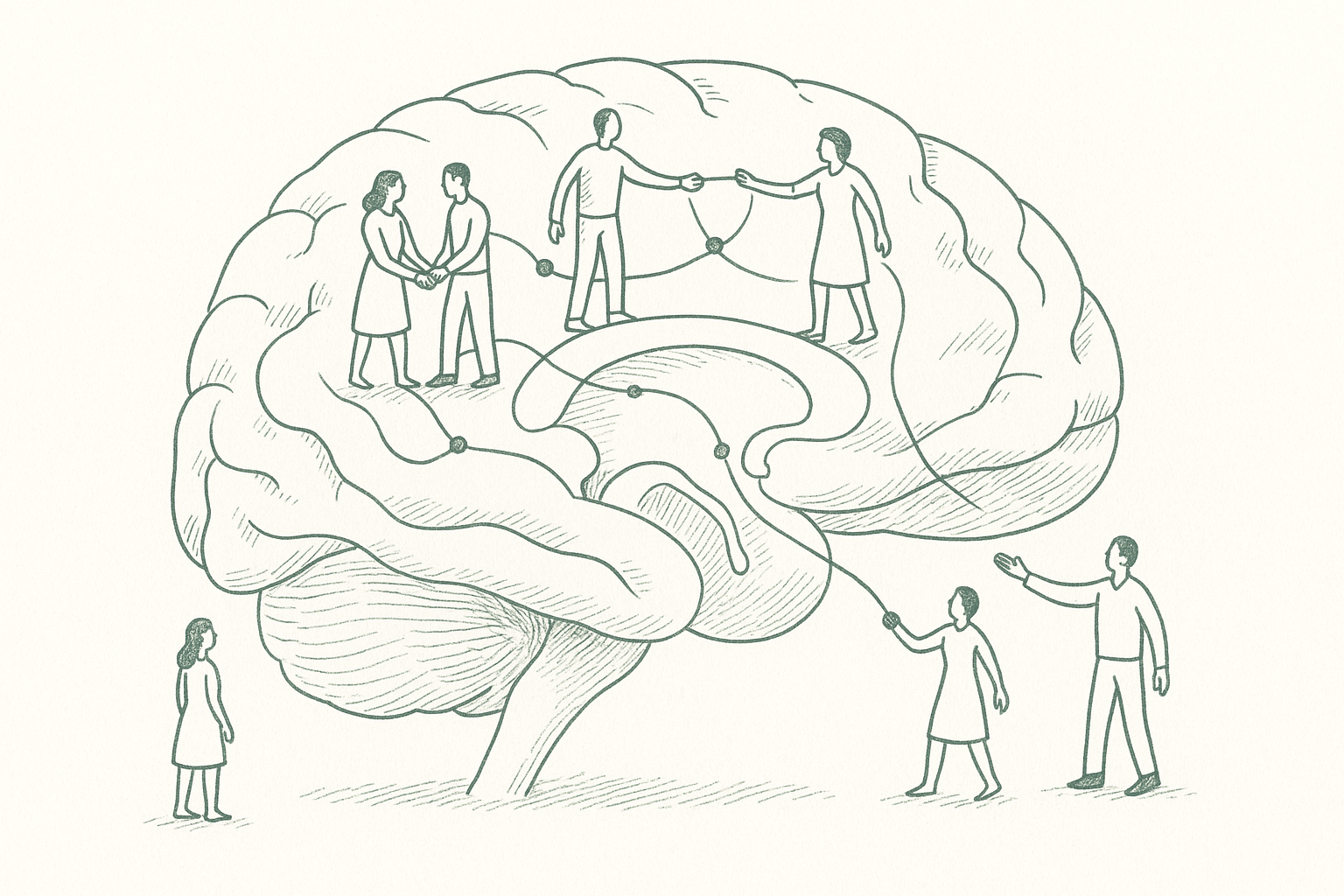
There is a standard assumption baked into how most people think about the brain. It goes like this: your default state is alone. Being with other people is a stimulus — an input that requires processing, an addition to the brain's workload. Social interaction is something the brain does, on top of its baseline operations.
James Coan, a neuroscientist at the University of Virginia, spent more than a decade building a case that this assumption is exactly backward. His work — Social Baseline Theory — proposes something that is both obvious and radical: the human brain's default state is social. Being alone is not the baseline. Being alone is the deviation. And the brain responds to it the way it responds to any other threat: by working harder, burning more energy, and making worse decisions.
The handholding experiment
Coan's foundational study, published in 2006 in Psychological Science with Hillary Schaefer and Richard Davidson, used a deceptively simple design. He put married women into an fMRI scanner and told them that when they saw a certain symbol on a screen, they had a 20% chance of receiving a mild electric shock to the ankle. He measured their brain's threat response — the activation of regions like the anterior insula, superior frontal gyrus, and hypothalamus — under three conditions: alone, holding a stranger's hand, and holding their spouse's hand.
The results were not subtle. When women faced the threat alone, their brains lit up with threat-related activation across multiple regions. When they held a stranger's hand, the response diminished somewhat. When they held their spouse's hand, the threat response dropped dramatically — in some regions, nearly to the level of someone who was not being threatened at all.
But here is the detail that changed Coan's entire research program. The mechanism was not what anyone expected. The prevailing model of social support assumed it worked through regulation — that the prefrontal cortex would ramp up its activity to suppress the threat response, the way you might consciously talk yourself down from anxiety. Coan found the opposite. The prefrontal regulatory circuits were less active during spousal handholding, not more. The brain was not working harder to manage the threat. It was perceiving the threat as less threatening in the first place. Social proximity did not regulate the fear response. It reduced the perceived demand.
"The difference," Coan and his colleague David Sbarra wrote in Current Opinion in Psychology in 2015, "is attributable less to the activation of regulatory circuitry and more to a decrease in perceived demand associated with the threat, a decrease proportional to the increase in resources brought."
Why the brain treats isolation as a threat
Social Baseline Theory offers an evolutionary explanation that is hard to argue with. Humans evolved in small, interdependent groups. For hundreds of thousands of years, being alone was not a lifestyle choice. It was a survival emergency. A solitary human in the ancestral environment was a human who had to do everything — threat vigilance, food acquisition, shelter, navigation — without distributing any of that cognitive load to others.
The theory proposes that the brain evolved to assume the presence of trusted others as its operating default. When those others are present, the brain can afford to allocate fewer resources to threat detection, risk assessment, and self-regulation. It literally has less work to do. When those others are absent, the brain has to pick up the slack — scanning for threats that a group would normally distribute, processing risks that shared attention would normally dilute, maintaining a vigilance level calibrated for a creature operating without backup.
SBT describes two mechanisms for this: risk distribution and load sharing. Risk distribution is the simple safety-in-numbers principle — individual threat vigilance decreases as group size increases, a pattern observed across social species from birds to primates. Load sharing goes further. It is not just the distribution of risk but the distribution of effort toward shared goals. In a group with shared objectives and interdependence, the brain can outsource entire categories of cognitive work — from emotional regulation to probabilistic reasoning to threat monitoring — to the collective.
This is not metaphorical. The fMRI data shows the brain literally looks more "at rest" when social resources are obviously available. Being alone adds perceived work. Having trusted people nearby removes it. The brain, in Coan's framing, responds to being alone "as if sensory stimuli have been added, not taken away."
The relationship quality variable
Not all social contact produced the same brain effect. In the original handholding study, relationship quality was a powerful moderator. Women in higher-quality marriages showed greater reductions in threat-related brain activation during spousal handholding. The better the relationship, the more the brain stood down from its threat posture.
This matters because it separates Social Baseline Theory from a naive "more people equals better" claim. The brain is not calmed by mere physical proximity. It is calmed by proximity to people it trusts — people characterized by what Coan describes as shared goals, interdependence, and predictability. A room full of strangers at a networking event does not produce the same neural regulation as a small group of trusted peers who meet regularly and know each other's problems.
A 2017 replication study published in Social Cognitive and Affective Neuroscience confirmed this specificity. Greater perceived social support corresponded with less threat-related brain activity, but only during partner handholding — not during stranger handholding. The brain is not indiscriminate about whose presence it treats as a resource. It requires the kind of trust and familiarity that develops through repeated, honest interaction over time.
What this means for founders who operate alone
Half of CEOs report experiencing loneliness in their role, according to survey data cited in Harvard Business Review. Of that group, 61% believe the isolation hinders their performance. This is not a soft complaint. It is a neurological prediction.
According to Social Baseline Theory, a founder who routinely makes high-stakes decisions without trusted peers is operating in a brain state that is measurably different from one who has those peers available. The isolated founder's brain is allocating more resources to threat vigilance, burning more cognitive energy on risk assessment, and perceiving challenges as more threatening than they actually are. Not because the founder is weak. Because the brain was engineered to function in a social ecology, and operating outside that ecology is computationally expensive.
A 2026 UC Davis study published in the Journal of Personality and Social Psychology, drawing on data from 18 countries, found that a 10% increase in reported loneliness was associated with an 8-9% increased risk of cognitive impairment. The lead author, Tomiko Yoneda, noted that loneliness is a perception — "you could be surrounded by a crowd of people and still feel lonely" — which is precisely the kind of isolation founders describe. They have employees, investors, customers, and advisors surrounding them. But none of those people share their specific burden. None of them are peers in the way the brain requires.
This is the mechanism behind what the GoodGrowth Journal has documented as the feedback desert — the phenomenon where the higher you climb, the less truth you hear. Social Baseline Theory explains why this is not just frustrating but cognitively damaging. When you cannot trust the people around you to share genuine assessments, your brain cannot offload the computational work of threat assessment to the group. You are running your own security detail, your own risk analysis team, and your own emotional regulation department, all from the same overtaxed neural infrastructure.
The load-sharing argument for peer groups
Social Baseline Theory does not just explain why isolation is costly. It explains why specific kinds of social connection reduce that cost. The two conditions are shared goals and interdependence. Random social contact does not trigger load sharing. A networking happy hour does not produce it. A LinkedIn connection certainly does not. What produces it is a small group of people who are working on overlapping problems, who meet regularly enough to develop genuine familiarity, and who depend on each other for the kind of honest input they cannot get from employees, investors, or spouses.
A peer group structured around recurring meetings, real accountability, and shared problem-solving hits both of Coan's conditions cleanly. The shared goal is obvious — each member is trying to build a better business, and the group exists to make that possible. The interdependence is functional — each person takes a hot seat, each person gives input, each person holds the others to their commitments. Over time, this produces the kind of trust and predictability that Coan's research identifies as the switch that turns down the brain's threat response.
Consider the neural economics of a well-run mastermind group through the lens of SBT. A founder walks into a hot seat session carrying a problem — say, whether to fire a cofounder, or whether to take a bridge round that will dilute the cap table. Alone, the brain treats this as a high-threat situation requiring maximal cognitive resources devoted to risk assessment, scenario modeling, and emotional regulation. In a room with five trusted peers who have faced similar decisions, the brain can distribute that load. Threat vigilance drops. Cognitive resources freed from threat processing become available for creative problem-solving. The decision gets made with a brain that is literally running on different circuitry than the one that would have made it alone.
Why the brain encodes peers as part of the self
The deepest claim in Social Baseline Theory is also the most provocative. Coan's research, supported by extensive neuroimaging data, suggests that the brain does not just benefit from trusted relationships — it incorporates them into its neural representation of the self. The brain literally encodes other people's resources, knowledge, and capabilities as extensions of its own.
This maps directly onto what transactive memory research has documented at the behavioral level — the phenomenon where group members develop a shared awareness of who knows what, effectively expanding each individual's cognitive capacity by incorporating the group's distributed knowledge. SBT argues this is not just a cognitive strategy but a neurological reality. The brain treats trusted others as part of its resource base the way it treats the body's own limbs and senses.
The implication is stark. When a founder loses access to trusted peers — whether through the natural isolation of scaling a company, or through the power dynamics that prevent honest conversation with employees and investors — the brain experiences something analogous to losing a sense. The self contracts. Threats steepen. Hills get harder. The proverbial challenges of running a business become neurologically more challenging, not because the business got harder but because the brain's available resources shrank.
Coan puts it bluntly: "The end of a relationship represents a move away from our social baseline to an alone condition. As a result, threats should look more threatening, the environment should feel more burdensome, the proverbial hills of life should steepen."
The structure matters more than the sentiment
The practical takeaway from Social Baseline Theory is not "founders need friends." Founders have friends. They have families, partners, and social lives. The problem is that none of those relationships meet the specific conditions the brain requires for cognitive load sharing in a business context: shared goals, relevant interdependence, and the kind of deep familiarity that comes from seeing someone wrestle with real problems over months and years.
Your spouse cannot share the cognitive load of a pricing decision, no matter how supportive they are, because they do not share the goal or the context. Your employees cannot share it because the power dynamic prevents the honest interaction the brain requires. Your investors cannot share it because their incentives diverge from yours in ways the brain detects and responds to. The only people who can trigger genuine neural load sharing on business decisions are other founders at your stage, working on their own versions of the same problems, in a structure that enforces the mutual vulnerability and consistent presence the brain needs to treat them as trusted resources.
This is why structured peer groups have shown up independently across 300 years of history, from Ben Franklin's Junto to the PayPal Mafia to modern mastermind groups. It is not because someone read a business book and thought small groups sounded nice. It is because the brain was built for them, and the founders who stumble into the right structure discover that their thinking changes — not their knowledge, not their strategy, but the actual quality of their cognition — once they stop trying to process everything alone.
Social Baseline Theory does not tell you to be more social. It tells you that your brain is already running a deficit if you are leading without trusted peers. The question is not whether you can handle the isolation. It is how much cognitive capacity you are losing by trying to.