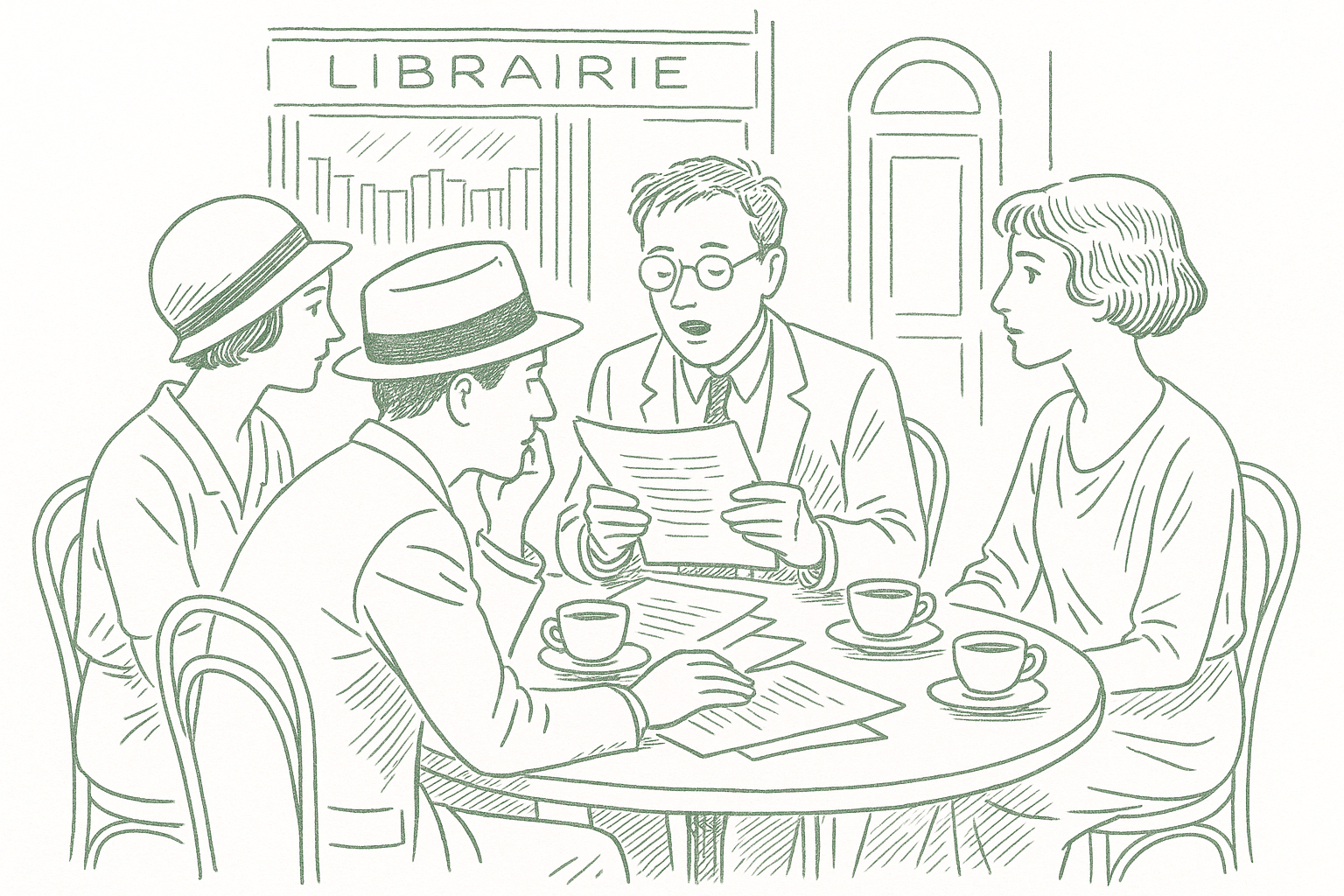
In the winter of 1921, a 22-year-old journalist from Oak Park, Illinois arrived in Paris with his wife, a typewriter, and a letter of introduction from Sherwood Anderson. He had no book contract. No reputation. No money to speak of. His name was Ernest Hemingway, and the letter was addressed to a 47-year-old American writer who held Saturday evening salons in a cramped apartment at 27 rue de Fleurus.
The writer was Gertrude Stein. The apartment was covered in paintings — Picassos, Matisses, Cézannes — acquired years earlier when both the artists and their work were still cheap. Stein read Hemingway's early stories and told him, bluntly, that his writing was new and unique but not yet good enough to be published in major outlets. She told him to begin over again and concentrate. She told him there was too much description.
This feedback changed American literature. Not because Stein was a genius editor — though she was formidable — but because she was the first serious writer who looked at Hemingway's work and told him the truth. Within four years of that first meeting, Hemingway published In Our Time, The Sun Also Rises, and Men Without Women, establishing the spare, declarative prose style that would define modern American fiction.
But Hemingway was not alone. The apartment at 27 rue de Fleurus, the bookshop at 12 rue de l'Odéon, the cafés along Boulevard du Montparnasse — these were the gathering places for a loose network of American expatriates who, between roughly 1921 and 1929, produced an astonishing volume of work that reshaped literature, poetry, and publishing. Hemingway. F. Scott Fitzgerald. Ezra Pound. John Dos Passos. Archibald MacLeish. Djuna Barnes. The group would eventually produce multiple Nobel Prizes, Pulitzers, and works that remain on university syllabi a century later.
Stein called them "a lost generation." But they were not lost. They were found — by each other, in a city where the rent was low and the feedback was honest.
Three rooms that built a literary movement
The Lost Generation did not operate out of a single meeting place. It operated out of three, each serving a different function in the peer ecosystem.
Gertrude Stein's salon at 27 rue de Fleurus was the inner circle. Stein and her partner Alice B. Toklas hosted Saturday evening gatherings where writers and artists showed up, drank, argued, and — critically — brought their work. Stein read manuscripts. She gave feedback that was direct to the point of brutality. She told Hemingway to cut. She told him his early novel had too much description and not enough action. She told him to "begin over again and concentrate." Hemingway, for his part, helped Stein prepare and proofread her own manuscripts.
This was not a cocktail party. It was a working salon — a structured peer environment where reputations were not spared and work was taken apart in real time. The social component existed, but it served the creative work, not the other way around. This is a pattern that appears in nearly every historically significant peer group: the social container is not incidental to the output. It is the mechanism that builds enough trust for genuinely honest feedback.
Shakespeare and Company at 12 rue de l'Odéon was the commons. Sylvia Beach, an American expatriate from Princeton, New Jersey, opened her English-language bookshop and lending library in 1919. Within two years it had become the primary gathering place for the Anglophone literary community in Paris. Hemingway, Fitzgerald, Pound, Eliot, James Joyce, André Gide, and Paul Valéry all frequented it. Beach lent books, extended credit, forwarded mail, and — in the case of Joyce — personally published Ulysses in 1922 when no other publisher in the English-speaking world would touch it.
Shakespeare and Company functioned as what a modern founder would recognize as a co-working space with community management. Beach was not just a bookseller. She was a connector. She introduced writers to each other, to publishers, to patrons. She created the conditions under which an unknown 22-year-old journalist from Illinois could end up in the same room as the most influential avant-garde writers in the world. Talent in isolation does not reliably find its audience. Talent inside a well-connected peer network does.
The cafés of Montparnasse and the Left Bank were the daily working environment. Hemingway wrote at La Closerie des Lilas, which he loved for its relative quiet. The Dôme, La Rotonde, and Le Select were louder, more social, and served as informal meeting points where writers could find each other without an appointment. Hemingway described the scene in A Moveable Feast: "On the Left Bank the light brightened, the cafés became more animated, and a general air of happiness spread from the homely fact that so many who frequented them were writers and artists actively at work."
The key phrase is "actively at work." These were not expatriates killing time. They were writers producing pages, sharing those pages with peers who were also producing pages, and receiving feedback that made the next draft better. The cafés created ambient accountability — if everyone around you is working on a manuscript, the social cost of not working on yours increases significantly. Accountability does not require a formal structure. It requires proximity to people doing the same thing you are trying to do.
The ten-page letter that made The Sun Also Rises
In April 1925, F. Scott Fitzgerald met Hemingway at the Dingo Bar on rue Delambre. Fitzgerald was already famous — The Great Gatsby had been published weeks earlier. Hemingway was still largely unknown, with only a small press collection of short stories to his name. The two men became fast friends, and their friendship produced one of the most consequential acts of peer editing in literary history.
When Hemingway completed a draft of The Sun Also Rises in the summer of 1926, Fitzgerald read it and sent back a ten-page handwritten letter. The feedback was detailed and unflinching. Fitzgerald told Hemingway the opening chapters exhibited a "condescending casualness." He said the first 16 pages should be cut entirely. He pointed to specific scenes that needed to be tightened, reorganized, or removed.
Hemingway cut the first 16 pages. He incorporated nearly all of Fitzgerald's suggestions. The Sun Also Rises was published in October 1926 and immediately established Hemingway as one of the most important writers of his generation.
Fitzgerald did more than edit. He introduced Hemingway to his own editor, Maxwell Perkins, and his publisher, Scribner's — the publishing house that would handle Hemingway's work for the rest of his career. This was not charity. It was the natural function of a peer network: someone who is further along in their career recognizes quality in someone who is not, and uses their own connections to accelerate the person behind them. The person doing the helping often benefits as much as the person being helped — Fitzgerald's editorial eye on Hemingway's work sharpened his own critical faculties.
The relationship was not always warm. Hemingway later described Fitzgerald as undisciplined, too focused on wealth, and dominated by his wife Zelda. Fitzgerald, increasingly consumed by alcoholism and financial pressure, watched Hemingway's star rise as his own dimmed. When Fitzgerald published Tender Is the Night in 1934, Hemingway's private critique was savage: "too sentimental, too polished, too far from the raw truth." He told Fitzgerald to stop dressing up his words and write with courage.
Brutal feedback. Honest to the point of damage. And yet: both men acknowledged that the other had fundamentally shaped their work. Hemingway called The Great Gatsby "about the best American novel ever written." Fitzgerald's editorial intervention on The Sun Also Rises turned a good manuscript into a masterpiece.
This is what distinguishes a genuine peer relationship from a pleasant professional acquaintance. The groups that produce mediocre results are the ones where everyone is too polite to say what they actually think. The groups that produce extraordinary work are the ones where the feedback is hard enough to hurt and the trust is deep enough to survive it.
Ezra Pound: the editor who cut a masterpiece in half
If Stein was the salon keeper and Fitzgerald was the peer editor, Ezra Pound was the connective tissue. Pound arrived in Paris in 1920, already established as the central figure of literary modernism. He had coined the term "imagism," launched the careers of several poets, and positioned himself as the primary gatekeeper between talent and publication.
Pound's editorial method was surgical. In January 1922, T.S. Eliot brought a 19-page draft of a long poem to Paris. The working title was "He Do the Police in Different Voices." Pound read it and cut over 200 lines. He restructured sections, tightened the language, and convinced Eliot to change the title to The Waste Land. The poem that emerged from Pound's editing became the most important work of English-language poetry in the 20th century.
Eliot dedicated The Waste Land to Pound with the inscription "il miglior fabbro" — "the better craftsman." It was an acknowledgment that the poem as published was substantially the product of peer editing. Eliot's original manuscript was brilliant but bloated. Pound's editorial intervention gave it the compression and density that made it a masterpiece.
Pound did the same for Hemingway. He read Hemingway's early short stories, marked them up, and sent them to literary magazines with personal recommendations. He introduced Hemingway to editors at The Dial and the Little Review. He helped arrange the publication of Hemingway's first book, Three Stories and Ten Poems, in 1923.
The pattern is consistent. In every case, the mechanism was the same: a more established peer reads the work of a less established peer, provides honest editorial feedback, and then uses their network to connect the work with its audience. This is not mentorship in the traditional sense — Pound was not Hemingway's teacher, and Fitzgerald was not Hemingway's boss. They were peers operating at different stages, and the value flowed in both directions. Pound's association with Hemingway and Eliot enhanced his own reputation. Fitzgerald's editorial work on The Sun Also Rises sharpened his critical instincts. The peer effect is reciprocal by nature.
Why Paris and why the 1920s
The Lost Generation's explosion of literary output was not accidental. It was the product of specific structural conditions that any founder or operator would recognize.
The cost of living was absurdly low. In the early 1920s, the French franc had collapsed against the dollar. An American with even modest savings or a freelance journalism income could live comfortably in Paris on what would barely cover rent in New York. Hemingway and his wife Hadley lived on her small trust fund — roughly $2,000 a year — and ate well, drank well, and traveled through Europe. This economic arbitrage freed writers from the pressure of making a living through their craft alone, giving them the time to develop their work.
The concentration of talent was unprecedented. Paris in the 1920s attracted not just American writers but painters (Picasso, Matisse, Man Ray), musicians (Cole Porter, Aaron Copland, George Antheil), photographers (Berenice Abbott), and publishers (Sylvia Beach, Robert McAlmon, Harry and Caresse Crosby). The density of creative talent in a walkable area of the Left Bank meant that a writer could wake up, walk to a café, and run into someone working on a masterpiece. Networks that are too large fail to produce deep connections. The Left Bank in the 1920s was small enough — and geographically concentrated enough — that everyone knew everyone, and the ambient pressure to produce was constant.
The distance from home removed social constraints. In America, these writers were sons and daughters of the middle class, expected to pursue conventional careers and maintain conventional values. In Paris, they were nobody — free to experiment, fail publicly, and reinvent themselves without the judgment of parents, neighbors, or the literary establishment. The geographic distance functioned as psychological permission. It is far easier to take creative risks when you are not performing for your hometown.
The trauma of World War I created a shared emotional context. Hemingway had driven ambulances in Italy and been seriously wounded. Dos Passos had served with the French ambulance corps. Cummings had been imprisoned in a French detention camp. Even those who did not serve directly — Fitzgerald, Stein — lived in a world whose certainties had been shattered by the war. This shared experience created an immediate bond that bypassed the normal timeline of trust-building. When everyone in the room has seen the same catastrophe, the conversation starts at a different level.
These are not exotic conditions. They are structural advantages that can be designed. Low cost, high concentration, shared context, and freedom from the pressures of existing social expectations. Every effective peer group — whether a mastermind, an accelerator, or a writing circle — creates some version of these conditions. The best groups are intentional about the container, not just the content.
The output: a decade that rewrote the canon
The literary output of the Lost Generation in its Paris years is staggering in both volume and significance.
Hemingway published In Our Time (1925), The Sun Also Rises (1926), Men Without Women (1927), and A Farewell to Arms (1929). Fitzgerald published The Great Gatsby (1925) and Tender Is the Night (1934). Pound published much of The Cantos. Dos Passos published Manhattan Transfer (1925) and began U.S.A. Djuna Barnes published Nightwood (1936). James Joyce, a core member of the Paris circle though Irish rather than American, published Ulysses (1922) — printed by Sylvia Beach because no English-language publisher would risk it — and spent the next 17 years writing Finnegans Wake.
T.S. Eliot published The Waste Land (1922), edited into its final form by Pound in Paris. Gertrude Stein published The Making of Americans (1925) and The Autobiography of Alice B. Toklas (1933). Archibald MacLeish published The Pot of Earth (1925) and Conquistador (1932), which won the Pulitzer Prize.
Multiple Nobel Prizes in Literature — Hemingway in 1954, Eliot in 1948. Multiple Pulitzers. Works that defined American literature for the rest of the century and remain foundational texts today.
The question is not whether these writers were talented. They obviously were. The question is whether they would have produced the same caliber of work without each other. The evidence strongly suggests they would not. Hemingway without Stein's editing is a promising journalist who might never have found his voice. Hemingway without Fitzgerald's intervention on The Sun Also Rises is a good novelist with a weak opening. Eliot without Pound's editing of The Waste Land is a great poet with a sprawling, unfocused manuscript.
The individual talent was the necessary condition. The peer network was the sufficient one.
What the Lost Generation teaches about peer groups
You do not need to be a writer to learn from what happened on the Left Bank. The organizational dynamics that made the Lost Generation productive are identifiable, replicable, and directly applicable to any structured peer group.
Honest feedback requires trust, and trust requires a container. Stein's salon, Beach's bookshop, and the cafés of Montparnasse were not formal organizations with bylaws and membership fees. But they were containers — physical spaces where the same people showed up repeatedly, built relationships, and developed enough trust to tell each other the truth about their work. The feedback that shaped The Sun Also Rises and The Waste Land was only possible because the people giving it had earned the right to be heard. Psychological safety is not a buzzword. It is the precondition for the kind of honesty that produces great work.
Connectors are as important as creators. Sylvia Beach never wrote a major novel. She published one — Joyce's Ulysses — and that act changed literary history. But her primary contribution was connecting people. She introduced writers to each other, to publishers, to patrons. Sherwood Anderson's letter of introduction sent Hemingway to Stein. Fitzgerald introduced Hemingway to Perkins and Scribner's. Pound introduced everyone to everyone. The peer network functioned because certain people made it their business to create connections rather than just consume them.
The group does not need to agree to be effective. Hemingway and Stein had a falling-out so bitter that Hemingway savaged her in A Moveable Feast. Hemingway and Fitzgerald's friendship disintegrated into resentment and cruelty. Pound's politics eventually made him a pariah. The personal relationships were frequently dysfunctional. The professional output was extraordinary. A peer group is not a friendship group. It is a working relationship — and the most productive working relationships are often the ones with the most tension.
Proximity and frequency matter more than formal structure. The Lost Generation had no meetings, no agendas, no facilitators. What it had was geography. Everyone lived within walking distance of everyone else. Everyone went to the same cafés. Everyone read each other's work because it was right there, on the next table, in the next apartment, at the next Saturday salon. The frequency of interaction was daily, not monthly. The feedback loop was tight enough that a draft written on Tuesday could be critiqued on Wednesday and revised by Thursday. Modern peer groups that meet once a month struggle to maintain momentum precisely because the intervals are too long.
The peer network outlasts the peer group. The Paris years ended. The Great Depression pulled most of the expatriates back to America. Stein and Beach stayed. Hemingway went to Key West, then Cuba. Fitzgerald went to Hollywood. Pound went to Italy. But the connections forged in Paris continued to shape their work and careers for decades. Hemingway and Fitzgerald corresponded until Fitzgerald's death in 1940. The editorial principles Pound taught Hemingway and Eliot in the 1920s remained the foundation of their work in the 1940s and 1950s. The most valuable peer groups are the ones whose influence persists long after the formal meetings end.
Look at the bookshelf of any English department in any university in the world. The Great Gatsby. The Sun Also Rises. The Waste Land. Ulysses. A Farewell to Arms. These are not just great books. They are artifacts of a peer network — products of a small group of people who lived close together, read each other's work, gave each other the truth when nobody else would, and pushed each other past what any of them could have achieved alone.
A handful of broke writers in rented apartments. A bookshop that doubled as a mailroom. A Saturday salon in a living room. That is all it took to produce the defining literature of the 20th century.
The room was everything.