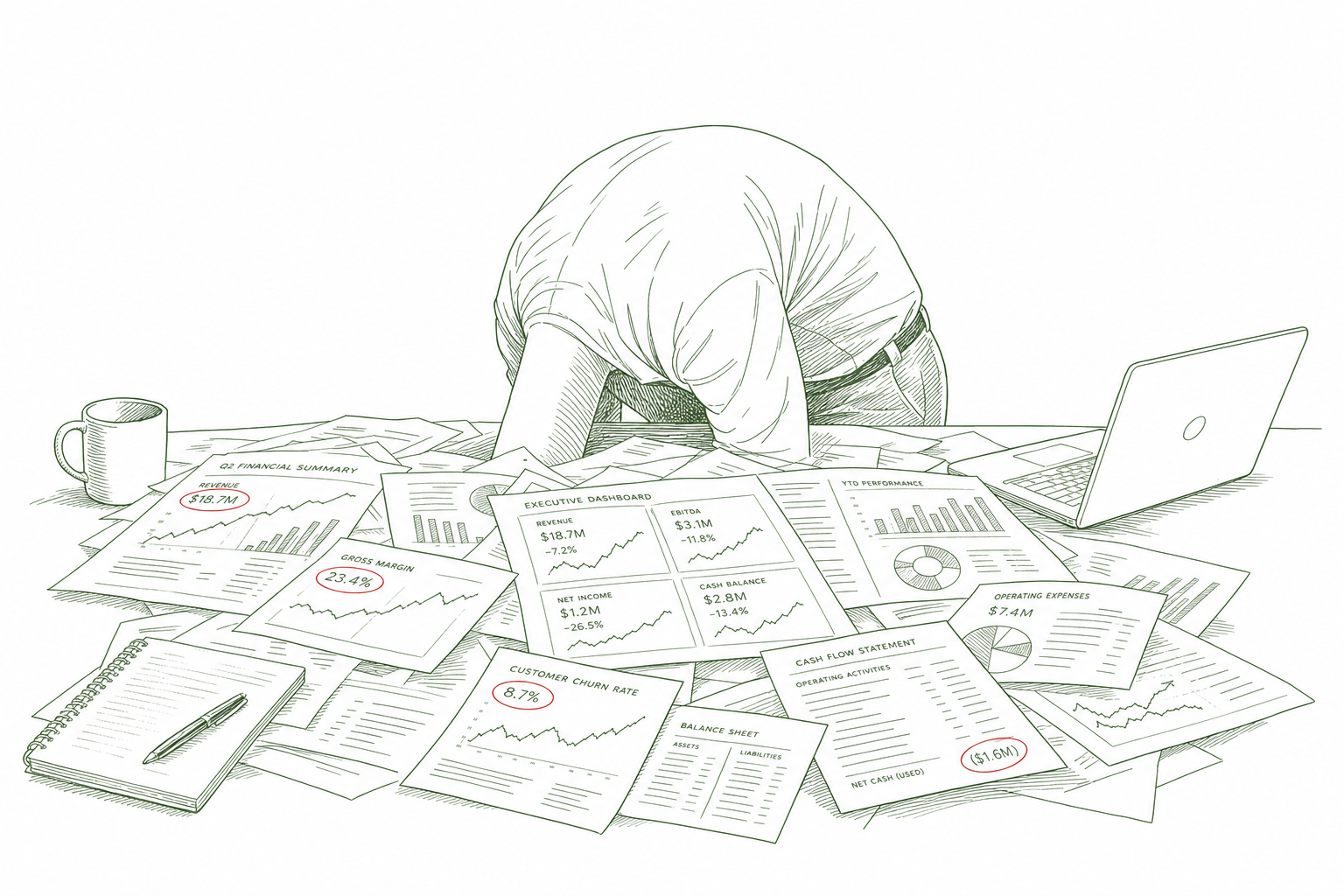
Ostriches do not actually bury their heads in the sand. That is a myth dating back to Pliny the Elder, who apparently never spent much time observing actual ostriches. But the metaphor stuck because it describes something painfully real about human behavior: when information threatens to be painful, people do not just fail to seek it. They actively construct ways to avoid encountering it.
For investors, this means not logging in. For founders, the consequences are considerably worse.
The research behind the head in the sand
The term entered academic literature in two waves. In 2006, Israeli economists Dan Galai and Orly Sade published their study in The Journal of Business, defining the ostrich effect as "avoiding apparently risky financial situations by pretending they do not exist." Their experiments showed that investors were willing to accept lower returns on illiquid assets — assets whose value was reported less frequently — essentially paying a premium for the bliss of ignorance. People preferred investments that did not tell them how things were going.
In 2009, Karlsson, Loewenstein, and Seppi published their landmark paper "The Ostrich Effect: Selective Attention to Information" in the Journal of Risk and Uncertainty. Their central finding was not just that people avoid bad news — it was that attention itself is selective and strategic. Analyzing data from Scandinavian and American investment platforms, they demonstrated that investors monitored their portfolios significantly more often when markets were rising than when markets were falling or flat. The information was equally available in both conditions. The difference was entirely in whether people chose to look at it.
The 2015 follow-up study — the one with 852 million observations — added a critical dimension. Loewenstein, Seppi, Nachum Sicherman of Columbia, and Stephen Utkus of Vanguard found that the ostrich effect was not a momentary lapse. It was a stable personality characteristic. Some investors consistently avoided looking during downturns, across years of data. The trait was more pronounced in investors with higher equity exposure — precisely the people for whom the information was most consequential. The higher the stakes, the deeper the head went into the sand.
Information avoidance is bigger than investing
In 2017, Russell Golman, David Hagmann, and George Loewenstein published a sweeping review in the Journal of Economic Literature that situated the ostrich effect within a broader phenomenon they called information avoidance. The findings were damning for anyone who believes that rational actors always seek useful data.
People at risk for diseases skip screenings. Dieters avoid calorie counts. Teachers refuse to read student evaluations. In each case, the information is available, free, and decision-relevant. In each case, the person actively chooses not to obtain it because the anticipated emotional cost of knowing outweighs the decision-making benefit. Golman, Hagmann, and Loewenstein emphasized that this is not laziness or forgetfulness. It is strategic. The brain is running a cost-benefit analysis — and the "cost" column includes the psychological pain of confronting an uncomfortable truth.
For founders, this cost-benefit calculation is warped by several factors that make them more susceptible than almost any other population.
Why founders are uniquely vulnerable
Identity fusion makes bad numbers feel personal. Research on entrepreneurial identity by Melissa Cardon and colleagues in Personnel Psychology shows that founders frequently merge their sense of self with their venture. When the company's churn rate is climbing, it does not register as a business metric in need of attention. It registers as evidence that the founder — the person, not just the business — is failing. The brain's response to that kind of threat is predictable: avoid the information that triggers it. Do not open the dashboard. Do not run the report. Do not calculate the real burn rate. The ostrich effect is not a financial behavior for founders. It is an identity-protection mechanism.
Optimism bias provides cover. Entrepreneurs score significantly higher on optimism scales than the general population — a finding replicated across multiple studies, including Cooper, Woo, and Dunkelberg's 1988 study in the Journal of Business Venturing, where 81 percent of founders rated their chances of success at 70 percent or better, and a third rated them at 100 percent. This built-in optimism provides a ready-made justification for not looking at the numbers: things will get better. The dip is temporary. Next month will be different. Optimism does not require the founder to confront the data that might disconfirm it — and the ostrich effect ensures they never do.
Isolation removes the forcing function. In an organization with a board, investors, or a management team, someone eventually asks to see the numbers. The request itself is the intervention — it forces the founder to look. A solo founder, or a founder whose team is too deferential to push, has no such forcing function. The dashboard sits there. The report sits there. The spreadsheet sits there. Nobody asks. Nobody looks. And the ostrich effect does what it does best: it turns the absence of looking into a habit, and the habit into a culture.
The Ford dashboard problem
In 2006, Alan Mulally took over as CEO of Ford. The company was losing $17 billion that year. At his first weekly business review meeting, he asked each division leader to report their status using a simple traffic light system: green for on-track, yellow for caution, red for problems.
Every single light was green.
Ford was hemorrhaging money at a rate that threatened its existence, and every division reported that everything was fine. The ostrich effect had not just infected individual decision-makers — it had become the operating system of the entire organization. Surfacing bad news was culturally punished. Avoiding it was culturally rewarded. The information existed. It was in the systems. But looking at it — really looking, and saying "this is red" — required the kind of psychological safety that Ford's culture had systematically destroyed.
Mulally's turnaround began not with a strategic pivot or a cost-cutting initiative. It began with a simple structural intervention: he made it safe to report red. When Mark Fields became the first executive to show a red light — for a production delay on the Ford Edge — Mulally stopped the meeting and applauded. Within weeks, the dashboards were covered in red and yellow. The information had been there all along. What changed was that someone created the conditions under which people were willing to look at it.
Most founders do not have an Alan Mulally. They do not have a board that forces the traffic light conversation. They have a dashboard they built themselves, populated with metrics they chose, and nobody is asking whether any of those lights should be red. The higher you climb, the less truth you hear — and the ostrich effect ensures you do not go looking for it on your own.
What the avoidance actually costs
The ostrich effect does not make the numbers go away. It makes the response to them later, more expensive, and more desperate.
CB Insights' analysis of 110+ startup post-mortems found that "ran out of cash" and "no market need" were the top two causes of failure. In case after case, the founders acknowledged after the fact that the warning signs were visible months before the company died. The data was in the system. The churn was accelerating. The burn rate was unsustainable. The pipeline was not converting. They saw peripheral glimpses of it. They just never sat down and looked at all of it at once, because looking at all of it at once would mean acknowledging what they already suspected: the current trajectory was not working.
The Karlsson, Loewenstein, and Seppi research offers a precise mechanism for why this delay is so costly. Their theory proposes that attention amplifies the emotional impact of information. Looking at a declining metric does not just inform you that things are bad — it makes you feel that things are bad, in a way that not-looking does not. The brain treats the act of looking as optional, the same way it treats opening a credit card statement as optional. The debt does not change whether you open the envelope. But the pain of knowing does. So the envelope stays sealed, the dashboard stays unchecked, and the founder loses the window in which the problem was fixable.
The planning fallacy compounds this. Founders already underestimate how long things will take and how much they will cost. The ostrich effect ensures they do not check whether their optimistic timelines are actually on track. The two biases reinforce each other in a loop: the planning fallacy sets unrealistic expectations, and the ostrich effect prevents the founder from discovering that the expectations were unrealistic until it is too late to adjust.
Why knowing about the bias does not fix it
This is the part that matters most, and the part that most writing about cognitive biases conveniently skips. Knowing about the ostrich effect does not make you immune to it. The 2017 Golman, Hagmann, and Loewenstein review was explicit on this point: information avoidance is not a failure of awareness. It is a motivated strategy. The brain is not accidentally overlooking the data. It is deliberately prioritizing short-term emotional comfort over long-term decision quality.
Confirmation bias operates in the same territory — founders selectively seek information that validates what they already believe. But the ostrich effect is its darker cousin. Confirmation bias says: I will look, but only at what confirms my thesis. The ostrich effect says: I will not look at all. The first distorts your picture of reality. The second eliminates the picture entirely.
This is why articles telling founders to "track your metrics" and "face the hard truths" accomplish nothing. The founder already knows they should track their metrics. The problem is not knowledge. The problem is that the act of looking triggers a threat response that the brain is designed to avoid. Telling someone to overcome the ostrich effect through willpower is like telling someone to overcome fear of heights by deciding not to be afraid. The mechanism operates below the level where conscious intention has much influence.
What actually works
The research on overcoming information avoidance converges on a single structural principle: external accountability makes the cost of not-looking higher than the cost of looking.
The Mulally story illustrates this at the organizational level. Before Mulally, the cost of reporting red was higher than the cost of not-looking — because the culture punished honesty. After Mulally restructured the incentives, the cost flipped. Not-reporting became riskier than reporting. The information started flowing not because people suddenly became braver, but because the structural conditions changed.
For a founder, the structural equivalent is a recurring peer group with a defined accountability format. When a founder knows that every two weeks, they will sit in front of five people who will ask about the numbers — not in a punitive way, but in the way that real accountability works — the calculus changes. Not-looking is no longer a costless default. It becomes something you have to explain. "I did not check the churn numbers" is a sentence you can say to yourself indefinitely. It is a much harder sentence to say to five peers who asked you two weeks ago to check the churn numbers.
The Hawthorne effect is the adjacent mechanism: being observed changes behavior. The observation itself — knowing that someone will ask — is often enough to override the avoidance impulse. The founder opens the dashboard not because they have overcome their bias, but because the social cost of not opening it now exceeds the emotional cost of what they might find.
Solomon's paradox adds another layer. People give better advice to others than to themselves because they can evaluate others' situations without the emotional entanglement. In a peer group, the founder is not the only one looking at the numbers. Five other people are looking at them too — people who are not emotionally invested in the outcome, who do not have their identity fused with the metric, and who can say "this is red" without it feeling like a personal indictment. The group provides the emotional distance that the founder cannot manufacture alone.
The intervention is structural, not motivational
The critical insight from four decades of ostrich effect research is this: the problem is not that founders lack discipline, courage, or analytical skill. The problem is that the human brain has a built-in mechanism for avoiding information that threatens its current emotional state, and founders operate in conditions that maximize that mechanism's activation. High identity investment. High personal responsibility. High uncertainty. Chronic decision fatigue. All of these amplify the ostrich effect beyond what any individual, regardless of how self-aware they are, can reliably override through willpower alone.
The fix is not a better dashboard. It is not a reminder to check your metrics. It is not a motivational quote about facing hard truths. The fix is a structural commitment — a recurring obligation to show up, open the numbers, and discuss them with people who care about you enough to ask and who are distant enough from the numbers to evaluate them honestly.
Your network is too large to do this for you. A thousand contacts will never ask about your churn rate. Five people in a structured group will. Not because they are nosy. Because that is what the structure is for. And the structure exists because four decades of research have made something uncomfortably clear: when it comes to the numbers that matter most, the default human behavior is to look away. The only reliable corrective is someone standing next to you, asking you to look.