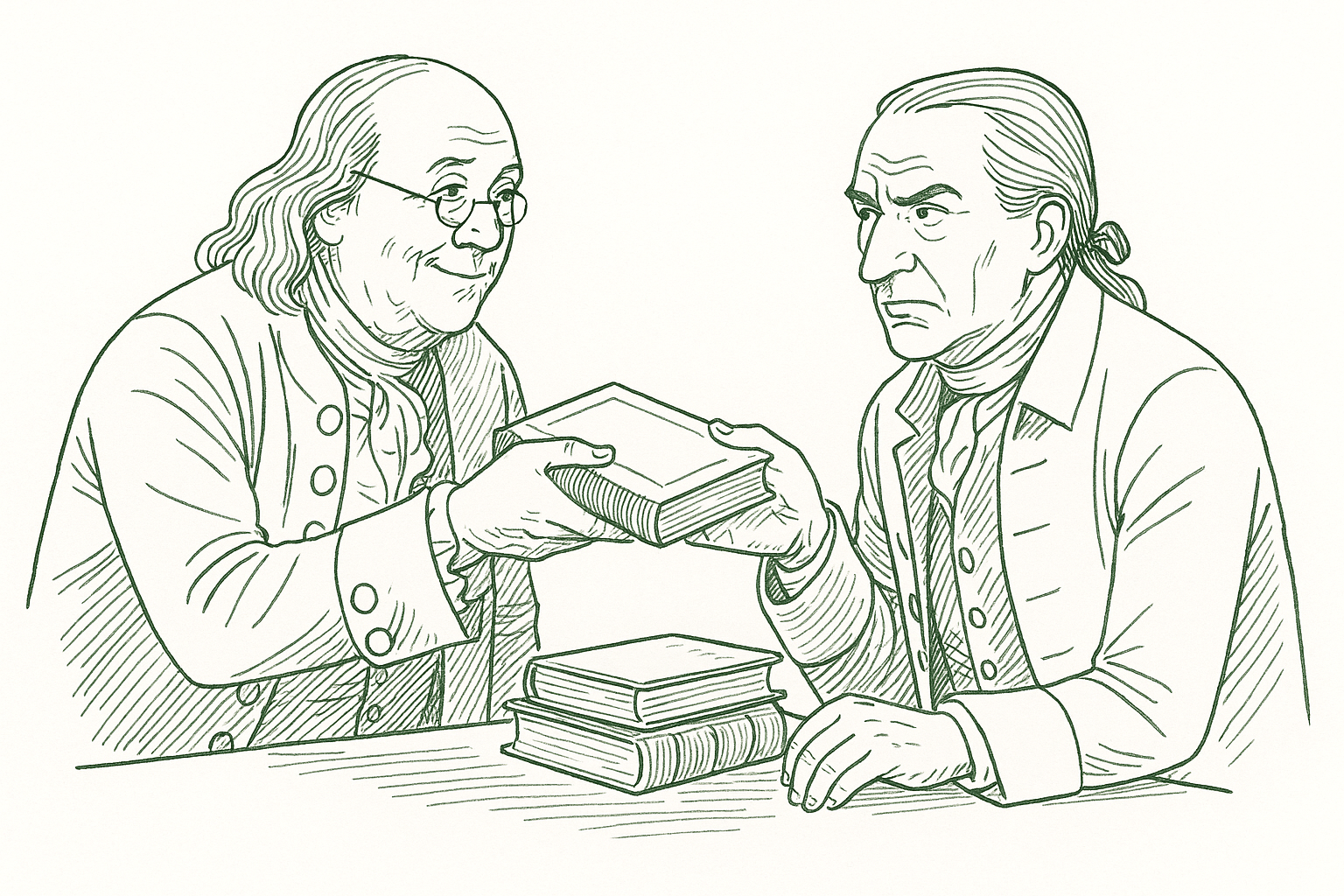
In 1736, a young Pennsylvania legislator named Benjamin Franklin had a problem. A rival member of the General Assembly had delivered a long speech against him and was actively working to undermine his influence. Franklin needed this man's cooperation. The conventional move would have been to grovel, to offer a favor, to try to buy goodwill. Franklin did the opposite.
He sent a note asking to borrow a rare book from the man's library.
The rival obliged. Franklin returned the book a week later with a warm thank-you note. And something shifted. "When we next met in the House," Franklin wrote in his autobiography, "he spoke to me, which he had never done before, and with great civility; and he ever after manifested a readiness to serve me on all occasions, so that we became great friends, and our friendship continued to his death."
Franklin did not do the rival a favor. He asked for one. And the asking is what built the trust.
This was not a diplomatic trick. It was, as psychologists would prove two centuries later, a structural feature of how human cognition works.
The experiment that proved it
In 1969, psychologists Jon Jecker and David Landy at the University of California ran an experiment designed to test whether Franklin's anecdote reflected something real. They invited students to participate in a question-and-answer competition where they could win small sums of money. After the competition, they split the winners into three groups.
The first group was approached directly by the researcher, who explained he had funded the prize money himself and was running short. He asked if they would return their winnings as a personal favor. The second group received the same request, but from a secretary, framed as a departmental budget issue. The third group was not asked to return anything.
Then all three groups rated how much they liked the researcher.
The group that did the researcher a personal favor rated him most likable. The group asked by an intermediary rated him least likable. The control group fell in the middle. Doing a favor for someone — specifically, a direct, personal favor — made people like the person more. Not the other way around.
Jecker and Landy published their findings in the journal Human Relations, and the result has been replicated and extended dozens of times since. The finding upended the commonsense assumption that liking drives generosity. In many cases, generosity drives liking. We do not help people because we like them. We like people because we helped them.
The cognitive dissonance engine
The mechanism behind the Ben Franklin effect is cognitive dissonance — the discomfort your brain feels when your actions contradict your beliefs. Leon Festinger formalized the theory in 1957, and it remains one of the most robustly supported findings in social psychology.
Here is how it works in the Franklin scenario. You do a favor for someone you feel neutral or negative toward. Your brain now holds two conflicting pieces of information: "I went out of my way for this person" and "I don't particularly like this person." That contradiction creates psychological tension. And the brain resolves it the only way it can — by updating the belief. "I must like them. Otherwise, why would I have helped?"
This is not a conscious calculation. It happens below the level of awareness, which is what makes it so powerful. The person experiencing the effect does not feel manipulated. They feel a genuine shift in warmth. The favor creates the affection rather than the other way around.
Psychologist Daryl Bem offered a complementary explanation through his self-perception theory, published in 1967. Bem argued that when people are uncertain about their own attitudes, they observe their own behavior and infer their feelings from it — the same way an outside observer would. "I helped this person, so I probably like them" follows the same logic as "she's running, so she's probably in a hurry." We read our own actions like we read other people's.
In 1971, University of North Carolina psychologists John Schopler and John Compere tested this directly. They had participants act kindly toward one person and harshly toward another. When asked afterward, participants reported genuinely liking the person they had been kind to — even though the assignment was random. The behavior came first. The feeling followed.
Why this matters more than networking advice
Most conventional networking advice gets the direction of trust exactly backward. Go to events. Meet people. Exchange value. Help others so they will help you. The implicit model is transactional: I give, therefore I earn trust. The Ben Franklin effect says the more powerful path is the opposite: I ask, therefore I create trust.
This is counterintuitive enough that most people resist it. Asking for help feels like a vulnerability, a concession of weakness. Founders in particular avoid it because they have internalized the mythology that leadership means having answers, not questions. But the psychology is unambiguous: asking someone to contribute to your problem makes them more invested in you, not less.
The Forbes analysis of the Ben Franklin effect found that the mechanism is particularly strong in professional contexts where people are uncertain about each other — exactly the conditions that describe a new peer group. When two founders who do not know each other sit down and one asks "here is what I am struggling with — what would you do?" the person answering does not just share advice. They invest. And investment creates attachment.
This is one of the reasons masterminds work and networking events do not. A networking event is a room full of people trying to project competence. Nobody is asking for real help. Nobody is granting real favors. The Ben Franklin effect never activates because neither side does anything for the other that involves genuine effort or vulnerability.
The favor loop inside peer groups
Structured peer groups create the conditions for the Ben Franklin effect to operate continuously. Every meeting is a series of asks. A founder presents a problem. The group listens, questions, and offers perspectives. Each act of giving attention, sharing experience, or challenging an assumption is a favor — a small, specific investment of cognitive effort on behalf of someone else.
And the research says each of those favors deepens the bond.
The hot seat format is particularly effective at activating this mechanism. When a founder takes the hot seat, they are doing exactly what Franklin did — asking for something specific from people who have no obligation to give it. The group members who respond are granting favors. And granting those favors makes them more invested in the person they helped. The cycle repeats every meeting. Trust compounds.
This is different from what happens in communities, Slack groups, or casual founder dinners. In those contexts, helping is optional and intermittent. The Ben Franklin effect requires repeated, specific acts of contribution directed at specific people. A Slack reply to a stranger's question does not carry the same psychological weight as sitting with someone for 20 minutes, learning their context, and offering a considered perspective. The structure matters because it ensures the favors actually happen, in both directions, consistently.
Research on the peer effect confirms this. The bonds that produce the strongest outcomes in peer groups are not formed by shared demographics or shared industries. They are formed by shared effort — the act of working on each other's problems. The Ben Franklin effect explains the underlying psychological mechanism: the work itself creates the trust.
Vulnerability as a trust engine
The Ben Franklin effect has a precondition that most people miss. The favor has to feel real. Lending a rare book works because it requires actual generosity — the lender has to trust the borrower with something valuable. A performative ask does not trigger the effect. You cannot fake vulnerability and expect the cognitive dissonance engine to start.
This is why psychological safety is not a soft skill or a nice-to-have in peer groups. It is the structural prerequisite for the Ben Franklin effect to function. If members do not feel safe enough to ask real questions — about problems they have not solved, decisions they are unsure about, fears they have not voiced — the favors never happen. And without favors, the trust never forms.
The American Society of Training and Development found that people have a 65% chance of achieving a goal when they commit to another person, rising to 95% when they have ongoing accountability appointments. But the commitment has to be genuine. Accountability without trust is surveillance. Trust without vulnerability is politeness. The Ben Franklin effect explains how to get from politeness to actual trust: ask for something real, and let the other person's brain do the rest.
This also explains why groups that enforce reciprocal contribution outperform groups that let members participate passively. When everyone is required to both ask and answer — to take the hot seat and to respond when others do — the Ben Franklin effect operates in both directions simultaneously. Every member is both granting and receiving favors, building trust in both directions at once. The research on reciprocal vulnerability confirms this: turn-taking disclosure produces significantly more trust and closeness than one-sided sharing, and the effect compounds with each interaction.
Franklin's second insight
There is a detail in the original Franklin story that most people overlook. After his rival lent the book, Franklin returned it with a note — and then mentioned it again when they next met. The favor was not a one-time transaction. Franklin created a loop: ask, receive, acknowledge, follow up. The relationship deepened not from a single act but from a sequence of them.
This is precisely the structure of a recurring peer group. You ask for help in week one. You report back in week three. The group asks follow-up questions. You implement, return, and report again. Each cycle is a new favor, a new investment, a new activation of the cognitive dissonance that deepens trust. Starting a group that actually lasts requires building these loops into the format itself.
The most enduring groups in history understood this intuitively. Franklin's Junto — the peer group he founded in 1727, nine years before the book-lending incident — met every Friday night for over 30 years. The format was built on mutual contribution: each member was expected to bring questions, share knowledge, and help the others. The Junto did not survive because its members liked each other at the start. It survived because the structure forced them to do favors for each other every week until the liking became real. A generation later, Emerson would build the same pattern into his Transcendental Club — thirty meetings that rewired American philosophy.
The Kohler effect adds another layer. In small groups where effort is visible, people work harder — not because of external pressure, but because they can see that their contribution matters. Combine this with the Ben Franklin effect and you get a compounding cycle: visible effort creates deeper trust, deeper trust enables more vulnerable asks, more vulnerable asks generate more meaningful favors, and more meaningful favors deepen trust further. The flywheel spins faster with each rotation.
Stop offering. Start asking.
The instinct for most founders entering a peer group is to prove themselves. Show up with answers. Demonstrate expertise. Add value. This instinct is exactly wrong. The Ben Franklin effect says the fastest path to trust is not showing how much you know — it is showing that you need something specific from the people in the room.
Franklin did not win over his rival by doing him a favor. He won by asking for one. The rival's brain did the rest, resolving the dissonance between "I lent him my book" and "I don't like him" by updating the second belief. Two centuries of research have confirmed the mechanism. The behavior changes the belief. The favor creates the bond.
Your network is too big to help you. You have hundreds of connections and almost none of them would lend you a rare book. The question is not whether you know enough people. The question is whether you have a small group of people who have invested enough in your specific problems that the Ben Franklin effect has had time to do its work.
If you do not, you are not lacking connections. You are lacking the structure that turns strangers into allies — not through charm, not through favors owed, but through the simple, powerful act of asking for help and letting the other person's brain decide that helping you was something they wanted to do all along.