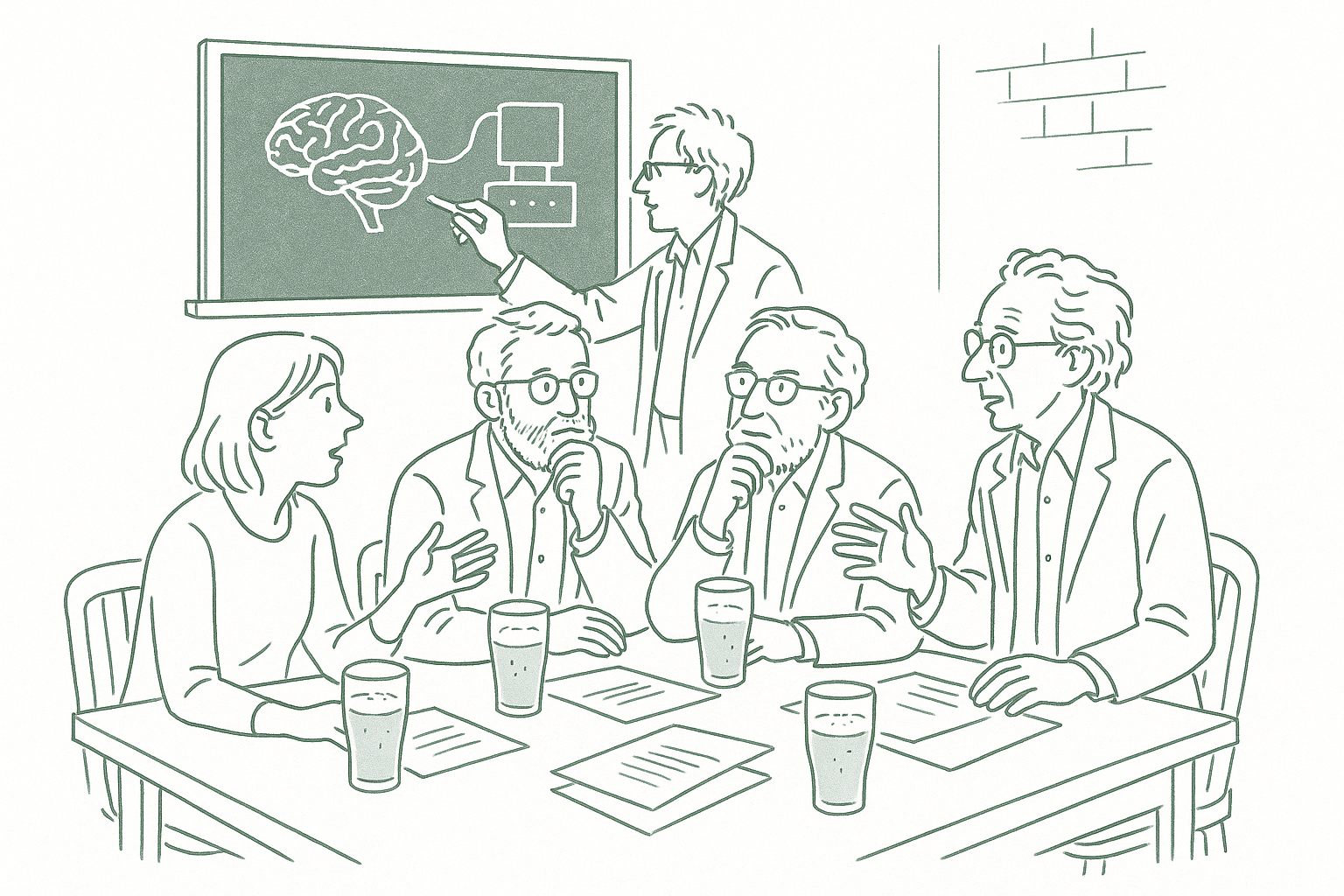
In September 1949, a thirty-one-year-old neurologist named John Bates sent a letter to a handful of colleagues. The idea, he wrote, was simple: gather a small group of young scientists interested in how brains and machines processed information, feed them dinner and beer in the basement of the National Hospital for Nervous Diseases in Queen Square, London, and see what happened when they argued.
The result was the Ratio Club — twenty-one members, no professors allowed, no published proceedings, no minutes, and almost no public record that it existed until decades later. Over the next nine years, this group would produce the first autonomous robots, pioneer computational neuroscience, help define the concept of machine intelligence, and quietly build the intellectual foundations for artificial intelligence, all while meeting roughly once a month in a room that smelled like antiseptic and beer.
The club's name, suggested by the psychologist Albert Uttley, came from the Latin ratio — computation, or the faculty of mind that calculates, plans, and reasons. The word was almost certainly a nod to Norbert Wiener's phrase "machina ratiocinatrix," the reasoning machine. But there was a catch: to be invited, you had to have been thinking about cybernetics before Wiener's 1948 book popularized the field. The Ratio Club was not a reading group. It was a room full of people who had independently arrived at the same frontier and wanted to argue about what came next.
Twenty-one people who changed how we think about thinking
The membership list reads like a founding document for half the fields that define the modern world. Alan Turing — mathematician, wartime codebreaker, the person who formalized the concept of computation itself — was a regular attendee. W. Ross Ashby, a psychiatrist who had built the Homeostat, one of the first machines capable of adapting to its environment, brought the perspective of someone who had already proven that machines could learn. W. Grey Walter, a neurophysiologist, brought two small robotic "tortoises" named Elmer and Elsie to meetings — autonomous machines that could navigate toward light, avoid obstacles, and exhibit behaviors complex enough that visitors regularly mistook them for living creatures.
Then there was Horace Barlow, a vision neuroscientist and great-grandson of Charles Darwin, who would go on to propose the "efficient coding hypothesis" — the foundational theory that sensory neurons are optimized to transmit maximum information with minimum energy. I.J. Good, who had been Alan Turing's chief statistician at Bletchley Park during the war, brought a probabilistic framework that would eventually become central to Bayesian statistics and, much later, to machine learning. Thomas Gold, an astrophysicist who would later provide the correct explanation for pulsars — rapidly rotating neutron stars — contributed a physicist's instinct for elegant models in a room full of biologists and engineers.
John Pringle studied how invertebrate nervous systems process information. Donald MacKay worked on the physics of information. Pat Merton investigated how the brain controls voluntary movement. Harold Shipton built the electrical equipment that made brain research possible. Every member was under forty. Every member was working at the edge of what was known. And the one rule that Bates enforced rigorously was this: if you got promoted to professor, you were expected to resign.
The no-professors rule was not anti-intellectual snobbery. It was structural design. Bates understood that hierarchy kills honest conversation. When someone in the room has power over your career, you edit yourself. You soften your objections. You defer to authority rather than to evidence. By excluding professors, Bates ensured that every person in the room could say exactly what they thought without professional consequence. The Ratio Club was not a seminar. It was a space where dangerous ideas could be tested before they were ready for the world.
The format: beer, blackboards, and arguments that lasted past midnight
The meetings followed a loose but deliberate pattern. One member would present a talk — not a polished lecture, but a working idea, often half-formed, sometimes deliberately provocative. Then the room would argue. The conversations ranged from the mathematics of neural networks to whether a machine could ever truly think, from the information capacity of a single nerve fiber to the philosophical implications of feedback loops in biological systems.
The setting mattered. A basement room in a hospital, not a university lecture theater. Beer and sandwiches, not formal dinners. Phil Husbands and Owen Holland, who wrote the definitive academic account of the club for MIT Press, described the atmosphere as "intense but convivial" — serious ideas discussed in an environment that deliberately stripped away formality. Bates understood something that modern research on group dynamics has since confirmed: psychological safety does not come from comfort. It comes from the absence of the specific threats — career risk, reputational damage, hierarchical judgment — that cause people to self-censor.
The topics were extraordinary for 1949. These were people discussing machine intelligence, neural coding, autonomous robotics, and self-organizing systems at a time when the first electronic computers were the size of rooms and the word "cybernetics" was barely a year old. They were not reporting established science. They were inventing the questions that the next seventy-five years of science would attempt to answer.
Turing reportedly used the club as a testing ground for the ideas he published in his landmark 1950 paper, "Computing Machinery and Intelligence," which introduced what we now call the Turing Test — the proposal that a machine should be considered intelligent if its responses are indistinguishable from a human's. The paper appeared in the journal Mind in October 1950, but the core arguments had already survived months of interrogation in the Ratio Club basement. By the time the world saw them, they had been stress-tested by twenty of the sharpest minds in Britain.
Grey Walter's tortoises: the first autonomous machines
Of all the work that emerged from or was shaped by the Ratio Club, W. Grey Walter's robotic tortoises may be the most vivid proof that peer groups produce outcomes that individuals cannot.
Walter, a neurophysiologist at the Burden Neurological Institute in Bristol, built Elmer and Elsie between 1948 and 1949 from war surplus components — a light sensor, a touch sensor, two motors, and a handful of vacuum tubes. The machines were small, slow, and physically unimpressive. What made them revolutionary was their behavior. Each tortoise navigated autonomously toward light sources, avoided obstacles, and — when its battery ran low — sought out a charging station with a bright light mounted above it. When two tortoises encountered each other, each one's headlamp triggered the other's light sensor, producing an interaction that Walter described as a "mutual recognition" — a behavior complex enough that he called it "an imitation of life."
Walter demonstrated these machines at Ratio Club meetings. The feedback from Turing, Ashby, Barlow, and others did not just validate the project — it sharpened it. Walter's insight was that complex behavior does not require a complex brain. Two sensors and two motors, connected by simple circuits, could produce behavior that looked purposeful. This was a direct challenge to the prevailing assumption that intelligence required centralized, top-down control — an assumption that Ashby was simultaneously dismantling with his Homeostat, and that Turing was approaching from a purely mathematical direction.
The Ratio Club was the only room in the world where all three approaches — Walter's embodied robotics, Ashby's adaptive machines, and Turing's formal computation — were being discussed simultaneously by the people who created them. Each approach challenged and refined the others. The field that eventually became artificial intelligence was not born in a single paper or a single laboratory. It was born in conversations among peers who were working on adjacent problems and who forced each other to confront the implications of their own work.
Why the Ratio Club was not the Macy Conferences
The obvious comparison is to the Macy Conferences on cybernetics, held in New York between 1946 and 1953. The Macy Conferences were larger, more formal, better funded, and far better documented — their published transcripts became foundational texts in systems theory. Norbert Wiener, John von Neumann, Warren McCulloch, Margaret Mead, and Gregory Bateson all participated. By any institutional measure, the Macy Conferences were the more important gathering.
But the Ratio Club produced more working machines and more directly shaped the trajectory of British science, for structural reasons that illuminate what makes small groups more effective than large ones.
First, the Ratio Club was small. Twenty-one members, compared to the Macy Conferences' rotating roster of dozens. Research on optimal group size consistently shows that groups above about twelve people shift from discussion to performance. People begin talking to the room rather than to each other. Arguments become presentations. The Ratio Club stayed small enough that every member could engage directly with every other member, every meeting.
Second, the Ratio Club was informal. No published proceedings. No journalists. No transcripts. This meant that members could present incomplete ideas, make mistakes in public, and change their minds without professional risk. The Macy Conferences published everything. That transparency was valuable for spreading ideas, but it created an incentive to present finished work rather than work in progress. The best feedback comes from people who see your thinking before it is polished, not after.
Third, the Ratio Club was flat. No professors, no institutional hierarchy, no distinction between a neurologist and a mathematician and an engineer. The Macy Conferences had a clear status hierarchy — Wiener and von Neumann were intellectual celebrities, and the dynamic of the room reflected that. The Ratio Club's deliberate egalitarianism meant that a thirty-year-old neurobiologist could challenge Alan Turing's argument without deference, and Turing could challenge back without pulling rank. Accountability works when people feel they owe something to the group, not when they are performing for an audience.
What the members built after the basement
The Ratio Club held its last regular meeting in 1955, with a final reunion in 1958. But the intellectual trajectories that converged in that basement room defined British science for the next half-century. A partial inventory:
- Alan Turing — published "Computing Machinery and Intelligence" (1950), the paper that defined the terms of the artificial intelligence debate for seventy-five years and counting. His work on morphogenesis — how biological patterns form — opened an entirely new field of mathematical biology before his death in 1954.
- W. Ross Ashby — published Design for a Brain (1952) and An Introduction to Cybernetics (1956), two of the most influential texts in systems theory. His "law of requisite variety" became a foundational principle in control theory, management science, and organizational design.
- W. Grey Walter — his robotic tortoises became the direct ancestors of modern autonomous robotics. The principle that complex behavior can emerge from simple rules — demonstrated by Elmer and Elsie in 1949 — underpins everything from swarm robotics to the behavior-based approach championed by Rodney Brooks at MIT decades later.
- Horace Barlow — proposed the efficient coding hypothesis in 1961, arguing that the brain's sensory systems are optimized to reduce redundancy in incoming information. This theory remains a cornerstone of computational neuroscience and has influenced how engineers design artificial neural networks.
- I.J. Good — developed much of the mathematical framework for Bayesian statistics, published hundreds of papers on probability and inference, and in 1965 wrote the first serious analysis of what he called an "intelligence explosion" — the idea that a sufficiently advanced machine intelligence could recursively improve itself. The concept is now central to discussions of artificial superintelligence.
- Thomas Gold — correctly identified pulsars as rotating neutron stars in 1968, a prediction that was initially ridiculed and later confirmed. Co-originated the steady-state theory of cosmology with Fred Hoyle and Hermann Bondi.
- Donald MacKay — became one of the most influential thinkers on the relationship between information theory and the philosophy of mind, producing work that bridged physics, neuroscience, and philosophy.
The pattern is clear. These were not people who happened to be talented and happened to attend the same club. The peer effect — the documented phenomenon in which people's performance, ambitions, and standards converge toward those of their closest peers — was operating at an extraordinary level. When your dinner companions include the person who will define machine intelligence, the person who will build the first robots, and the person who will invent computational neuroscience, the ambient standard of what constitutes good work adjusts accordingly.
What the Ratio Club teaches about how breakthroughs happen
The conventional story of scientific progress is that breakthroughs come from individual genius — a lone thinker has an insight, publishes a paper, and changes the world. The Ratio Club is a case study in why that story is almost always wrong.
Turing's Turing Test was not produced in isolation. It was produced in a room where neurologists, engineers, and physiologists were all working on the same question from different angles. Walter's robots were not created in a vacuum. They were demonstrated to, and refined by feedback from, a group that included the foremost mathematical and biological thinkers on intelligence. Ashby's cybernetic theories were not developed in solitude. They were pressure-tested in arguments with people who understood both the mathematics and the biology well enough to find the weak points.
The Ratio Club worked because it embodied four principles that the best peer groups still rely on:
Small enough to be honest. Twenty-one members, with active attendance at meetings closer to a dozen. Small enough that you could not hide. Small enough that every person's contribution — or absence — was noticed. The Köhler effect shows that people work harder in small groups where their effort is visible. The Ratio Club was small enough to make every member's effort visible at every meeting.
Diverse enough to be useful. A room containing only mathematicians would have produced elegant theory. A room containing only engineers would have produced clever machines. A room containing only neurologists would have produced careful observations. The Ratio Club had all three — plus physicists, psychologists, and psychiatrists. The most transformative peer groups in history consistently combine people from different disciplines working on adjacent problems. The breakthrough happens at the intersection, not in the silo.
Structured enough to recur. Monthly meetings, a consistent format, a stable membership. The Ratio Club was not a conference you attended once. It was a commitment. You showed up month after month, which meant you developed the trust required to present unfinished ideas, and the accountability required to follow through on the ideas you had presented. Groups that meet irregularly fail because they never build the trust that comes from repeated interaction.
Flat enough to argue. No professors. No hierarchy. No one whose approval you needed. Just peers — people who were your equals in ability and ambition, who could push back without pulling rank. The quality of feedback in a flat group is categorically different from feedback in a hierarchical one. In a hierarchy, you get validation from above and compliance from below. In a flat group, you get genuine challenge. The Ratio Club's members did not validate each other's ideas. They dismantled them. And the ideas that survived the dismantling were the ones that changed the world.
A basement room that built the future
The Ratio Club has no monument. There is no plaque at the National Hospital in Queen Square. For decades, historians of science barely mentioned it. The club left almost no written record — no transcripts, no proceedings, no manifestos. What it left was outcomes. Twenty-one people, meeting in a basement once a month for six years, produced foundational contributions to artificial intelligence, autonomous robotics, computational neuroscience, Bayesian statistics, information theory, and systems science.
Every modern conversation about AI — whether machines can think, what intelligence actually means, how artificial systems should learn — is a conversation that the Ratio Club started over sandwiches and beer in 1949. Every autonomous robot that navigates a warehouse or drives a car is a descendant of Grey Walter's tortoises, demonstrated to a room of twenty people who were the only audience that mattered. Every neural network that processes information efficiently is built on principles that Horace Barlow first articulated after years of arguing about sensory coding in a hospital basement.
The lesson is not that the Ratio Club was special because its members were geniuses. They were, but genius is not rare. What is rare is the structure that makes genius productive — a small group, meeting regularly, with no hierarchy, no agenda beyond the work, and a shared commitment to asking the hardest possible questions about the hardest possible problems.
John Bates, the neurologist who started it all, understood something that most organizers of intellectual life still get wrong. He did not create a lecture series. He did not create a conference. He created a dinner club. He selected the members carefully, set the rules to prevent hierarchy from forming, and then got out of the way. The room did the rest.
It usually does.