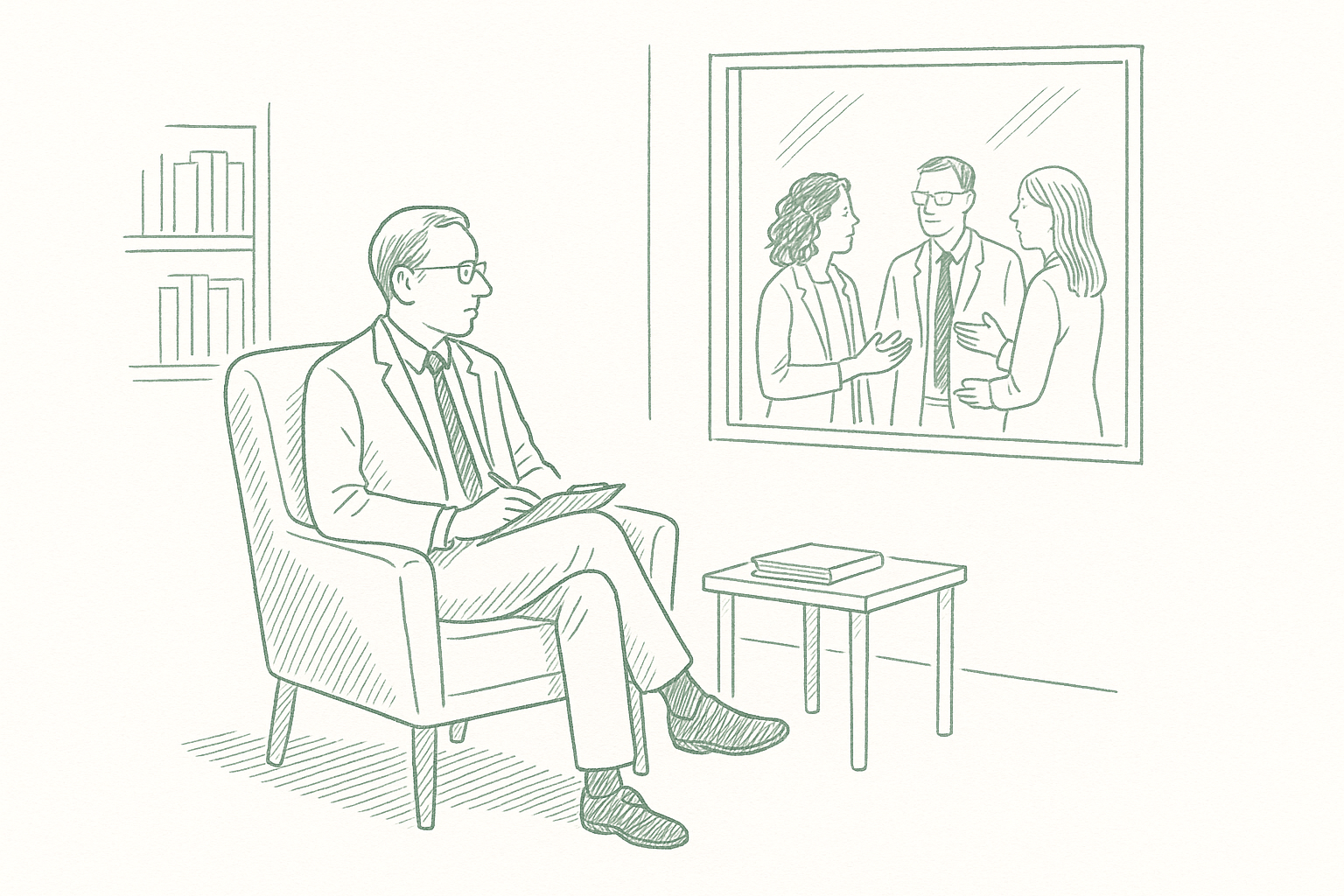
A therapist spends eight hours a day helping people process their hardest moments. Grief. Anxiety. Relationship collapse. Career paralysis. The sessions end, the client leaves, and the therapist sits in an empty room. Maybe they write notes for an hour. Maybe they check their schedule. Then the next client walks in, and the whole cycle starts again.
There are roughly 200,000 licensed therapists and 81,000 psychologists practicing in the United States. The majority of them, especially those in private practice, do this work in near-total professional isolation. They know more about what isolation does to decision-making than almost any other profession. And they experience more of it than almost anyone.
The profession that understands connection can't find any
The burnout numbers for mental health professionals are staggering. A 2022 APA survey found that 52% of psychologists reported experiencing burnout. A broader behavioral health workforce survey put the number at 93%, with 62% rating their burnout an 8, 9, or 10 on a ten-point scale. In 2025, 54% of mental health clinicians reported frequent burnout, with administrative burden cited as the primary driver.
The consequences are not abstract. Research published in JAMA Network Open found that patients treated by burned-out therapists achieve clinically meaningful improvement at significantly lower rates. Client outcomes worsen by 22% when the therapist is burned out. Productivity drops by 35%. Turnover increases by 27%. The average therapist now spends 11 hours per week on unpaid documentation, costing private practices an estimated $71,500 annually in lost revenue opportunity per clinician.
And here is the number that should alarm everyone: 40% of therapists have seriously considered leaving the profession in the past year. Against a backdrop of 137 million Americans living in Mental Health Professional Shortage Areas and HRSA projections of 88,000 counselor vacancies by 2037, every therapist lost to preventable burnout deepens an access crisis that is already severe.
Why therapy is structurally isolating
The therapeutic relationship is, by design, one-directional. Therapists provide empathy, holding, and insight. They do not receive it back. They sit with people's pain for a living, and then they go home and are expected to be fine. The professional norm is emotional self-sufficiency. Asking for help can feel like admitting incompetence in the one domain where you are supposed to be the expert.
Confidentiality compounds the isolation. A therapist can't debrief about a difficult session with friends or family. They can't text a colleague and say "this case is keeping me up at night" without navigating ethical boundaries. The very thing that makes therapy work for clients makes it impossible for therapists to access the kind of casual, spontaneous peer support that other professionals take for granted.
Private practice amplifies all of this. When a therapist leaves a group practice or agency setting, they gain autonomy but lose every informal support structure. No hallway conversations. No shared lunch where someone says "I had a session like that once, here's what I tried." No one to notice when their energy shifts or their case notes start getting sloppy. The loneliest jobs are the ones where competence is assumed and struggle is invisible.
A 2024 study found that 75% of psychologists experienced significant distress, with 36.7% reporting that it negatively impacted their client care. The people charged with recognizing distress in others are, by the structure of their profession, the least likely to have someone recognize it in them.
Supervision ends. Then what?
Therapists in training receive clinical supervision. It is required for licensure and widely understood as essential. A supervisor reviews cases, offers perspective, catches blind spots, and provides the kind of structured accountability that makes clinicians better.
Then licensure happens, and most of that structure evaporates.
Some therapists maintain a paid supervisor or consultant. Many do not, because supervision costs $50 to $250 per hour out of pocket, and solo practitioners are already managing tight margins. The result is that the most experienced therapists, the ones handling the most complex cases, often have the least oversight and the fewest people to talk to about their work.
This is not a training problem. It is a structural one. The profession acknowledges that no clinician should work in isolation during training, then quietly assumes isolation is fine once the license arrives. It is the same mistake every industry makes. Founders stop seeking feedback after they "make it." AA figured out decades ago that the need for peer support doesn't decrease with experience. It increases.
What a peer group actually does for a therapist
Peer consultation groups exist in therapy. They have for years. The Association for Contextual Behavioral Science runs them. Organizations like Hopscotch and Belongly have built platforms around them. Gordon Brewer's Practice of Therapy runs structured masterminds specifically for therapists growing private practices.
The research on their effectiveness is consistent with what peer effect research shows across every field: therapists in regular peer consultation groups report lower burnout, higher professional satisfaction, and better client outcomes. Supervision programs lower emotional exhaustion by 31%. The mechanism is straightforward. Someone who understands your work asks how you are doing. Not your client asking. Not your partner asking in a way that requires you to translate clinical language into human language. A peer. Someone who gets it without explanation.
But peer consultation groups in therapy have traditionally been clinical in focus. They discuss cases. They review diagnoses. They consult on treatment approaches. What they rarely address is the business side of practice: pricing, marketing, hiring, scaling, technology, revenue, and the relentless administrative burden that the burnout research identifies as the primary driver of distress.
This is where the mastermind model fills a gap that clinical consultation cannot. A therapist who needs to decide whether to raise their rates, how to evaluate a group practice partnership, whether to invest in a new EHR system, or how to handle insurance panel departures needs more than clinical supervision. They need peers who are navigating the same business decisions and are willing to share real numbers, real strategies, and real accountability.
The business problems nobody trained you for
Graduate programs in psychology, social work, and counseling produce excellent clinicians and terrible business owners. This is not a criticism. It is a structural fact. Most programs include zero hours of business training. A therapist can spend seven years learning to treat complex PTSD and graduate without knowing how to read a P&L.
Private practice then demands both skill sets simultaneously. You are a clinician and a CEO. You are providing trauma therapy at 2:00 PM and negotiating a lease renewal at 4:00 PM. You are managing your own burnout while also managing payroll, insurance credentialing, website copy, and a marketing funnel you were never taught to build.
Large professional networks don't solve this. Facebook groups with 30,000 therapists don't solve this. Conferences with 500 attendees don't solve this. These venues are good for general awareness but bad for the specific, vulnerable, numbers-on-the-table conversations that actually move a practice forward. "Should I fire my biller?" is not a question you ask in a public forum. It is a question you ask five people who know your practice and your revenue and your temperament and whether you've been avoiding this conversation for six months.
The people who need the room the most are the last to enter it
There is a particular irony in therapists avoiding peer groups. They spend their professional lives encouraging clients to seek support, to stop isolating, to build relational structures that sustain well-being. They know the research. They cite the research. They use the research every day.
And then they go home and do exactly what they tell their clients not to do.
The barriers are familiar. "I should be able to handle this myself." "I don't want to be seen as struggling." "I'll be judged by my peers." These are the same cognitive distortions therapists identify and challenge in their clients every single day. The psychological safety that makes a peer group work is the same psychological safety that makes therapy work. Therapists know this better than anyone. The knowing doesn't make the doing easier.
But the cost of not doing it is measurable. A profession where 93% report burnout and 40% are considering leaving cannot afford to treat peer support as optional. The pattern is identical to what veterinarians face — another helping profession where the people doing the caring are the last to receive it. Informal community is not enough. What therapists need is the same thing they prescribe: a structured, consistent, small-group environment where someone asks "how are you, really?" and has the context to know whether the answer is honest.
Five people. Same time every session. The model is 300 years old. The therapists who use it already know what it does. The rest are still sitting alone in the room after the last client leaves, wondering why the work that fulfills them is also the work that's burning them out.
GoodGrowth builds structured peer groups for therapists and mental health professionals who are done solving every problem alone. Small groups. Consistent structure. People who understand the weight of the work without needing it explained. Read more from the journal, or see what accountability actually looks like.