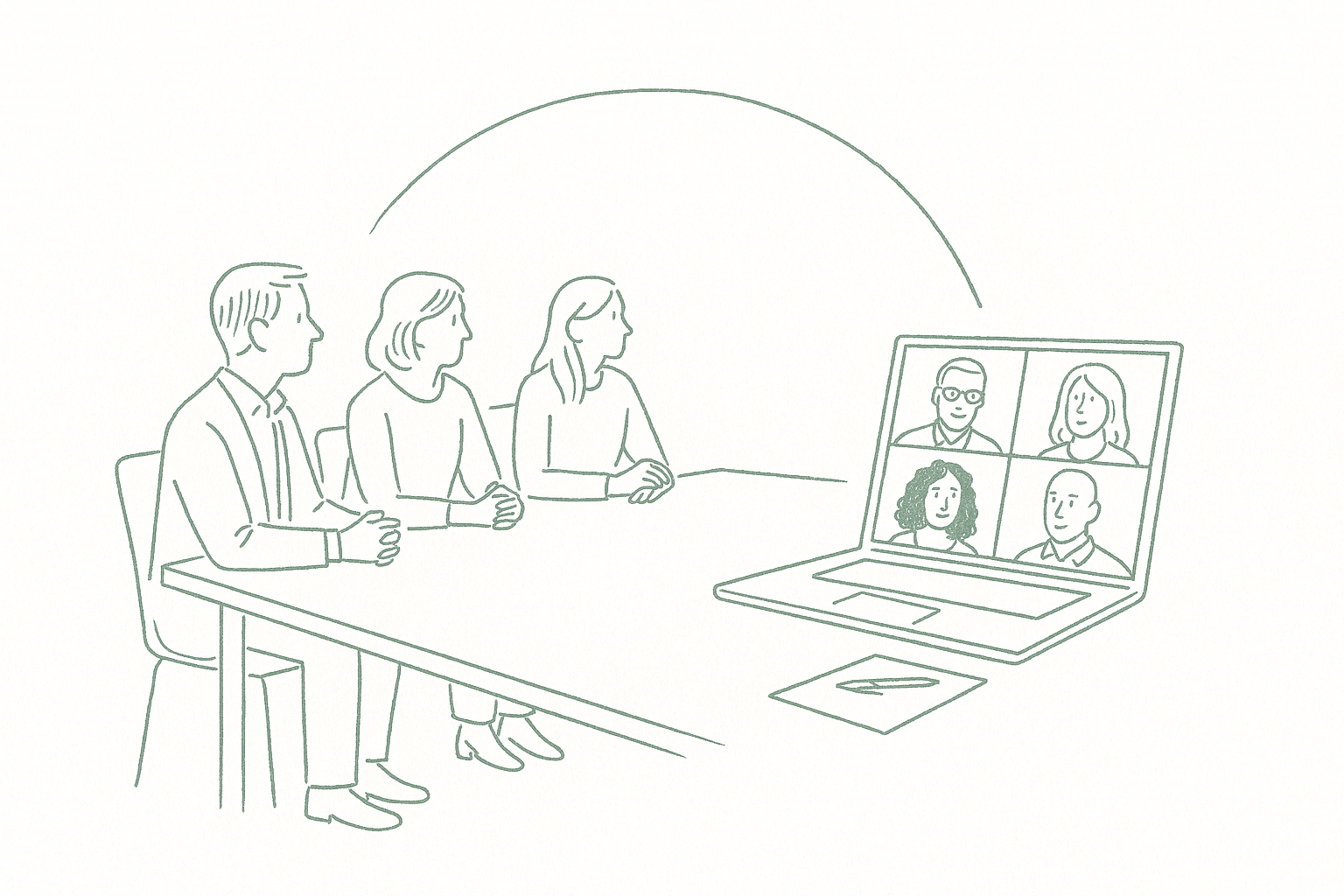
Ask anyone with an opinion about mastermind groups whether they should be in-person or online, and you will get a confident answer. The in-person camp will tell you that real trust requires a handshake, that body language carries 55% of communication, and that nothing beats breaking bread together. The virtual camp will tell you that geography is a prison, that the best minds are scattered across the globe, and that Zoom made the question obsolete.
Both camps are citing vibes, not evidence. The research tells a more interesting story.
What the research actually says about format
A 2026 meta-analysis published in JMIR Mental Health reviewed digital peer support interventions and found small-to-moderate improvements in depression and anxiety symptoms, with functional outcomes — social functioning, quality of life, personal recovery — also improving modestly. The critical variable was not whether the group met online or in person. It was whether the format was interactive. Video conferencing and real-time messaging produced significantly better outcomes than passive formats like forums or email chains.
This matches what organizational psychologists have known for years. The Oxford Review's analysis of trust in face-to-face versus virtual teams found that trust does develop more slowly in virtual settings. But it also found that the gap narrows over time and that structured virtual interaction can eventually reach parity with in-person trust levels. The speed of trust-building differs. The ceiling does not.
Wharton's research on team effectiveness reinforced this: the factors that predict high-performing teams — psychological safety, clear norms, mutual accountability — are structural, not geographic. A poorly run in-person group underperforms a well-run virtual one every time.
The real advantages of in-person groups
That said, in-person groups do have genuine advantages. They are just not the ones people usually cite.
The first is speed. IESE Business School research found that shared physical presence accelerates what psychologists call "swift trust" — the initial willingness to be vulnerable with strangers. In a room, you read micro-expressions, you notice who leans in and who crosses their arms, you pick up on energy that a two-dimensional screen flattens. For new groups, this matters. The first 60 days of a mastermind group are the fragile period, and in-person meetings compress the trust-building timeline.
The second is focus. When you drive 45 minutes to a meeting, sit in a room with no browser tabs, and look people in the eye, you are present in a way that requires effort on a video call. Dr. Judith Olson at UC Irvine has studied distributed collaboration for decades. Her findings are consistent: physical co-presence reduces the cognitive overhead required to maintain attention. You do not have to try to focus. The environment does it for you.
The third is what researchers call "incidental interaction" — the conversations that happen before the meeting starts, during the break, walking to the parking lot. Harvard Business Review's research on informal networks found that these unstructured moments generate a disproportionate share of novel ideas and relationship depth. You cannot schedule serendipity on Zoom.
The real advantages of virtual groups
Virtual groups have their own set of genuine advantages, and some of them are structural in ways that in-person groups cannot replicate.
The most obvious is access. If you are a veterinarian in rural Montana or a salon owner in a small town, there may not be five other people within driving distance who understand your problems. Virtual removes the geographic constraint entirely. The best match for you might be 2,000 miles away. In a virtual group, that does not matter.
The second advantage is consistency. An April 2025 study in the Journal of Mentoring & Tutoring found that virtual peer discussion groups achieved higher attendance rates and more consistent participation than their in-person equivalents. The reason is friction. When joining requires a 90-second commute from your desk to your laptop, the barrier to showing up drops dramatically. And in a mastermind group, the single best predictor of outcomes is whether people actually show up. Every session. On time.
The third is matching quality. When geography is not a constraint, you can optimize for the variable that actually matters: problem fit. Dunbar's research tells us that meaningful relationships require small numbers. But small numbers only work if the people in the room share enough context to be useful to each other. A virtual group can match a SaaS founder struggling with churn to four other founders who solved churn last quarter, regardless of where any of them live. An in-person group is limited to whoever happens to be in the same city.
The format question is a distraction
Here is the uncomfortable truth that the format debate obscures: most mastermind groups fail regardless of whether they meet in person or online. The reasons they fail have almost nothing to do with format and almost everything to do with structure.
They fail because the members were not matched well. They fail because nobody enforced accountability. They fail because the group lacked a clear format for meetings, so conversations wandered. They fail because one person dominated and three people checked out. They fail because there was no mechanism to address the Ringelmann effect — the tendency for individual effort to decline as group size increases.
None of these failure modes are format-dependent. Every one of them is structure-dependent.
The Kauffman Foundation's research on peer matching in entrepreneurship found that the quality of the match — how well members' challenges, stages, and contexts align — predicted outcomes far more reliably than any other variable, including meeting format. A perfectly matched virtual group will outperform a poorly matched in-person group every day of the week.
What a well-structured virtual group looks like
The groups that work in virtual settings share specific design choices that compensate for the absence of physical co-presence.
First, they keep the group small. Research on optimal group size converges on five to six people. On a video call with twelve people, half the group is on mute, mentally elsewhere. With five, everyone is visible, everyone speaks, and the Köhler effect — the motivation gain from being observed — stays active.
Second, they use cameras-on as a non-negotiable norm. The trust deficit in virtual settings comes from reduced social cues. Cameras restore a meaningful portion of those cues. Groups that tolerate cameras-off behavior are accepting a structural handicap they do not need.
Third, they maintain a consistent cadence. Gallup's research on remote work effectiveness found that consistency of interaction matters more than frequency. A biweekly group that never misses is more effective than a weekly group that cancels half its sessions. The rhythm matters more than the tempo.
Fourth, they build in between-session accountability. This is where virtual groups can actually surpass in-person ones. A text message asking "Did you do the thing you said you would do?" costs nothing, takes ten seconds, and creates the kind of low-friction accountability that a well-designed mastermind meeting format enables. In-person groups often lose momentum between monthly meetings because there is no mechanism for contact between them. Virtual groups, already operating through digital channels, can maintain a continuous thread.
The hybrid answer nobody wants to hear
The honest answer to "online or in-person?" is: both, if you can. And if you cannot, virtual with good structure beats in-person with bad structure.
Organizations like Vistage and EO figured this out during the pandemic. Vistage's 45,000 members shifted to virtual formats and, after initial resistance, many groups opted to stay virtual or adopt a hybrid cadence. EO's Forum structure — one of the longest-running peer group models in the world — now includes virtual chapters that connect members across countries who would never have met in a geography-locked model.
The Stanford Social Innovation Review's work on collective intelligence found that the diversity of perspective within a group predicted decision quality more reliably than any measure of individual intelligence. Virtual formats, by removing geographic constraints, expand the pool of potential perspectives dramatically. You are no longer limited to the five best founders in your city. You can find the five best founders for your specific problem, wherever they are.
Choosing the right mastermind group comes down to structure, matching, and accountability. Not whether you are sharing a room or a screen. The room is nice. The structure is essential. And the structure works in any format — as long as someone builds it deliberately.
Stop debating the medium. Fix the structure.
If your mastermind group is not working, the problem is almost certainly not that you are meeting on Zoom instead of in a conference room. The problem is that you are in a group of twelve when research says five. Or that nobody follows up between sessions. Or that the matching was based on geography and title instead of the actual problem everyone is trying to solve. Or that the group has no format, no hot seat, no accountability check-in — just a loose conversation that meanders until someone checks their phone.
Starting a mastermind group that lasts requires getting the structure right. The format is a detail. An important detail, but a detail. Making decisions alone is the real problem. Arguing about whether you should solve that problem on Zoom or in a coffee shop is missing the point entirely.
Pick the format that gets five well-matched people in the same conversation, on a regular cadence, with accountability between sessions. Then do it again next week. The medium will not save you. The people will.