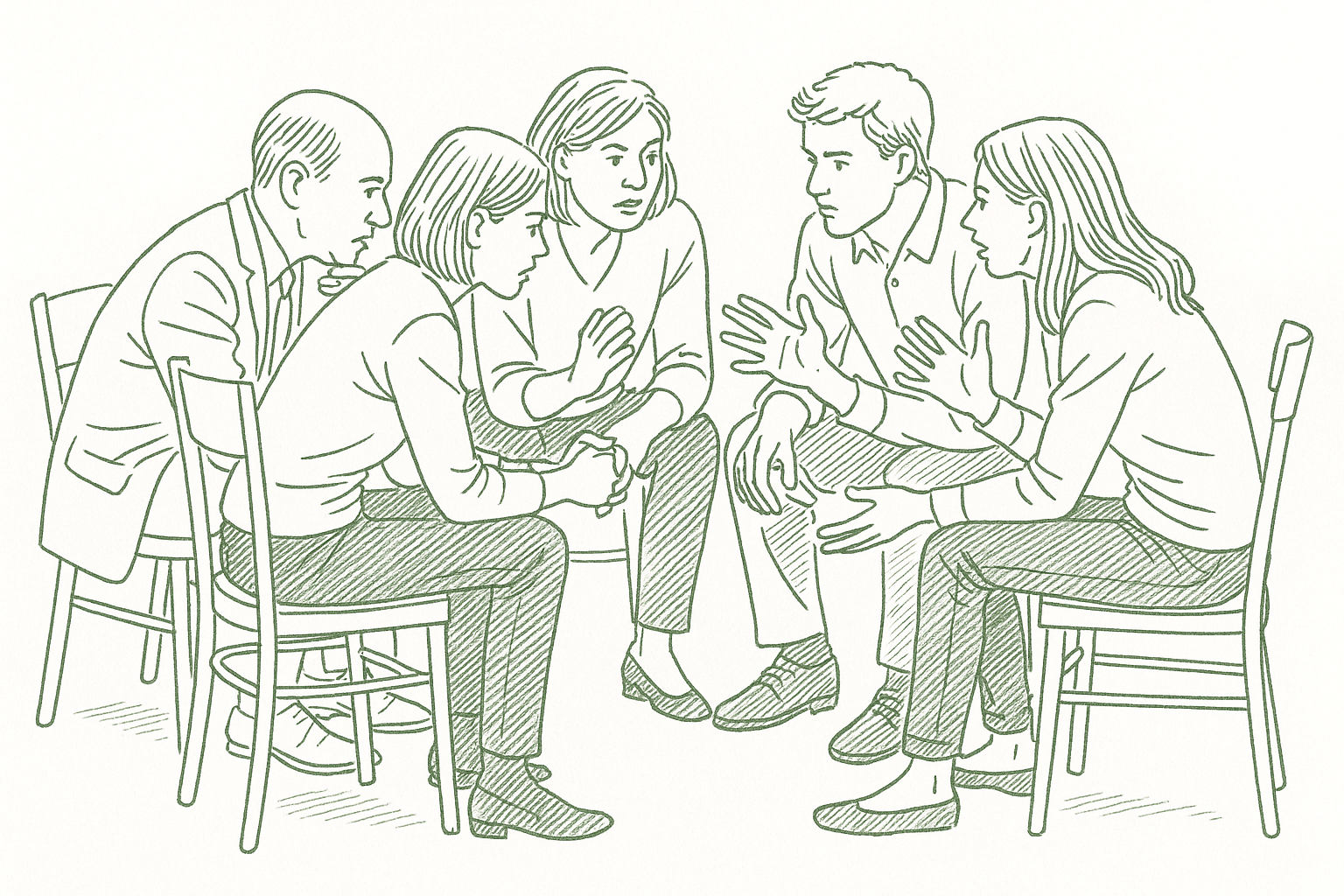
In 1975, Mihaly Csikszentmihalyi published a book that changed how psychology understood happiness. It was called Beyond Boredom and Anxiety, and it introduced a concept he called "flow" — a mental state of complete absorption where the challenge of a task perfectly matches the skill of the person performing it. Time distorts. Self-consciousness disappears. Performance spikes. The person stops thinking about what they are doing and simply does it.
Csikszentmihalyi spent the next four decades studying flow in individuals. Chess players. Surgeons. Rock climbers. Artists. His 1990 bestseller Flow: The Psychology of Optimal Experience became one of the most cited works in positive psychology. Martin Seligman, former president of the American Psychological Association, called him the world's leading researcher on the subject.
But here is the part most people missed: Csikszentmihalyi did not think flow was a solo phenomenon. He believed it could happen in groups. He just never fully mapped how.
Keith Sawyer did.
The jazz pianist who cracked group creativity
Before Keith Sawyer became a professor at the University of North Carolina, he was a jazz pianist. And before that, he was a game designer at Atari. This combination — improvisation and systems thinking — turned out to be the exact lens needed to study something psychologists had been skirting for years: what happens when flow spreads from one brain to several.
Sawyer coined the term "group flow" in 2003. He defined it as the collective equivalent of individual flow — a state where a group becomes so deeply engaged in a shared activity that the experience feels effortless, unpredictable, and intrinsically rewarding. His 2007 book Group Genius: The Creative Power of Collaboration laid out a framework based on years of studying jazz ensembles, improv comedy troupes, and business teams.
What Sawyer found was counterintuitive. Individual flow requires a match between challenge and skill. Group flow requires something different: a match between the participants themselves. Not their credentials. Not their experience levels. The match is in how they interact — the rhythm of listening, responding, building, and letting go.
He identified ten conditions that make group flow possible. Each one has what he calls a "Goldilocks quality" — too much or too little of any single condition kills the state.
The ten conditions (and why most groups violate all of them)
Sawyer's ten conditions for group flow are: a shared group goal, close listening, complete concentration, being in control, blending egos, equal participation, familiarity, good communication, a sense of forward movement, and the potential for spontaneous creativity.
Read that list slowly. Now think about the last meeting you attended. How many of those conditions were present?
Most group settings fail before they start. Board meetings have a shared goal but no equal participation — one person runs the agenda, everyone else reacts. Slack channels offer good communication but no concentration — the notifications alone destroy any chance of immersion. Conferences have familiarity but no forward movement — you meet people, exchange pleasantries, and leave without having built anything together.
The condition that matters most — the one Sawyer returns to again and again — is blending egos. In group flow, no single person dominates. Ideas do not belong to individuals. They belong to the group. One person says something, another extends it, a third redirects it, and the result is something none of them would have produced alone. Sawyer calls this "collaborative emergence" — the group creates something that cannot be traced back to any single member.
This is the exact opposite of how most founder meetings work. Most founders show up to pitch their idea, defend their position, and leave having confirmed what they already believed. The IKEA effect is operating at full power. Ego is not blended. It is fortified.
Team flow is a different brain state. Literally.
In 2021, a research team led by Mohammad Shehata at the California Institute of Technology published a paper in eNeuro that changed the conversation from psychology to neuroscience. They used EEG hyperscanning — recording brain activity from multiple people simultaneously — to study what happens in people's brains during team flow.
What they found was striking. Team flow is not just individual flow happening to multiple people at the same time. It is a neurologically distinct state. The researchers identified increased beta-gamma power in the left middle temporal cortex during team flow — a region involved in integrating information from multiple sources. This activation was specific to team flow. It did not appear during individual flow. It did not appear during ordinary social interaction. It only appeared when both conditions — flow and social engagement — merged.
Even more remarkable: the study found enhanced interbrain neural synchrony during team flow. The participants' brain waves synchronized across individuals. Their brains were not just active — they were active in the same patterns, at the same times. The researchers described this as evidence that team flow induces a unique neurocognitive state with enhanced information integration both within and between brains.
This is not a metaphor. It is a measurement. When people enter team flow together, their brains literally coordinate in ways that do not happen when they work alone or when they are merely socializing. (This builds on a more fundamental phenomenon: social facilitation, the finding that the mere presence of others improves performance on practiced tasks — a century-old result that group flow takes to its neurological conclusion.) The whole is not just greater than the sum of its parts. It operates on different neural architecture.
Why size matters (and small groups win)
Sawyer's research consistently points to small groups as the sweet spot for group flow. Jazz quintets. Improv troupes of five to seven. Startup teams. The research on optimal group size converges around the same number: five to twelve people, with performance peaking at the lower end.
The reason connects directly to Sawyer's conditions. Equal participation becomes impossible above about twelve people. Close listening degrades with every additional voice in the room. Ego blending requires trust, and trust requires familiarity, and familiarity at depth is something the human brain can only maintain with a limited number of people.
A 2014 study by Aubé, Brunelle, and Rousseau published in Motivation and Emotion tested the relationship between flow, team goal commitment, and team performance. They found that flow experience in teams was positively related to performance — but only when the team had high goal commitment and active information exchange. Both of these conditions are easier to achieve in small groups, where social loafing is harder to hide and free-riding carries real social cost.
The Ringelmann effect explains why. As groups grow larger, individual effort drops. In a rope-pulling experiment from the 1880s, each additional person on the rope reduced per-person effort. Three people pulled at 85% of their individual capacity. Eight people pulled at 49%. The group got bigger and weaker at the same time. Group flow requires maximum effort from every participant. The Köhler effect works in the opposite direction — in small groups, weaker members actually increase their effort because their contribution is visible and necessary.
The first rule of improv is also the first rule of peer groups
Sawyer's most powerful insight came from studying improvisational theater. The first rule of improv is "Yes, and" — accept what your scene partner gives you and build on it. Do not negate. Do not redirect. Take what they offered and extend it.
Group flow flourishes under this principle. Sawyer found that jazz ensembles rarely hit flow during rehearsal. They needed the risk of a live performance — real stakes, real possibility of failure. The combination of structure (the chord progression, the form) and freedom (the solo, the improvisation) created the conditions where group flow became possible.
This is the same dynamic that operates in effective peer groups. A well-structured mastermind meeting provides the chord progression — a format, a time limit, a focus question. The participants provide the improvisation — honest reactions, unexpected perspectives, connections the founder would never have made alone. Accountability provides the stakes. You are not rehearsing. You are performing. The problem is real, the clock is ticking, and the people in the room are going to ask you what happened next time.
This is why networking events never produce flow. There is no structure, no stakes, no continuity. You cannot "Yes, and" a conversation with someone you met three minutes ago and will never see again. Group flow requires ongoing relationships, shared context, and a format that allows ideas to build on each other over time. It requires a room you return to.
What the history already told us
Before Csikszentmihalyi or Sawyer named it, group flow was already operating throughout history. The most productive groups of the last 300 years share the same structural DNA.
Ben Franklin's Junto met every Friday night — twelve members, a fixed format, rotating questions. The structure was the chord progression. The conversation was the improvisation. The Vienna Circle held Thursday meetings where a single paper was presented and then pulled apart by the group. The Ratio Club — the dinner group where Alan Turing and his contemporaries laid the groundwork for modern AI — limited membership to twenty and met biannually with structured presentations followed by unstructured debate.
Every one of these groups hit Sawyer's conditions without knowing the framework existed. Small size. Equal participation. Shared goals. Blended egos. Close listening. Forward movement. The recipe was the same every time. The ingredients were always the same: a handful of people, a recurring commitment, a real problem, and a structure that allowed ideas to collide and compound.
Flow is not a productivity hack. It is an argument for showing up.
The corporate world has turned flow into a productivity hack. Buy the noise-canceling headphones. Block your calendar. Enter deep work. This framing treats flow as a solo optimization — a way to squeeze more output from a single brain.
Csikszentmihalyi never said that. He said flow was about optimal experience — the state in which people report the highest quality of life. And the research consistently shows that flow experienced in groups produces higher subjective enjoyment than flow experienced alone. The Shehata team's 2021 paper confirmed it: team flow enables "enhanced positive experiences, as compared with individual flow or regular socializing."
The peer effect already tells us that the people around us change our outcomes. Group flow tells us something deeper: the people around us change our cognitive state itself. When you sit in a room with four other people who are fully engaged in the same problem, your brain does not just think better. It enters a different mode of thinking. Information integrates differently. Patterns surface that would stay buried in a solo session. The left middle temporal cortex lights up in a way it does not when you are alone.
You cannot enter group flow with a podcast. You cannot enter it with a webinar. You cannot enter it in a Slack thread. You enter it by showing up, with a small number of people you trust, to work on a problem that matters, in a format that holds space for both structure and surprise.
Csikszentmihalyi got the foundation right. Sawyer extended it to groups. Neuroscience confirmed it is real. The only question left is whether you have a group that makes it possible.